PLato said,"Look to the perfection of the heavens for truth," while Aristotle said "look around you at what is, if you would know the truth" To Remember: Eskesthai
Enrico Fermi's notebook of December 1948 contains four pages that represent the genesis of his theory of cosmic rays, particles that can hit the Earth's atmosphere at high speeds. In these pages, he worked out the acceleration of cosmic rays due to a series of collisions with magnetic clouds moving through the universe, a process later named Fermi acceleration.SEE:Archive: Logbook
An analysis of four Fermi-detected gamma-ray bursts (GRBs) is given that sets upper limits on the energy dependence of the speed and dispersion of light across the universe. The analysis focuses on photons recorded above 1 GeV for Fermi detected GRB 080916C, GRB 090510A, GRB090902B, and GRB 090926A. Upper limits on time scales for statistically significant bunching of photon arrival times were found and cataloged. In particular, the most stringent limit was found for GRB 090510A at redshift z & 0.897 for which t < 0.00136 sec, a limit driven by three separate photon bunchings. These photons occurred among the first seven super-GeV photons recorded for GRB 090510A and contain one pair with an energy difference of E & 23.5 GeV. The next most limiting burst was GRB 090902B at a redshift of z & 1.822 for which t < 0.161, a limit driven by several groups of photons, one pair of which had an energy difference E & 1.56 GeV. Resulting limits on the differential speed of light and Lorentz invariance were found for all of these GRBs independently. The strongest limit was for GRB 090510A with c/c < 6.09 x 10⁻²¹. Given generic dispersion relations across the universe where the time delay is proportional to the photon energy to the first or second power, the most stringent limits on the dispersion strengths were k1 < 1.38 x 10⁻⁵ sec Gpc−1 GeV−1 and k2 < 3.04 x 10⁻⁷ sec Gpc−1 GeV−2 respectively. Such upper limits result in upper bounds on dispersive effects created, for example, by dark energy, dark matter or the spacetime foam of quantum gravity. Relating these dispersion constraints to loop quantum gravity
energy scales specifically results in limits of M1c2 > 7.43 x 10²¹ GeV and M2c2 > 7.13 x 10¹¹ GeV respectively. See: Limiting properties of light and the universe with high energy photons from Fermi-detected Gamma Ray Bursts
The point here is that Energetic disposition of flight time and Fermi Calorimetry result point toward GRB emission and directly determination of GRB emission allocates potential of underlying structure W and the electron-neutrino fields?
Fig. 3: An electron, as it travels, may become a more complex combination of disturbances in two or more fields. It occasionally is a mixture of disturbances in the photon and electron fields; more rarely it is a disturbance in the W and the electron-neutrino fields. See: Another Speed Bump for Superluminal Neutrinos Posted on October 11, 2011 at, "Of Particular Significance"
***
What I find interesting is that Tamburini and Laveder do not stop at discussing the theoretical interpretation of the alleged superluminal motion, but put their hypothesis to the test by comparing known measurements of neutrino velocity on a graph, where the imaginary mass is computed from the momentum of neutrinos and the distance traveled in a dense medium. The data show a very linear behaviour, which may constitute an explanation of the Opera effect: See: Tamburini: Neutrinos Are Majorana Particles, Relativity Is OK
UC Berkeley's Raphael Bousso presents a friendly introduction to the ideas behind the holographic principle, which may be very important in the hunt for a theory of quantum gravity. Series: "Lawrence Berkeley National Laboratory Summer Lecture Series" [3/2006] [Science] [Show ID: 11140]
The debate between science and spirituality is framed as a knock down fight for truth with winner take all. But does it have to be that way? Deepak Chopra is a physician and one of the most highly regarded spiritual teachers in the world; and Leonard Mlodinow teaches at Cal Tech and co-authored, along with Stephen Hawking, "The Grand Design." Chopra and Mlodinow wrote "War of the Worldviews: Science vs. Spirituality" to help start an intelligent and civil conversation about this very hot subject.
In this hour long video, Deepak Chopra and Leonard Mlodinow debate science and spirituality moderated by Paul Brandeis Raushenbush, Senior Religion Editor for The Huffington Post. This conversation was streamed live on Oct. 4, 2011 on the date of the publication of "War of the Worldviews: Science vs. Spirituality" by Deepak Chopra and Leonard Mlodinow.
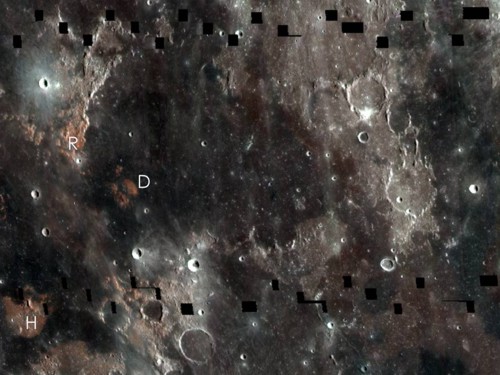
A map of the Moon combining observations in visible and ultraviolet wavelengths shows a treasure trove of areas rich in Titanium ores. Not only is Titanium a valuable mineral, it is key to helping scientists unravel the mysteries of the Moon’s interior. Mark Robinson and Brett Denevi will be presenting the results from the Lunar Reconnaissance Orbiter mission today at the joint meeting of the European Planetary Science Congress and the American Astronomical Society’s Division for Planetary Sciences. >EPSC-DPS JOINT MEETING 2011 PRESS NOTICE
ISSUED 13:15 CEST ON FRIDAY 7TH OCTOBER
Ref. PN: EPSC11/14
It seems this Europlanet is a little bit behind the times. Check label below on Plato's Nightlight Mining Company. What more can I say?
Bee:And for all I know you need a charge for Cherenkov radiation and neutrinos don't have one.
Fig. 1: Cerenkov radiation involves the nearly continuous emission of photons by a charged particle moving faster than the speed of light in its vicinity. The charged particle gradually radiates away its energy. Cohen-Glashow emission involves the occasional creation, near a speeding neutrino, of an electron-positron pair, in which the neutrino loses a large fraction of its energy in one step.
But these details almost don’t matter, because Cohen and Glashow then put another chunk of powerful evidence on the table. They point out that neutrinos have been observed, at two other experiments, SuperKamiokande and IceCube, 100 to 1000 times more energetic than the neutrinos in OPERA’s beam. These neutrinos come out of the earth having traveled many hundreds or thousands of kilometers across interior of the planet. The fact that these neutrinos did not lose most of their energy while traveling all that distance implies that they, too, did not undergo CG emission. In short, they must have traveled very close to, and conservatively no more than about fifteen parts per billion faster than, the speed of light in empty space. (The limit from IceCube data may be as good as ten parts per trillion!)See: Is the OPERA Speedy Neutrino Experiment Self-Contradictory?
"The end he (the artist) strives for is something else than a perfectly executed print. His aim is to depict dreams, ideas, or problems in such a way that other people can observe and consider them." - M.C. Escher
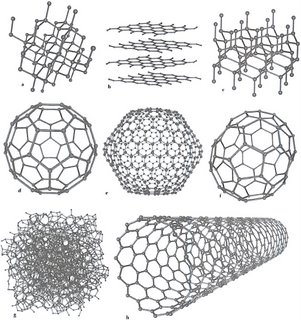
I too have always been interested at the idea of what we can see deeper then what we observe on the surface. As if an abstraction in the geometry may be leading when considering Polytopes and allotrope s or even Penrose Tilings as to the Truth?:)
In quasicrystals, we find the fascinating mosaics of the Arabic world reproduced at the level of atoms: regular patterns that never repeat themselves. However, the configuration found in quasicrystals was considered impossible, and Dan Shechtman had to fight a fierce battle against established science. The Nobel Prize in Chemistry 2011 has fundamentally altered how chemists conceive of solid matter. See: The Nobel Prize in Chemistry 2011 Dan Shechtman
I do not think one can ever imagine what goes through my mind and I guess that's part of my artistic journey is to better learn how to describe what I am seeing. It goes back some time as to what I learn about myself and how some of these geometers see. I did not ever feel apart from them as I tried to look deeper into reality and see what the basis is and how we might describe that.
You must also know I now sport an interesting tattoo that I will share shortly. Maybe even consider it as a line break, and as a pointer. You'll see why when I upload picture. So, that has been my thing when I look at all this science and those espouse the teaching of, that I tried to find my place in it. I mean I could be so wrong in a long of things.....but isn't that part of the evolution of being? Learning about those mistakes and dealing with the responsibility of finding that truth within self?
My second tattoo will be as in the picture showing below on this blog site demonstrating and seen above is an ancient idea about "our heart" in relation to "the truth." How we weight that against one another and how the choices we make will have us asking whether we acted in accordance with that truth. That is "the final judgement" and if this is understood then we can access whether or not we have much more to learn. I know that setting right past mistakes is not an easy thing but if you at least start then that is part of the success of not of having to repeat them. Maybe repeat many times until you finally actually get it.
Well then,how does one simplify that picture of such Judgement in the Hall of Ma'at as to know that this message is alive and well in today's world and just as valid? How well will the tattooist portray this design? I'll have to give it to her so she has some time to look at it and decipher.:)
.....tau lepton may travel some tens of microns before decaying back into neutrino and charged tracks
Before I comment on the result, let me give you a little background on the whole thing. Opera is a very innovative concept in neutrino detection. Its aim is to detect tau neutrino appearance in a beam of muon neutrinos. A Six-Sigma Signal Of Superluminal Neutrinos From Opera!
The OPERA result is based on the observation of over 15000 neutrino events measured at Gran Sasso, and appears to indicate that the neutrinos travel at a velocity 20 parts per million above the speed of light, nature’s cosmic speed limit. Given the potential far-reaching consequences of such a result, independent measurements are needed before the effect can either be refuted or firmly established. This is why the OPERA collaboration has decided to open the result to broader scrutiny. The collaboration’s result is available on the preprint server arxiv.orghttp://arxiv.org/abs/1109.4897.
In order to perform this study, the OPERA Collaboration teamed up with experts in metrology from CERN and other institutions to perform a series of high precision measurements of the distance between the source and the detector, and of the neutrinos’ time of flight. The distance between the origin of the neutrino beam and OPERA was measured with an uncertainty of 20 cm over the 730 km travel path. The neutrinos’ time of flight was determined with an accuracy of less than 10 nanoseconds by using sophisticated instruments including advanced GPS systems and atomic clocks. The time response of all elements of the CNGS beam line and of the OPERA detector has also been measured with great precision.
***
By classifying the neutrino interactions according to the type of neutrino involved (electron-neutrino or muon-neutrino) and counting their relative numbers as a function of the distance from their creation point, we conclude that the muon-neutrinos are "oscillating." See: STATEMENT: EVIDENCE FOR MASSIVE NEUTRINOS FOUND by Dave Casper
***
We present an analysis of atmospheric neutrino data from a 33.0 kiloton-year (535-day)exposure of the Super-Kamiokande detector. The data exhibit a zenith angle dependent de ficit of muon neutrinos which is inconsistent with expectations based on calculations of the atmospheric neutrino flux. Experimental biases and uncertainties in the prediction of neutrino fluxes and cross sections are unable to explain our observation. . Evidence for oscillation of atmospheric neutrinos
Taking the formalisms of electromagnetic radiation and supposing a tachyon had an electric charge—as there is no reason to suppose a priori that tachyons must be either neutral or charged—then a charged tachyon must lose energy as Cherenkov radiation[15]—just as ordinary charged particles do when they exceed the local speed of light in a medium. A charged tachyon traveling in a vacuum therefore undergoes a constant proper time acceleration and, by necessity, its worldline forms a hyperbola in space-time. However, as we have seen, reducing a tachyon's energy increases its speed, so that the single hyperbola formed is of two oppositely charged tachyons with opposite momenta (same magnitude, opposite sign) which annihilate each other when they simultaneously reach infinite speed at the same place in space. (At infinite speed the two tachyons have no energy each and finite momentum of opposite direction, so no conservation laws are violated in their mutual annihilation. The time of annihilation is frame dependent.) Even an electrically neutral tachyon would be expected to lose energy via gravitational Cherenkov radiation, because it has a gravitational mass, and therefore increase in speed as it travels, as described above. See: Tachyon
***
An early set of experiments with a facility called the solar neutrino telescope, measured the rate of neutrino emission from the sun at only one third of the expected flux. Often referred to as the Solar Neutrino Problem, this deficiency of neutrinos has been difficult to explain. Recent results from the Sudbury Neutrino Observatory suggest that a fraction of the electron neutrinos produced by the sun are transformed into muon neutrinos on the way to the earth. The observations at Sudbury are consistent with the solar models of neutrino flux assuming that this "neutrino oscillation" is responsible for observation of neutrinos other than electron neutrinos. See: Detection of Neutrinos
Measurements by GPS confirm that the neutrinos identified by the Super-Kamiokande detector were indeed produced on the east coast of Japan. The physicists therefore estimate that the results obtained point to a 99.3% probability that electron neutrino appearance was detected.Neutrino Oscillations Caught in the Act
The Gran Sasso National Laboratory (LNGS) is one of four INFN national laboratories.
Abstract: Can neutrinos really travel faster than light? Recently released experimental data from CERN suggests that they can. Join host Dr. Richard Epp and a panel of Perimeter Institute scientists in a live webinar to discuss this unexpected and puzzling experimental result, and some theoretical questions it might raise.
The NOνA Experiment (Fermilab E929) will construct a detector optimized for electron neutrino detection in the existing NuMI neutrino beam. The primary goal of the experiment is to search for evidence of muon to electron neutrino oscillations. This oscillation, if it occurs, holds the key to many of the unanswered questions in neutrino oscillation physics. In addition to providing a measurement of the last unknown mixing angle, θ13, this oscillation channel opens the possibility of seeing matter/anti-matter asymmetries in neutrinos and determination of the ordering of the neutrino mass states.See:The NOνA Experiment at Fermilab (E929)
***
Image from a neutrino detection experiment. (Credit: Image courtesy of Southern Methodist University)
What's new @CERN ? a new video programme launched on webcast.cern.ch , every first Monday of the Month. For the first one, the themes are the results of the LHC experiments about Higgs boson, standard model and supersymmetry, and also neutrinos of OPERA experiment faster than the speed of light.
The Cassiopeia Project is an effort to make high quality science videos available to everyone. If you can visualize it, then understanding is not far behind.
This is a project conducted by ChrisDavis and IgorNikolic to visualize the growth of wiki.tudelft.nl since its beginning in late 2004. Since then, it has grown to over 10,000 pages, and is now part of the officially supported ICT infrastructure of Delft University of Technology. This wiki is meant to be a free-form repository of information where people contribute content that helps with their research. This often takes the form of pages documenting articles that people have read, "how to" pages, and records of conferences and meetings.Project Motivation
This is a visualization of the evolution of wiki.tudelft.nl from the very beginning, 5 years ago. Each node is a page, links are connections between pages. Graph is laid out using a force-directed algorithm, where the edges (links between pages) pull the nodes (pages) together, and the nodes (pages) repel each other. This means that the more tightly connected nodes will be closer together than weakly connected ones, which are pushed to the outside. The entire thing is created using Prefuse (http://prefuse.org/), wiki is using the TWiki engine (http://twiki.org). The soundtrack is from DJ Cary's Eastern Grooves compilation from Magnatune.com. More info about this can be found at http://wiki.tudelft.nl/bin/view/Main/WikiGrowthOverTime
Partial map of the Internet based on the January 15, 2005 data found on opte.org. Each line is drawn between two nodes, representing two IP addresses. The length of the lines are indicative of the delay between those two nodes. This graph represents less than 30% of the Class C networks reachable by the data collection program in early 2005. Lines are color-coded according to their corresponding RFC 1918 allocation as follows:
In conclusion, we have a rich panorama of experiments that all make use of neutrinos as probes of exotic phenomena as well as processes which we have to measure better to gain understanding of fundamental physics as well as gather information about the universe.See:Vernon Barger: perspectives on neutrino physics May 22, 2008
This image presents a beautiful composite of X-rays from Chandra (red, green, and blue) and optical data from Hubble (gold) of Cassiopeia A, the remains of a massive star that exploded in a supernova. Evidence for a bizarre state of matter has been found in the dense core of the star left behind, a so-called neutron star, based on cooling observed over a decade of Chandra observations. The artist's illustration in the inset shows a cut-out of the interior of the neutron star where densities increase from the crust (orange) to the core (red) and finally to the region where the "superfluid" exists (inner red ball). X-ray: NASA/CXC/UNAM/Ioffe/D. Page, P. Shternin et al.; Optical: NASA/STScI; Illustration: NASA/CXC/M. WeissSee Also:Superfluid and superconductor discovered in star's core
Illustration of Cassiopeia A Neutron Star
This is an artist's impression of the neutron star at the center of the Cassiopeia A supernova remnant. The different colored layers in the cutout region show the crust (orange), the higher density core (red) and the part of the core where the neutrons are thought to be in a superfluid state (inner red ball). The blue rays emanating from the center of the star represent the copious numbers of neutrinos that are created as the core temperature falls below a critical level and a superfluid is formed. (Credit: Illustration: NASA/CXC/M.Weiss)
X-ray and Optical Images of Cassiopeia A
Two independent research teams studied the supernova remnant Cassiopeia A, the remains of a massive star, 11,000 light years away that would have appeared to explode about 330 years as observed from Earth. Chandra data are shown in red, green and blue along with optical data from Hubble in gold. The Chandra data revealed a rapid decline in the temperature of the ultra-dense neutron star that remained after the supernova. The data showed that it had cooled by about 4% over a ten-year period, indicating that a superfluid is forming in its core. (Credit: X-ray: NASA/CXC/UNAM/Ioffe/D.Page,P.Shternin et al; Optical: NASA/STScI)
The OPERA neutrino experiment at the underground Gran Sasso Laboratory has measured the velocity of neutrinos from the CERN CNGS beam over a baseline of about 730 km with much higher accuracy than previous studies conducted with accelerator neutrinos. The measurement is based on highstatistics data taken by OPERA in the years 2009, 2010 and 2011. Dedicated upgrades of the CNGS timing system and of the OPERA detector, as well as a high precision geodesy campaign for the measurement of the neutrino baseline, allowed reaching comparable systematic and statistical accuracies.
An early arrival time of CNGS muon neutrinos with respect to the one computed assuming the speed of light in vacuum of (60.7 ± 6.9 (stat.) ± 7.4 (sys.)) ns was measured. This anomaly corresponds to a relative difference of the muon neutrino velocity with respect to the speed of light (v-c)/c = (2.48 ± 0.28 (stat.) ± 0.30 (sys.)) ×10-5. See:Measurement of the neutrino velocity with the OPERA detectorin the CNGS beam
According to Einstein's special theory of relativity, a clock moving at a significant fraction of the speed of light with respect to an observer runs more slowly than the observer's own clock. This implies that time must be flowing more slowly in a moving frame of reference, which is referred to as time dilation. If a process (such as the decay of an unstable particle) occurs with an average lifetime of in the rest frame, the lifetime of the particle moving at speed is given by , where is the speed of light, 2.9979 × m/sec. The decay of muons has provided verification of Einstein's formula to a high degree of accuracy. The negative muon , with a mass of 105.7 MeV/, is the second-generation lepton analogous to the electron . The antiparticles and (the positron) are similarly related. The mean lifetime of free muon decay is 2.197 sec in the rest frame. The decay processes are and . Here is a neutrino and an antineutrino, each occurring in both electron and muon flavors. In finer detail, these weak-interaction processes involve bosons as intermediates.
High-energy collisions of protons produce copious numbers of pions, which, in turn, decay into muons. This all happens within the blue square in the graphic. The beam of muons thus produced is injected into a circular synchrotron, which can accelerate them to energies up to 10,000 MeV (10 GeV). The lifetimes are then determined as a function of energy. Muons accelerated to 750 MeV already travel at 99% the speed of light and have average lifetimes enhanced by an order of magnitude. At the maximum energy available in this Demonstration, speeds of 0.9999 are achieved and the muon lifetime is increased by a factor of 100.
Earlier experiments on muons produced by cosmic rays found their half-lives to be dependent on distance traveled through the atmosphere; they also exhibited relativistic time dilation.
It has been recently shown that puzzling excess events observed by the LSND and MiniBooNE neutrino experiments could be interpreted as a signal from the radiative decay of a heavy sterile neutrino (nu_h) of the mass from 40 to 80 MeV with a muonic mixing strength ~ 10^{-3} - 10^{-2}. If such nu_h exists its admixture in the ordinary muon decay would result in the decay chain mu -> e nu_e nu_h -> e nu_e gamma nu. We proposed a new experiment for a sensitive search for this process in muon decay at rest allowing to definitively confirm or exclude the existence of the nu_h. To our knowledge, no experiment has specifically searched for the signature of radiative decay of massive neutrinos from muon decays as proposed in this work. The search is complementary to the current experimental efforts to clarify the origin of the LSND and MiniBooNE anomalies. Bounds on the muonic mixing strength from precision measurements with muons are discussed.See: New muon decay experiment to search for heavy sterile neutrino and also The LSND/MiniBooNe excess events and heavy neutrino from muon and kaon decays
The historical experiment upon which the model muon experiment is based was performed by Rossi and Hall in 1941. They measured the flux of muons at a location on Mt Washington in New Hampshire at about 2000 m altitude and also at the base of the mountain. They found the ratio of the muon flux was 1.4, whereas the ratio should have been about 22 even if the muons were traveling at the speed of light, using the muon half-life of 1.56 microseconds. When the time dilation relationship was applied, the result could be explained if the muons were traveling at 0.994 c.
In an experiment at CERN by Bailey et al., muons of velocity 0.9994c were found to have a lifetime 29.3 times the laboratory lifetime.
Both radio observations with the VLBA and optical observations with the Hubble Space Telescope have measured the motions of concentrations of material in M87's jets, and have shown the material to be moving at apparent speeds greater than that of light. This "superluminal" motion is a geometric illusion created by material moving nearly, but under, the speed of light, but in a direction somewhat toward the Earth.
***
I've walked these streets
A virtual stage
It seemed to me
Make up on their faces
Actors took their
Places next to me Natalie Merchant, Carnival
I've walked these streets
In the mad house asylum
They can be
Where a wild eyed misfit prophet
On a traffic island stopped
And he raved of saving meNatalie Merchant, Carnival
Hyperreality is used in semiotics and postmodern philosophy to describe a hypothetical inability of consciousness to distinguish reality from fantasy, especially in technologically advanced postmodern cultures. Hyperreality is a means to characterize the way consciousness defines what is actually "real" in a world where a multitude of media can radically shape and filter an original event or experience. Some famous theorists of hyperreality include Jean Baudrillard, Albert Borgmann, Daniel Boorstin, and Umberto Eco.
The medium is the message is a phrase coined by Marshall McLuhan meaning that the form of a medium embeds itself in the message, creating a symbiotic relationship by which the medium influences how the message is perceived. See: The medium is the message (phrase)
‘In front of Plato’s school had been inscribed, “Let noone enter un-geometried” rather than “unequal” or “unjust,” for geometry maintains equality and justness.’
At any rate, Pseudo-Galen (post 2 A.D.?) quotes the phrase at the beginning of ‘On the divisions of philosophy,’ and makes geometry a preliminary to theology:
‘Plato divided it (theoretical philosophy) into physiology and theology. In fact, he did not want mathematics to be a part of philosophy, but a sort of progymnasma like grammar and rhetoric. That’s why, before his private lecture-room, he inscribed “Let no one enter un-geometried.” He inscribed this since he discoursed on theology in all matters and dwelt on theology, and included mathematics, of which geometry is a part, into theology’s forms of knowledge.’ See:Plato’s Motto Written by Dennis McHenry. December 10, 2005
***
Polish Society of St. Thomas Aquinas-Plato's Academy
Candidates for philosophy to be properly prepared.
Plato introduction to the philosophy of mathematics has made, highlighting the non-the usual benefits of studying mathematics in the improvement mind. At the front of the AP, as the legend goes, was engraved the inscription: "There is no WStE-pu anyone who does not know geometry. " In the Republic (VII 528 a) Plato classification mathematical sciences conducted on the basis of views Pythagoreans, who shared in the mathematical sciences depending on what questions to give answer: "How much?" - arithmetic and music, "how much?" - geometry and mechanical chanika. Plato arranges in order of mathematical sciences: arithmetic, geometry (distinguished by the geometry of the flat - planimetry and spatial geometry -stereometry), astronomy, music, and considers that these sciences are related to the relation-my formal, uwidocznionymi eg decreasing their abstractness. http://www.ptta.pl/pef/pdf/a/akademiaplaton.pdf
***
If the late character of our sources may incite us to doubt the autheticity of this tradition, there remains that, in its spirit, it is in no way out of character, as can be seen by reading or rereading what Plato says about the sciences fit for the formation of philosophers in book VII of the Republic, and especially about geometry at Republic, VII, 526c8-527c11. We should only keep in mind that, for Plato, geometry, as well as all other mathematical sciences, is not an end in itself, but only a prerequisite meant to test and develop the power of abstraction in the student, that is, his ability to go beyond the level of sensible experience which keeps us within the "visible" realm, that of the material world, all the way to the pure intelligible. And geometry, as can be seen through the experiment with the slave boy in the Meno (Meno, 80d1-86d2), can also make us discover the existence of truths (that of a theorem of geometry such as, in the case of the Meno, the one about doubling a square) that may be said to be "transcendant" in that they don't depend upon what we may think about them, but have to be accepted by any reasonable being, which should lead us into wondering whether such transcendant truths might not exist as well in other areas, such as ethics and matters relating to men's ultimate happiness, whether we may be able to "demonstrate" them or not.See: Frequently Asked Questions about Plato by Bernard SUZANNE
Most certainly that given perspective about the reality of geometry in the context of the abstract, it is buried deep within ourselves that our creativity leads us that much closer to the truth and points to a depth of our being. Have you not ever been there to know, that by such mapping schematically, any direction lies under the sociological underpinnings of our associations and our dealings with reality?
On any road to self discovery it was apparent to me that by observing levels of awareness that we usually don't take the time to observe, the more I looked, a abstract math of let's say Game Theory, was apparent. When being lead through a mathematical landscape, could we arrive at our everyday dealings in society?
Economically, it had to make sense that such algorithms could be written and many of us as observers of the information world are unaware of the constrains we have applied to our everyday reading of the economic world?
“This result comes as a complete surprise,” said OPERA spokesperson, Antonio Ereditato of the University of Bern. “After many months of studies and cross checks we have not found any instrumental effect that could explain the result of the measurement.While OPERA researchers will continue their studies, we are also looking forward to independent measurements to fully assess the nature of this observation.”
“When an experiment finds an apparently unbelievable result and can find no artefact of the measurement to account for it, it’s normal procedure to invite broader scrutiny, and this is exactly what the OPERA collaboration is doing, it’s good scientific practice,” said CERN Research Director Sergio Bertolucci. “If this measurement is confirmed, it might change our view of physics, but we need to be sure that there are no other, more mundane, explanations. That will require independent measurements.”See:OPERA experiment reports anomaly in flight time of neutrinos from CERN to Gran Sasso
Have we considered their mediums of expression to know that we have witnessed Cerenkov radiation as a process in the faster than light, to know the circumstances of such expressions to have been understood as backdrop measures of processes we are familiar with. Explain the history of particulate expressions from vast distances across our universe?
This is something very different though and it will be very interesting the dialogue and thoughts shared so as to look at the evidence in a way that helps us to consider what is sound in it's understanding, as speed of light.
A new movie from NASA's Chandra X-ray Observatory shows a sequence of Chandra images of the Crab Nebula, taken over an interval of seven months. Dramatic variations are seen, including the expansion of a ring of X-ray emission around the pulsar (white dot near center) and changes in the knots within this ring.
***
Mathematically, it has to make sense.To visualize the universe then such scenarios must allow the potential of information to help form perspectives which show dynamical activities toward identifying the shape of the universe. This has to be able to be done in the now, and what of it is becoming in any moment?
I have opened with Dirac's comments before, but I thought at this point I should show Sir Roger Penrose comment in contrast so you sort of get the idea.
[ROGER PENROSE]
The following is a quote from Dr. Roger Penrose's closing remarks.
"One particular thing that struck me... [LAUGHTER]...is the fact that he found it necessary to translate all the results that he had achieved with such methods into
algebraic notation. It struck me particularly, because remember I am told of Newton, when he wrote up his work, it was always exactly the opposite, in that he obtained so much of his results, so many of his results using analytical techniques and because of the general way in which things at that time had to be explained to people, he found it necessary to translate his results into the language of geometry, so his contemporaries could understand him. Well, I guess geometry… [INAUDIBLE] not quite the same topic as to whether one thinks theoretically or analytically, algebraically perhaps. This rule is perhaps touched upon at the beginning of Professor Dirac's talk, and I think it is a very interesting topic." See: Paul Dirac Talk: Projective Geometry, Origin of Quantum Equations
A gamma-ray burst detected by NASA's Swift satellite in April 2009 has been newly unveiled as a candidate for the most distant object in the universe. In this video, former Penn State University graduate student Antonino Cucchiara discusses this research at a press conference at the 218th meeting of the American Astronomical Society in Boston, Massachusetts, on 25 May 2011.
25 May 2011 — A gamma-ray burst detected by NASA's Swift satellite in April 2009 has been newly unveiled as a candidate for the most distant object in the universe. At an estimated distance of 13.14 billion light years, the burst lies far beyond any known quasar and could be more distant than any previously known galaxy or gamma-ray burst. Multiple lines of evidence in favor of a record-breaking distance for this burst, known as GRB 090429B for the 29 April 2009 date when it was discovered, are presented in a paper by an international team of astronomers led by former Penn State University graduate student Antonino Cucchiara, now at the University of California, Berkeley. The paper has been accepted for publication in the Astrophysical Journal. (A PDF of the paper is available here.) See:Cosmic Explosion is New Candidate for Most Distant Object in the Universe
The Sun as viewed by the Solar Dynamics Observatory (SDO) in 193 angstrom. The verticle black area near the center is the coronal hole. Credit: NASA/SDO
› View largerUPDATE: 09.09.11 - A strong geomagnetic storm is in progress following the impact of a CME around 7:30 EDT on Sept. 9th. This could be the first of several hits from a series of CMEs expected to reach Earth during the weekend, related to the sunspot 1283 flares during the week. High-latitude sky watchers should be alert for auroras after nightfall.
A high-speed solar wind stream flowing from a large coronal hole should reach Earth on Sept. 11-12 sparking even more aurora.