Wednesday, February 13, 2008

The Value of the Dollar

Ingenuity
The term ingenuity or applied ideas is used in the analysis of Thomas Homer-Dixon, building on that of Paul Romer, to refer to what is usually called instructional capital. Ingenuity is often inherent in creative individuals, and thus is considered hard to separate from individual capital. It is not clear if Dixon or Romer considered it impossible to do so, or if they were simply not familiar with the prior analysis of "applied ideas", "intellectual capital", "talent", or "innovation" where instructional and individual contributions have been carefully separated, by economic theorists.


I thought this link to Backreaction important.

Source Global Insight

See: World Gold Council

In regards to historical context of gold in relation to the American Dollar. What is it we see today in terms of Gold's value? An insecurity possibly on what was once a strong American Dollar, is now being undercut.

Addison Wiggin writes,

The power and influence of the United States in 1971 should not be ignored. It was the decision to go off the gold standard that, in effect, destroyed the orderly economic policies that had been possible through Bretton Woods. Introduction to the Demise of the Dollar ( John Wiley& Sons, 2005)


If effective changes were to be hidden within the society 's evolution why did it's citizens not know what was befalling them? Political deceptions practised? Was Nixon declaring bankruptcy?

Bretton_Woods_system

Free trade relied on the free convertibility of currencies. Negotiators at the Bretton Woods conference, fresh from what they perceived as a disastrous experience with floating rates in the 1930s, concluded that major monetary fluctuations could stall the free flow of trade.

The liberal economic system required an accepted vehicle for investment, trade, and payments. Unlike national economies, however, the international economy lacks a central government that can issue currency and manage its use. In the past this problem had been solved through the gold standard, but the architects of Bretton Woods did not consider this option feasible for the postwar political economy. Instead, they set up a system of fixed exchange rates managed by a series of newly created international institutions using the U.S. dollar (which was a gold standard currency for central banks) as a reserve currency.


Satisfying the Immediate Needs

So given information about the circumstances in society and the requirement of dealing with the sustainability of life, calculations had to be made that allow people those moments of creativity. So given the service industry and making free the ability to play, insightful moments produced a culture that was allowed these intimate moments, while it was necessary to make sure life dealt with the needs of sustainability.

So increase demands on the culture to apply themselves, and reducing the amount of money available, reinforces the dependency on self to make sure that life is taken care of. What adverse reaction does this place on those moments of creativity?

Artistic expansionism from Scientific valuation

Immediately what came to mind is the avenues of artist research into the methods of perspective and dimensional interpretation of form. While being given the "limits of knowledge in terms of geometric proportions" may be evident when an artist applies himself to what is understood in those limits?

Art Mirrors Physics Mirrors Art, by Stephen G. Brush


Arthur Miller addresses an important question: What was the connection, if any, between the simultaneous appearance of modern physics and modern art at the beginning of the 20th century? He has chosen to answer it by investigating in parallel biographies the pioneering works of the leaders of the two fields, Albert Einstein and Pablo Picasso. His brilliant book, Einstein, Picasso, offers the best explanation I have seen for the apparently independent discoveries of cubism and relativity as parts of a larger cultural transformation. He sees both as being focused on the nature of space and on the relation between perception and reality.

The suggestion that some connection exists between cubism and relativity, both of which appeared around 1905, is not new. But it has been made mostly by art critics who saw it as a simple causal connection: Einstein's theory influenced Picasso's painting. This idea failed for lack of plausible evidence. Miller sees the connection as being less direct: both Einstein and Picasso were influenced by the same European culture, in which speculations about four-dimensional geometry and practical problems of synchronizing clocks were widely discussed.

The French mathematician Henri Poincaré provided inspiration for both Einstein and Picasso. Einstein read Poincaré's Science and Hypothesis (French edition 1902, German translation 1904) and discussed it with his friends in Bern. He might also have read Poincaré's 1898 article on the measurement of time, in which the synchronization of clocks was discussed--a topic of professional interest to Einstein as a patent examiner. Picasso learned about Science and Hypothesis indirectly through Maurice Princet, an insurance actuary who explained the new geometry to Picasso and his friends in Paris. At that time there was considerable popular fascination with the idea of a fourth spatial dimension, thought by some to be the home of spirits, conceived by others as an "astral plane" where one can see all sides of an object at once. The British novelist H. G. Wells caused a sensation with his book The Time Machine (1895, French translation in a popular magazine 1898-99), where the fourth dimension was time, not space.


So given some insight in to artist rendition what value, when we find such moments conducive to sitting at a stream, and it;s ability to let the mind wonder free with that creative flow? You had to know yourself, and understand what was inspirational.


Penrose's Influence on Escher
During the later half of the 1950’s, Maurits Cornelius Escher received a letter from Lionel and Roger Penrose. This letter consisted of a report by the father and son team that focused on impossible figures. By this time, Escher had begun exploring impossible worlds. He had recently produced the lithograph Belvedere based on the “rib-cube,” an impossible cuboid named by Escher (Teuber 161). However, the letter by the Penroses, which would later appear in the British Journal of Psychology, enlightened Escher to two new impossible objects; the Penrose triangle and the Penrose stairs. With these figures, Escher went on to create further impossible worlds that break the laws of three-dimensional space, mystify one’s mind, and give a window to the artist heart.


To do with Less

So it comes full circle then that demands placed on people given the change i society, asks that we look to what we really need in life to support not only one's family, but the ability to work responsibly within in the confines of the dollars we work for. What is it's meaning then?

If we see the direction Gold is taking, can we then not surmise the valuation of monetary systems need to undergo a correction? Given that circumstance, what value do you place in Pensions knowing it is part of a unfunded liability that could disappear in a heart beat?

So immediately the baby boomers need to some calculations as well as set the pace for reforms. This will transfer down with the framework of society through that adjustment become what is acceptable once dependency on a manufacturing based is realized again. New technologies, replacing worn out old ones.

What about oil and gas, electricity as energy dependencies?

This presents the opportunity to apply the skills we need to undergo change and develop societal valuations on it's commodities.

Tabula rasa (Latin: scraped tablet or clean slate) refers to the epistemological thesis that individual human beings are born with no innate or built-in mental content, in a word, "blank", and that their entire resource of knowledge is built up gradually from their experiences and sensory perceptions of the outside world. See Tabula rasa: The Glass Room

Tuesday, February 12, 2008

Theoretical Excellence

Although Aristotle in general had a more empirical and experimental attitude than Plato, modern science did not come into its own until Plato's Pythagorean confidence in the mathematical nature of the world returned with Kepler, Galileo, and Newton. For instance, Aristotle, relying on a theory of opposites that is now only of historical interest, rejected Plato's attempt to match the Platonic Solids with the elements -- while Plato's expectations are realized in mineralogy and crystallography, where the Platonic Solids occur naturally.Plato and Aristotle, Up and Down-Kelley L. Ross, Ph.D.


This is the first introduction then that is very important to me about what is perceived as a mathematical framework. So it is not such an effort to think about our world and think hmmmm.... a mathematical abstract of our reality is there to be discovered. I first noticed this attribute in Pascal's triangle.

Nineteenth Century Geometry by Roberto Torretti

The sudden shrinking of Euclidean geometry to a subspecies of the vast family of mathematical theories of space shattered some illusions and prompted important changes in our the philosophical conception of human knowledge. Thus, for instance, after these nineteenth-century developments, philosophers who dream of a completely certain knowledge of right and wrong secured by logical inference from self-evident principles can no longer propose Euclidean geometry as an instance in which a similar goal has proved attainable. The present article reviews the aspects of nineteenth century geometry that are of major interest for philosophy and hints in passing, at their philosophical significance.


While I looked further into the world of Pythagorean developments I wondered how such an abstract could have ever lead to the world of non-euclidean geometries. There is this progression of the geometries that needed to be understood. It included so many people that we only now acknowledge the greatest names but it is in the exploration of "theoretical excellence" that we gain access to the spirituality's of the mathematical world.

"I’m a Platonist — a follower of Plato — who believes that one didn’t invent these sorts of things, that one discovers them. In a sense, all these mathematical facts are right there waiting to be discovered."Donald (H. S. M.) Coxeter


While some would wonder what value this exploration into such mathematical abstracts, how could we describe for ourselves the ways things would appear at such levels microscopically reduced, has an elemental quality to it? Yes, I have gone to one extreme, and understand, it included so many different mathematics, how could we ever understand this effort and assign it's rightful place in history? Theoretics then, is this effort?

How Strange the elements of our world?


The crystalline state is the simplest known example of a quantum , a stable state of matter whose generic low-energy properties are determined by a higher organizing principle and nothing else. Robert Laughlin


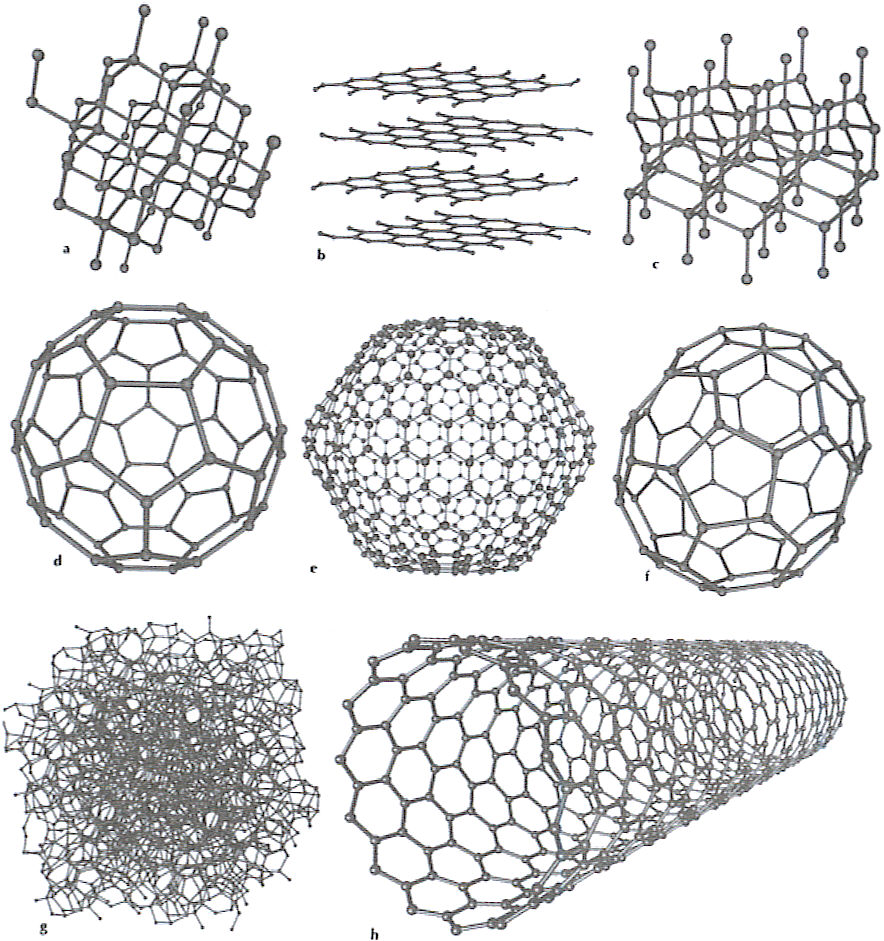
This illustration depicts eight of the allotropes (different molecular configurations) that pure carbon can take:

a) Diamond
b) Graphite
c) Lonsdaleite
d) Buckminsterfullerene (C60)
e) C540
f) C70
g) Amorphous carbon
h) single-walled carbon nanotube


Review of experiments

Graphite exhibits elastic behaviour and even improves its mechanical strength up to the temperature of about 2500 K. Measured changes in ultrasonic velocity in graphite after high temperature creep shows marked plasticity at temperatures above 2200 K [16]. From the standpoint of thermodynamics, melting is a phase transition of the first kind, with an abrupt enthalpy change constituting the heat of melting. Therefore, any experimental proof of melting is associated with direct recording of the temperature dependence of enthalpy in the neighbourhood of a melting point. Pulsed heating of carbon materials was studied experimentally by transient electrical resistance and arc discharge techniques, in millisecond and microsecond time regime (see, e.g., [17, 18]), and by pulsed laser heating, in microsecond, nanosecond and picosecond time regime (see, e.g., [11, 19, 20]). Both kind of experiments recorded significant changes in the material properties (density, electrical and thermal conductivity, reflectivity, etc. ) within the range 4000-5000 K, interpreted as a phase change to a liquid state. The results of graphite irradiation by lasers suggest [11] that there is at least a small range of temperatures for which liquid carbon can exist at pressure as low as 0.01 GPa. The phase boundaries between graphite and liquid were investigated experimentally and defined fairly well.

Monday, February 11, 2008

Inside Out

3.1 As Cytowic notes, Plato and Socrates viewed emotion and reason as in a kind of struggle, one in which it was vitally important for reason to win out. Aristotle took a more moderate view, that both emotion and reason are integral parts of a complex human soul--a theory proposed by Aristotle in explicit opposition to Platonism (De Anima 414a 19ff). Cytowic appears to endorse the Platonic line, with the notable difference that he would apparently rather have emotion win out.


I am trying to "create a image" that will use the one above. It is important that the select quoted comment below is understood. This can't be done without some reference.

So while the exercise may be going on "inside" things are happening on the outside. Scientists have never been completely honest with themselves, while some may concern themselves with whose name said what?


I use Plato as a namesake obviously, because of what I saw of some of our influential minds speaking, all the while making inferences to Plato. When ever you read something that resonates with you, it is of value because it correlates to something that you already know. This is what I tried to get across in the previous post, about what is "self evident." Little do some people recognize that while I may have inferred the point of some philosophical foundations, it is not without recognizing that the "qualitative phrases" have to be reduced as well to a logic. To reason.

How do you do that? Well I'll tell you what I found and then you can think whether I understood reason in it's proper format. Whether I understood the "shadows of Plato" to mean something other then what could have been interpreted as being wrong. What is that analogy of the Cave really mean?

Our attempt to justify our beliefs logically by giving reasons results in the "regress of reasons." Since any reason can be further challenged, the regress of reasons threatens to be an infinite regress. However, since this is impossible, there must be reasons for which there do not need to be further reasons: reasons which do not need to be proven. By definition, these are "first principles." The "Problem of First Principles" arises when we ask Why such reasons would not need to be proven. Aristotle's answer was that first principles do not need to be proven because they are self-evident, i.e. they are known to be true simply by understanding them.


Yes I did not enter the halls of higher learning in the traditional ways. You can converse for many years, does not mean you become devoid of the lessons that spoken amongst the commentors. How is it you can think that while listening to scientists you cannot uncover the the processes they use? If I had given thirty years to study, what exactly had I studied? I am a doctor of nothing.:)

This is a torus (like a doughnut) on which several circles are located. Unlike on a Euclidean plane, on this surface it is impossible to determine which circle is inside of which, since if you go from the black circle to the blue, to the red, and to the grey, you can continuously come back to the initial black, and likewise if you go from the black to the grey, to the red, and to the blue, you can also come back to the black.

My quote at Backreaction on this and that, reveals not only part of the understanding gained through this "infinite regress," but also the understanding we have with the world around us. Some would be better served to see the image of the Klein bottle, but I wanted to show what is going on in a "abstract way" to what is happening inside of us, and at the same time, what is happening outside.


I had used the brain and head as a place of our conscious awareness within context of our environment, our bodies. The topological explanations of the numbers above, and used them in the next paragraph. There will be confusion with the colour lines, please disregard that.

While I talked of the emotive and mental realities. I included the spiritual development in the end. The way this interaction takes place, is sometimes just as the mental function(yellow). Other times, it is the emotive realization of the experience. It is coloured by our emotion(red).

While we interact with our environment, there is this turning inside out, continuously. Sometimes we may say that "1" is the emotive realization, while the number 2 is seen as a mental extension of the situation. While the areas overlap each other, an outward progression may mean that the spiritual progress is numbered 4, while the interaction of the emotive, mental and spiritual progression may be number 3. Ultimately the spiritual progression is 4 (Violet). All these colours can mix and are significant in themself. They reveal something about our very constitution.

While some may wonder how could any conceptualization ever integrate the "Synesthesia views" of the world when it sees itself presented with such a comparison? The journey of course leads to the "Colour of Gravity." Discard your body, and one will wonder about the "clear light." What it means, in the "perceptive state of existence." If one is prepared, then one shall not have "to much time on their hands" getting lost in the fog.

Plato and Aristotle, Up and Down by Kelley L. Ross, Ph.D.

Rafael has Plato pointing up and Aristotle gesturing down to indicate the difference in their metaphysics. For Plato, true existence is in the World of Forms, in relation to which this world (of Becoming) is a kind of shadow or image of the higher reality. Aristotle, on the other hand, regards individual objects in this world as "primary substance" and dismisses Plato's Forms -- except for God as a pure actuality, without matter.

However, when it comes to ethics and politics, the gestures should be reversed. Plato, like Socrates, believed that to do the good without error, one must know what the good is. Thus, we get the dramatic moment in the Republic where Plato says that philosophers, who have escaped from the Cave and come to understand the higher reality, must be forced to return to this world and rule, so that their wisdom can benefit the state. Aristotle, on the other hand, says that the "good" is simply the goal of various particular activities, without one meaning in Plato's sense. The particular activities of most human affairs involve phronésis, "practical wisdom." This is not sophía, true wisdom, for Aristotle, which involves the theoretical knowledge of the highest things, i.e. the gods, the heavens, and God.

Thus, for philosophy, Aristotle should point up and would represent a contemplative attitude that was certainly more congenial to religious practices in the Middle Ages. By the same token, Aristotle's contribution to what we now think of as science was hampered by his lack of interest in mathematics. Although Aristotle in general had a more empirical and experimental attitude than Plato, modern science did not come into its own until Plato's Pythagorean confidence in the mathematical nature of the world returned with Kepler, Galileo, and Newton. For instance, Aristotle, relying on a theory of opposites that is now only of historical interest, rejected Plato's attempt to match the Platonic Solids with the elements -- while Plato's expectations are realized in mineralogy and crystallography, where the Platonic Solids occur naturally.

Therefore, caution is in order when comparing the meaning of the metaphysics of Plato and Aristotle with its significance for their attitudes towards ethics, politics, and science. Indeed, if the opposite of wisdom is, not ignorance, but folly, then Socrates and Plato certainly started off with the better insight.


It is good that you go to the top of the page of the linked quotes of Kelley L. Ross. You must know that I developed this site without really understanding the extent Mr. Ross had taken this issue. There is much that is familiar, and with him, an opposing view too.

See:

  • Induction and Deduction
    Intuitively Balanced: Induction and Deduction
  • Saturday, February 09, 2008

    Self Evident Truths

    I am convinced that those societies [as the Indians] which live without government enjoy in their general mass an infinitely greater degree of happiness than those who live under European governments.
    -- Thomas Jefferson to Edward Carrington, 1787


    There is a process that I had come to recognize when I look back to historical perspective that was important to me. Alain Connes defined it in terms of mathematics for me when he said,"the basic concepts of mathematics are infinitely closer to an indecomposable element", a kind of elementary particle" of thought with a minimal amount of ambiguity in their definition."

    A VIEW OF MATHEMATICS Alain CONNES

    Most mathematicians adopt a pragmatic attitude and see themselves as the explorers of this mathematical world" whose existence they don't have any wish to question, and whose structure they uncover by a mixture of intuition, not so foreign from poetical desire", and of a great deal of rationality requiring intense periods of concentration.


    While I myself am not versed in the number of mathematical systems out there, it was a journey to select the quotes and have these quotes direct my thinking, by comparative and correlative understandings. One had to have some core value system in order to recognize the "essential element of paradigmatic changes" that theoretical positions undergo when mathematical abstracts are introduced to creating perspective change in any system that is already in place.

    Nature's Greatest Puzzle by Chris Quigg-SLAC Summer Institute August 2, 2004

    While the thrust is experimental in design, there had been a move away from theoretical principle? If you would like a Michael Shermer of the science world to be represented by a man of Woitian design who thinks same, it would have been far better to listen to those who will acknowledge string theories mathematical construct for what it is.

    It is a reductionistic one, and pushes perspective farther back then Steven Weinberg's first Three Minutes. That is the lesson, that while the very idea of the matter defined states of existence, along side of those massless entities through collisional processes, we are looking to describe the interactions. It is also asking for such theoretical thinking to move itself ever closer to that "indecomposable element."

    Mind Maps: Mathematical Constructs


    Einstein and Schrödinger never fully accepted the highly abstract nature of Heisenberg's quantum mechanics, says Miller. They agreed with Galileo's assertion that "the book of nature is written in mathematics", but they also realized the power of using visual imagery to represent mathematical symbols. Arthur Miller


    The journey is an arduous one when one ventures ever close to that indecomposable element. That is the very exercise one should be interested in. Again, I would have had to listen to all those rejected from the validation process, to hear them say, "why not my exercise in mathematic judgement?" Something is wrong with it. The system, and not my construct of it? Hey, I hear you, what the heck do I know:)

    I had to know something Qui? I spot the very idea of Liminocentric structures to ponit out that a philosophical take is driving someone else's visions of thinking. No it is not Heliocentricity. I take this position as well because I recognize something. Okay, I am not a Garrett Lisi, whose derivations to all degrees of freedom, and the emergent process ultimately is defined in all elemental qualities to it's finality.:)

    But you see this is the point of using "the vision" and thinking about what is self evident. I advocated Susskind's rubber band image of mind, after intense efforts to deduction. What value this "aha moment" when it is a leap of faith? It arose out of deeper place that talks to that structured faculty of the mind to explore the reaches within.

    And I fiddled with it, I monkeyed with it. I sat in my attic, I think for two months on and off. But the first thing I could see in it, it was describing some kind of particles which had internal structure which could vibrate, which could do things, which wasn't just a point particle. And I began to realize that what was being described here was a string, an elastic string, like a rubber band, or like a rubber band cut in half. And this rubber band could not only stretch and contract, but wiggle. And marvel of marvels, it exactly agreed with this formula.

    I was pretty sure at that time that I was the only one in the world who knew this.
    LEONARD SUSSKIND:


    So you see there is a deductive process and an intuitive one that is in place that I am speaking too. It of course recognizes "the reason" with which such a deduction should take place. That it leads to to what is "self evident." From there, that time away from intense thinking allows for the limits of our reasoning, a look into the future.

    Strip yourself of your Ego. Strip yourself of your name. How naked then, that any possession means little. Think then, that what comes into mind is free, and like a pebble widens as rings. While on the soapbox and standing there, you then recognize how unimportant one's name is. It is coming to see, the finer parts of one's constitution that we finally see who the person is.

    See:

  • What a Good String Theorist Should Know?

  • Heralded from the 21st Century: String Theory
  • Winter Shangrila

    As to the date stamped on the pictures these are the correct ones. Mother Nature has sent us about another ten inches since then.


    As some of you know, I spent about seven months in 2007 building this house with my son and wife. We moved into it in late November, and was not able to complete some of the projects that needed to be completed.

    The most obvious of course is the siding that will be started, when I have poured the aggregate walkaways. I had prepared these before winter rolled in. I could not get my finisher to come in and complete because of a large contract he had an option on that superseded my work if he obtained. He let me know of course, and fighting time with Winter coming I tried my best. A spring/summer job then.


    After the foundation was done and before we started on the house construction, we brought in a 1200lb compactor to make sure that before any concrete was pour inside and out, the future walkways, this process was done. Also to build it up I brought in 2 10 yard truckloads of crush to build it up and pounded again, for levelling and to give it the height in relation to the house.

    In construction, there are three main types of compactor; the plate compactor, the "jumping jack" and the road roller. The roller type compactors are used for compacting crushed rock as the base layer underneath concrete or stone foundations or slabs. The plate compactor has a large vibrating baseplate and is suited for creating a level grade, while the jumping jack compactor has a smaller foot. The jumping jack type is mainly used to compact the backfill in narrow trenches for water or gas supply pipes etc. Road rollers may also have vibrating rollers.


    If you notice I had some rock work done on the pillars and the front of the house.

    Cultured Stone HistoryOwens Corning Cultured Stone products originated in 1962 when brothers Garrett and Floyd Brown of Vallejo, California saw the need for a new kind of building material.

    All around this house is stones of similar size, but we went and used a concrete product that looks much like those same rocks. While constructing the foundation, the plans did call for a 4 inch ledge to be in place for these rock additions, but it would have been to cumbersome to use the natural rocks and stone around here. I brought in an old Italian mason to do the work. We were very pleased.

    Friday, February 08, 2008

    Wildlife

    Moose (Alces alces)

    This was captured outside our garage door by my wife. I happened to be on the other side of the house, when I heard the dogs barking, and my wife telling me to come quick.

    Over the years we've viewed many Moose on properties that we had owned, and on other lands.

    Unfortunately, we have run into about four over the years with varying degrees of cost to vehicle repairs. The "plus side" is that we have not been hurt in these collisions. Were they unavoidable? Having this country life and going to work at the dark hours have made myself mostly a candidate for such incidents. Weather does dramatically place a part in this, and not being totally observant to the environment would have to be included.

    Pileated Woodpecker (Dryocopus pileatus)

    This picture is taken from one of the locations my wife feeds the birds. There are about four different types of birds that we have identified.

    Evening Grosbeaks(Coccothraustes vespertinus)Yellow are males, females greyer.

    These second two pictures are from the second location. At this second location there are other mouths that are being feed that I will put up shortly.

    Pine Grosbeak(Pinicola enucleator)Females are gray with two white wing bars. Male is pink to red with two white bars

    This little fellow below is a frequent visitor, along with many others who fight over territory amongst the trees. They have learnt to sometimes sit amongst the birds okay, while other times they make it their mission to keep each other from the feed.

    American Red Squirrel(Tamiasciurus hudsonicus)

    Understanding Nature

    While people even like myself may talk about it, have we really learnt of the differences in the animal world and the characteristics to each of the species? There is something primordial about the animal per say, yet, within context of the groups that they form, how well do we understand it's culture. Would it be wrong to assign such thing as "cultured" when a civilized society would seem more apt to such an expression?

    When you spend years with different animals you get to learn some of the things that are unique to them, as well as being the recipient of an animal wrath. Unbeknownst even to them, this primordial call of the wild, will inhibit even the most loyal animal, when it is ready to show it's colours for the opposite sex. I know by not being aware and walking in front of the line the animal paces, I did not realize how a bite on the side could hurt. That was my mistake for underestimating.

    So to the mothering instinct of the newborn, that a mother will protect. The very land becomes it's home and being marked, will become the territory of it's babies. How close to that zone, and how much a warning given? After the babies are grown and gone what is it that leaves mothers to believe that they are still protecting their home.


    That one would think Horses would show their very nature and we think the males dominant, when the very order is selected by the mare? So too, I would like to fool them when they are young and born to this world that the imprint and betrayal of my size, would have them believe at 1200lbs I could still pick them up. They are always still wary then. But then, that is history. They were sent to their rightful place up north.


    See:
  • Our Local Wildlife

  • The History of Magnetic Vision

  • Where Hockey Started, and Horses Live
  • Wednesday, February 06, 2008

    WE ARE A HEAVENLY FLOWER

    AND we should consider that God gave the sovereign part of the human soul to be the divinity of each one, being that part which, as we say, dwells at the top of the body, inasmuch as we are a plant not of an earthly but of a heavenly growth, raises us from earth to our kindred who are in heaven. And in this we say truly; for the divine power suspended the head and root of us from that place where the generation of the soul first began, and thus made the whole body upright. When a man is always occupied with the cravings of desire and ambition, and is eagerly striving to satisfy them, all his thoughts must be mortal, and, as far as it is possible altogether to become such, he must be mortal every whit, because he has cherished his mortal part. But he who has been earnest in the love of knowledge and of true wisdom, and has exercised his intellect more than any other part of him, must have thoughts immortal and divine, if he attain truth, and in so far as human nature is capable of sharing in immortality, he must altogether be immortal; and since he is ever cherishing the divine power, and has the divinity within him in perfect order, he will be perfectly happy. Now there is only one way of taking care of things, and this is to give to each the food and motion which are natural to it. And the motions which are naturally akin to the divine principle within us are the thoughts and revolutions of the universe. These each man should follow, and correct the courses of the head which were corrupted at our birth, and by learning the harmonies and revolutions of the universe, should assimilate the thinking being to the thought, renewing his original nature, and having assimilated them should attain to that perfect life which the gods have set before mankind, both for the present and the future.
    Plato from Timaeus, 90a-d, translated by B. Jowett

    Monday, February 04, 2008

    Mind Maps: Mathematical Structures?


    Plato's doctrine of recollection, however, addresses such criticism by saying that souls are born with the concepts of the forms, and just have to be reminded of those concepts from back before birth, when the souls were in close contact with the forms in the Platonic heaven. Plato is thus known as one of the very first rationalists, believing as he did that humans are born with a fund of a priori knowledge, to which they have access through a process of reason or intellection — a process that critics find to be rather mysterious


    What are Mind Maps?


    A mind map is a diagram used to represent words, ideas, tasks or other items linked to and arranged radially around a central key word or idea. It is used to generate, visualize, structure and classify ideas, and as an aid in study, organization, problem solving, decision making, and writing.

    It is an image-centered diagram that represents semantic or other connections between portions of information. By presenting these connections in a radial, non-linear graphical manner, it encourages a brainstorming approach to any given organizational task, eliminating the hurdle of initially establishing an intrinsically appropriate or relevant conceptual framework to work within.

    A mind map is similar to a semantic network or cognitive map but there are no formal restrictions on the kinds of links used.

    The elements are arranged intuitively according to the importance of the concepts and they are organized into groupings, branches, or areas. The uniform graphic formulation of the semantic structure of information on the method of gathering knowledge, may aid recall of existing memories.


    Well straight to the point then I guess.

    Bee:
    The important thing about the basis of our societies is not actually its fixed structure but the way to readjust it. A bit of scientific method would be good there.


    As I mentioned previously on Backreaction site and in giving subsequent information about this process. It has been a journey of my own discovery, that I would say that at the basis of reality is such a mathematical structure.

    I know when this process started for me and it would not serve any purpose at this point to speak to it directly. People have their reasons for and against such a proposal as their being such a mathematical structure, so what currently leads me to say that their are these two opposing views?


    Wigner’s Gift Horse By JULIE REHMEYER • Feb 1, 2008 See here for article.

    Stephen Wolfram argues that the way to unlock the rest of science is to give up on mathematics and look for explanations analogous to computer code. Very simple computer programs can produce remarkably complex behavior that mimics phenomena science has had difficulty modeling, like the motion of fluids, for example. So studying the behavior of these programs may provide scientists with new insights about these phenomena. Indeed, Wolfram thinks the universe itself may be generated by a computer program simple enough to be expressed in a few lines of code. “If the laws are simple enough, if we look in the right way we’ll find them,” he says. “If they’re not, it will be tougher. The history of physics makes one pessimistic that we could ever end physics. I don’t share that pessimism.”


    Tegmark believes in an extreme form of Platonism, the idea that mathematical objects exist in a sort of universe of their own. Imagine that, Tegmark says, “there’s this museum in this Platonic math space that has these mathematical objects that exists outside of space and time,” Tegmark says. “What I’m saying is that their existence is exactly the same as a physical existence, and our universe is one of these guys in the museum.”


    Also worth reading is the sum of any position that would infer the stance of Plato versus anti-Plato, to help distinguish whether or not one might have something of value in terms of the question of whether Mathematics is invented or discovered.

    Mathematical Platonism and its Opposites by Barry Mazur January 11, 2008. See here.

    For the Platonists. One crucial consequence of the Platonic position is that it views mathematics as a project akin to physics, Platonic mathematicians being—as physicists certainly are—describers or possibly predictors—not, of course, of the physical world, but of some other more noetic entity. Mathematics—from the Platonic perspective—aims, among other things, to come up with the most faithful description of that entity.


    For the Anti-Platonists. Here there are many pitfalls. A common claim, which is meant to undermine Platonic leanings, is to introduce into the discussion the theme of mathematics as a human, and culturally dependent pursuit and to think that one is actually conversing about the topic at hand.


    Mapping the interaction from a scientific point of view?

    As I read through the article I had previous insights while reading through Sir Roger Penrose's lecture on the Extended Physical WorldView. While I myself had picked the title, it would have been nicer to show the very image on the start of that lecture.


    This is a important statement I am making below because it distinguishes between where we think we might be going in terms of computer technologies versus what will always remain within the human domain.


    So on the one hand one might think about technologies in the 21st Century and wonder if computer technology can ever reach the status of Consciousness with which the "synaptic event" could include images, all the while it would include all the history to that point?


    While it is never clear to me about the origins of the universe, it had some relation in my mind to what first allowed any soul's expression. While I had shown the relation to the synaptic event, there had to be a place created for such an expression, to be fortunate and validated.

    Do I know what plan for every individual is, of course not, but that you choose such an expression is self evident. There is much to the word, "self evident" that remains to be explored within context of this site, and of value, in the iconic image of Raphael's expression with Plato and Aristotle at it's centre.

    Now, neuronic networking is supposedly the platform computer technologies can take in their designs, but what true aspect of the emergent process could ever define the human being and one's potential? The information that could enter such an synaptic event within your own thinking mind?

    So the process is one of self discovery. About processes within your own self that allow one to possibly develop the new mathematics that speak directly to the very unfolding of the universe?

    The Unreasonable Effectiveness of Mathematics in the Natural Sciences by Eugene Wigner

    The great mathematician fully, almost ruthlessly, exploits the domain of permissible reasoning and skirts the impermissible. That his recklessness does not lead him into a morass of contradictions is a miracle in itself: certainly it is hard to believe that our reasoning power was brought, by Darwin's process of natural selection, to the perfection which it seems to possess. However, this is not our present subject. The principal point which will have to be recalled later is that the mathematician could formulate only a handful of interesting theorems without defining concepts beyond those contained in the axioms and that the concepts outside those contained in the axioms are defined with a view of permitting ingenious logical operations which appeal to our aesthetic sense both as operations and also in their results of great generality and simplicity.

    [3 M. Polanyi, in his Personal Knowledge (Chicago: University of Chicago Press, 1958), says: "All these difficulties are but consequences of our refusal to see that mathematics cannot be defined without acknowledging its most obvious feature: namely, that it is interesting" (p 188).]


    What can arise from any person, to have defined that it reaches back into the forms. That it chooses to manifest "as the person" you have become? What lies dormant, that you awake to it in such a way that it will manifest in all that you do, and become part of the "history of recollection" that you unfold in this life, and have learnt these things before? You dream?

    I, Robot:

    ....signs of new life emerge as images photonically flicker in the new logic forming apparatus....

    I had a dream....


    We might like to think that computers are capable, while the very idea of the "image" holds such vasts amount of information. This is not a new idea from an historical perspective if one ever thought to consider the alchemists of our early science.

    How would you contain all the probability and outcomes, with ever looking beyond space and time, to realize that the "heavens" in some way, meet the earth. Manifest within you? Can find re-birthing through you? Inner/outer become one.

    Wednesday, January 23, 2008

    Ueber die Hypothesen, welche der Geometrie zu Grunde liegen.

    As I pounder the very basis of my thoughts about geometry based on the very fabric of our thinking minds, it has alway been a reductionist one in my mind, that the truth of the reality would a geometrical one.


    The emergence of Maxwell's equations had to be included in the development of GR? Any Gaussian interpretation necessary, so that the the UV coordinates were well understood from that perspective as well. This would be inclusive in the approach to the developments of GR. As a hobbyist myself of the history of science, along with the developments of today, I might seem less then adequate in the adventure, I persevere.


    On the Hypotheses which lie at the Bases of Geometry.
    Bernhard Riemann
    Translated by William Kingdon Clifford

    [Nature, Vol. VIII. Nos. 183, 184, pp. 14--17, 36, 37.]

    It is known that geometry assumes, as things given, both the notion of space and the first principles of constructions in space. She gives definitions of them which are merely nominal, while the true determinations appear in the form of axioms. The relation of these assumptions remains consequently in darkness; we neither perceive whether and how far their connection is necessary, nor a priori, whether it is possible.

    From Euclid to Legendre (to name the most famous of modern reforming geometers) this darkness was cleared up neither by mathematicians nor by such philosophers as concerned themselves with it. The reason of this is doubtless that the general notion of multiply extended magnitudes (in which space-magnitudes are included) remained entirely unworked. I have in the first place, therefore, set myself the task of constructing the notion of a multiply extended magnitude out of general notions of magnitude. It will follow from this that a multiply extended magnitude is capable of different measure-relations, and consequently that space is only a particular case of a triply extended magnitude. But hence flows as a necessary consequence that the propositions of geometry cannot be derived from general notions of magnitude, but that the properties which distinguish space from other conceivable triply extended magnitudes are only to be deduced from experience. Thus arises the problem, to discover the simplest matters of fact from which the measure-relations of space may be determined; a problem which from the nature of the case is not completely determinate, since there may be several systems of matters of fact which suffice to determine the measure-relations of space - the most important system for our present purpose being that which Euclid has laid down as a foundation. These matters of fact are - like all matters of fact - not necessary, but only of empirical certainty; they are hypotheses. We may therefore investigate their probability, which within the limits of observation is of course very great, and inquire about the justice of their extension beyond the limits of observation, on the side both of the infinitely great and of the infinitely small.


    For me the education comes, when I myself am lured by interest into a history spoken to by Stefan and Bee of Backreaction. The "way of thought" that preceded the advent of General Relativity.


    Einstein urged astronomers to measure the effect of gravity on starlight, as in this 1913 letter to the American G.E. Hale. They could not respond until the First World War ended.

    Translation of letter from Einstein's to the American G.E. Hale by Stefan of BACKREACTION

    Zurich, 14 October 1913

    Highly esteemed colleague,

    a simple theoretical consideration makes it plausible to assume that light rays will experience a deviation in a gravitational field.

    [Grav. field] [Light ray]

    At the rim of the Sun, this deflection should amount to 0.84" and decrease as 1/R (R = [strike]Sonnenradius[/strike] distance from the centre of the Sun).

    [Earth] [Sun]

    Thus, it would be of utter interest to know up to which proximity to the Sun bright fixed stars can be seen using the strongest magnification in plain daylight (without eclipse).


    Fast Forward to an Effect

    Bending light around a massive object from a distant source. The orange arrows show the apparent position of the background source. The white arrows show the path of the light from the true position of the source.

    The fact that this does not happen when gravitational lensing applies is due to the distinction between the straight lines imagined by Euclidean intuition and the geodesics of space-time. In fact, just as distances and lengths in special relativity can be defined in terms of the motion of electromagnetic radiation in a vacuum, so can the notion of a straight geodesic in general relativity.


    To me, gravitational lensing is a cumulative affair that such a geometry borne into mind, could have passed the postulates of Euclid, and found their way to leaving a "indelible impression" that the resources of the mind in a simple system intuits.

    Einstein, in the paragraph below makes this clear as he ponders his relationship with Newton and the move to thinking about Poincaré.

    The move to non-euclidean geometries assumes where Euclid leaves off, the basis of Spacetime begins. So such a statement as, where there is no gravitational field, the spacetime is flat should be followed by, an euclidean, physical constant of a straight line=C?

    Einstein:

    I attach special importance to the view of geometry which I have just set forth, because without it I should have been unable to formulate the theory of relativity. ... In a system of reference rotating relatively to an inert system, the laws of disposition of rigid bodies do not correspond to the rules of Euclidean geometry on account of the Lorentz contraction; thus if we admit non-inert systems we must abandon Euclidean geometry. ... If we deny the relation between the body of axiomatic Euclidean geometry and the practically-rigid body of reality, we readily arrive at the following view, which was entertained by that acute and profound thinker, H. Poincare:--Euclidean geometry is distinguished above all other imaginable axiomatic geometries by its simplicity. Now since axiomatic geometry by itself contains no assertions as to the reality which can be experienced, but can do so only in combination with physical laws, it should be possible and reasonable ... to retain Euclidean geometry. For if contradictions between theory and experience manifest themselves, we should rather decide to change physical laws than to change axiomatic Euclidean geometry. If we deny the relation between the practically-rigid body and geometry, we shall indeed not easily free ourselves from the convention that Euclidean geometry is to be retained as the simplest. (33-4)


    It is never easy for me to see how I could have moved from what was Euclid's postulates, to have graduated to my "sense of things" to have adopted this, "new way of seeing" that is also accumulative to the inclusion of gravity as a concept relevant to all aspects of the way in which one can see reality.

    See:

  • On the Hypothese at the foundations of Geometry

  • Gravity and Electromagnetism?

  • "The Confrontation between General Relativity and Experiment" by Clifford M. Will
  • Friday, January 18, 2008

    The Founder of Probabilty Theory?

    I want to understand what makes the world tick. Einstein said he wanted to know what was on God's mind when he made the world. I don't think he was a religious man, but I know what he means.Lenny Susskind


    Pierre de Fermat IPA: [pjɛːʁ dəfɛʁ'ma] (August 17, 1601 – January 12, 1665)

    With Blaise Pascal, Pierre de Fermat became the founders of the theory of probability.

    A Short History of Probability
    "A gambler's dispute in 1654 led to the creation of a mathematical theory of probability by two famous French mathematicians, Blaise Pascal and Pierre de Fermat. Antoine Gombaud, Chevalier de Méré, a French nobleman with an interest in gaming and gambling questions, called Pascal's attention to an apparent contradiction concerning a popular dice game. The game consisted in throwing a pair of dice 24 times; the problem was to decide whether or not to bet even money on the occurrence of at least one "double six" during the 24 throws. A seemingly well-established gambling rule led de Méré to believe that betting on a double six in 24 throws would be profitable, but his own calculations indicated just the opposite.

    MESSENGER Reveals Mercury’s Geological History

    Stefan of Backreaction posted a blog entry called,"Mercury looks like the Moon, nearly... that brought me up to speed on what the planet actually looks like.

    His article provides for the links here in this entry, as well sets the stage for the culminating vision I have of our solar system. Looking at the solar system in the processes I outline are important point of seeing the gravitational aspects of the universe as we have come to know it.

    I had never considered what the actual surface of Mercury would look like, other then what I had thought it to be, when told as a child. A molten surface.

    Using the laser altimeter, MESSENGER will verify the presence of a liquid outer core in Mercury by measuring the planet's libration. Libration is the slow 88-day wobble of the planet around its rotational axis.


    Seeing Mercury the way it is below provides for some thought about Mercury facing toward the Sun. It's surface looking at the picture below, I was wondering if facing directly in opposition to the Sun would showing brighter spots as we look to the right of this image.

    This also raised an interesting question on my mind about how the uniformity of the surface could retain it's moon like look while undergoing the passage of "increased heat" as it faced the sun at anyone time through it's rotation.

    Question 4 : What is the structure of Mercury's core?


    Credit: NASA/Johns Hopkins University Applied Physics Laboratory/Carnegie Institution of Washington

    More recently, Earth-based radar observations of Mercury have also determined that at least a portion of the large metal core is still liquid to this day! Having at least a partially molten core means that a very small but detectable variation in the spin-rate of Mercury has a larger amplitude because of decoupling between the solid mantle and liquid core. Knowing that the core has not completely solidified, even as Mercury has cooled over billions of years since its formation, places important constraints on the thermal history, evolution, and core composition of the planet.


    Credit: NASA/Johns Hopkins University Applied Physics Laboratory/Carnegie Institution of Washington

    This MESSENGER image was taken from a distance of about 18,000 kilometers (11,000 miles) from the surface of Mercury, at 20:03 UTC, about 58 minutes after the closest approach point of the flyby. The region shown is about 500 kilometers (300 miles) across, and craters as small as 1 kilometer (0.6 mile) can be seen in this image.


    The Gravity Field


    Clementine color ratio composite image of Aristarchus Crater on the Moon. This 42 km diameter crater is located on the corner of the Aristarchus plateau, at 24 N, 47 W. Ejecta from the plateau is visible as the blue material at the upper left (northwest), while material excavated from the Oceanus Procellarum area is the reddish color to the lower right (southeast). The colors in this image can be used to ascertain compositional properties of the materials making up the deep strata of these two regions. (Clementine, USGS slide 11)

    This is always of interest to be because it is an accumulation of the synthesis of views we gain as we come to understand not only the views of on the Window of the universe, as we look at the Sun under information obtain in the neutrino laboratory's and information modelling of how we can now look at the sun with this new view.

    But the truth is, the Earth's topography is highly variable with mountains, valleys, plains, and deep ocean trenches. As a consequence of this variable topography, the density of Earth's surface varies. These fluctuations in density cause slight variations in the gravity field, which, remarkably, GRACE can detect from space.

    Well, by adding the label of Grace and Grace satellite systems, it is important to me that not only is gravity considered in context of the exploration of space in terms of Lagrangian, but of viewing how we map the earth and the views we obtain of that new gravity model of earth. This application then becomes of interest as we understand how we see the gravity model of Mercury and how the geological structure of Mercury will be reflected in that gravity model.

    The Culminating Vision

    Fig. 1. Story line showing the principle of least action sandwiched between relativity and quantum mechanics See A call to action

    See:
  • The Periodic Table of the Moon's Strata
  • Time-Variable Gravity Measurements

  • Andrew Wiles and Fermat
  • Tuesday, January 15, 2008

    Boltzmann's Brain

    There is a new article by Dennis Overbye in the New York Times called, Big Brain Theory: Have Cosmologists Lost Theirs?

    It could be the weirdest and most embarrassing prediction in the history of cosmology, if not science.

    If true, it would mean that you yourself reading this article are more likely to be some momentary fluctuation in a field of matter and energy out in space than a person with a real past born through billions of years of evolution in an orderly star-spangled cosmos. Your memories and the world you think you see around you are illusions.


    Source: Sean Carroll, California Institute of Technology

    Alway part of the process is to find within my own site information that I had collected to help me understand where Ludwig Boltzmann comes into the picture in the above article.

    Now of course I go over to Cosmic Variance's version of Boltzmann's Universe where the article above is referred too.

    I look at the discussion that is taking place and try and put the exchange and points raised in mind so that I can understand as best I can "the jest" of the problem and the jest of what people are saying.

    This isn't an attempt to rewrite the article, but to open the door to a better understanding of what is being portrayed.

    Sean:lylebot, this is basically the point of the post — if the universe is a fluctuation around thermal equilibrium, then no matter what you condition on concerning our present state (including literally everything we know about it), it is overwhelmingly likely that it is a random fluctuation from a higher-entropy past. Even if we have memories apparently to the contrary!

    The Universe and Irreversibility

    Now it is quite loosely put together in my head that I went searching to try and understand the context in which the universe was placed in accordance to the state of equilibrium.

    In equilibrium, the entropy of the system cannot increase (because it is already at a maximum) and it cannot decrease (because that would violate the second law of thermodynamics). The only changes allowed are those in which the entropy remains constant.


    See: What is the entropy of the universe?

    Wednesday, January 09, 2008