Monday, November 06, 2006

Deja Vue?


NewScientistSpace-How to be in two places at once


The basis of this post is in answer to Bee's question in relation to, "Back to the Beginning of Time."

Bee writes:
interesting post. A question: what does it mean for the elephant to 'be' in more than one place. Or, what is there inside our space, how is 'it' different from the space, and how do we attribute a location to 'it'. And finally: what can we possibly say about 'it' being 'somewhere' without understanding the measurement problem in quantum theory? So many questions. Best,


Not many engage me in questions and it is appreciated when some involved in science take the time to do so. While spending considerable time as a hobby, I have not included the years of research in developing the thinking I did, based on past exercises. Without this interaction, I had to rely on "other ways" to bring the information forward.

Plato's dialogues, in the spirit of discussing ideas, served to do this, with, or without people involved.

It is these instances, which help to propel forward my thinking if corrected, or challenged that such delusions are less then likely held to the procedures of science. It's mechanisms. Anyway, the interaction is appreciated.


One needed a "testing ground," and a thought experiment usually precedes it??

The elephant and the event horizon By Amanda Gefter


Because of their enormous gravity and other unique properties, black holes have been fertile ground for researchers developing these ideas.


What was held in mind is the thought of spook action at a distance and Einstein.


Quanglement

next.....

B:
0 is the identity element of the addition, it’s a finite closed subgroup, it never gets you anywhere.


So where it "the beginning" then?

I gave a link further down in terms of poetry justice and the "short story." Underneath the short story is a link to something written by Ian Stewart.

That story is based on "Fuzzy Logic."


Do we selectively ignore other models from artificial intelligence such as Zadeh's Fuzzy Logic? This is a logic used to model perception and used in newly designed "smart" cameras. Where standard logic must give a true or false value to every proposition, fuzzy logic assigns a certainty value between zero and one to each of the propositions, so that we say a statement is .7 true and .3 false. Is this theory selectively ignored to support our theories?


There is something deterministic about this relationship, between the elephant inside the blackhole and outside the blackhole.


Or here
.

To resolve this, "fuzzy logic" lays itself over top of this "thought experiment."

B:
what does it mean for the elephant to 'be' in more than one place.


Black hole computers


Hawking radiation owes its existence to the weirdness of the quantum world, in which pairs of virtual particles pop up out of empty space, annihilate each other and disappear. Around a black hole, virtual particles and anti-particles can be separated by the event horizon. Unable to annihilate, they become real. The properties of each pair are linked, or entangled. What happens to one affects the other, even if one is inside the black hole.


B:
what is there inside our space, how is 'it' different from the space, and how do we attribute a location to 'it'.


"Fuzzy logic" assumes a position "between" the blackhole inside, and the blackhole outside. The event horizon.

Both locations are linked and like entanglement, resolves spooky action at a distance?

B:
what can we possibly say about 'it' being 'somewhere' without understanding the measurement problem in quantum theory


When probing the "perfect liquid," do our energy valuations take us to the anomalie or not? Imagine what a feather could do in zero viscosity, as we learn of the fundamental nature of that liquid.

Superfluid attributes of He4? Which leads me to the points of L positions in Lagrangian perspective.


At what point does a universe make? Are there "such locations" that are similar to what we perceive, as a passage through the "blackhole state" for new universes to begin?


Physically, the effect can be interpreted as an object moving from the "false vacuum" (where = 0) to the more stable "true vacuum" (where = v). Gravitationally, it is similar to the more familiar case of moving from the hilltop to the valley. In the case of Higgs field, the transformation is accompanied with a "phase change", which endows mass to some of the particles


Like "geometric principles" one needed a way in which to explain this transition from that "perfect fluid" to explain the mass particle initiations derived from the singularities to what new universe are and have been implied to bubble manifestations?

Sunday, November 05, 2006

Tonal Perception Changes


Sir Isaac Newton
It is true without lying, certain and most true. That which is Below is like that which is Above and that which is Above is like that which is Below to do the miracles of the Only Thing. And as all things have been and arose from One by the mediation of One, so all things have their birth from this One Thing by adaptationSir Isaac Newton


Of course I see these things a little differently then some of you because I have researched and found, "model changes using theoretical perceptions," allowed such perspectives to form. Sort of like "shifting perspective" by the shifting of the Tonal.

Now seen, and understood in context of current science valuation demonstrated, I thought it important to understand how the "effect of" the sun as a central theme, could have been transmitted to "our way of thinking," to a humanistic point of view?

Atheistic or not, you cannot change what the result of your biochemical thinking does and "subsequent states of consciousness" if you did not understand the deeper correlation to what "point of view" is being explored here.

Plato:
What if we “reversed” the way we believe the “mind is inherently embodied” to, “the body” is inherently embodied by the mind?”

Is this acceptable/not aceptable, to a scientist?


Now I don't want you to think that because my own life's research has been "shallow" and "just starting," that I might have been called a professor by now in years spent?

That I use the term "layman" because each departing point of perspective I find through such research, seems apparently "new" to my thinking. To others as well, I am quite sure?

What we have learned

We have found consciousness can be described as an emergent property of the complex electromagnetic process generated from predictable biochemical and biological processes. Although the terms soul and mind may have been useful at one time to describe this process, they are no longer required. They are more like the term "phlogiston" that was employed to describe why things burned before modern chemistry emerged. When there is no electrical current moving through the parts of a television, there is no picture. When the specific electromagnetic patterns are not generated within the brain structures there is no consciousness or awareness.

Some individuals with very different brain structures show different electromagnetic correlates that are associated with their ability to discern stimuli others cannot detect. Counter clockwise rotation of weak magnetic fields around the skull at specific rates of change (derivatives) can affect subjective time and allow the average person to experience many of the altered states reported by practitioners of mystical traditions as well as "paranormal" phenomena. The critical variables, like any chemical reaction, are the complexity and specificity of the temporal parameters. One component of consciousness may be "sequestered" within second or third derivatives of very narrow bands of changes in frequency within the theta range. Our calculations of resonance, based upon the power changes within quantitative electroencephalographic measures, suggest that one electromagnetic source of consciousness may actually exist within the 10 cm region outside of and surrounding the cranium.


I add this underline portion to show why I would assume such a statement represented in Cosmic Variance comment section under the God Conundrum presented by Sean Carroll.

Also the link in general to give Sean Carroll something to think about as he speaks of what the presence in terms of what a God might mean to him regardless of what he had to say from a atheistic position or from anyone else for that matter.

We are all responsible for building the walls/tonal around us. If you work hard enough to build the understanding you have and supportive positions then why would you not think the desired result would have far reaching consequences?

Plato:
While Persinger was not able to induce the desire state for even the “most skeptical,” the research is interesting nonetheless.


"Organized religion" for those "less then kind" for what a God might have meant to us? Those, "less then human" in their evolution, their actions in the name of?" Would this have been a safe statement under the guise of conformity?

We have seen enough rationalization under the "auspice of religious tenets," to know that such a statement is "shallow" from the animalistic brain? Fight or flight response?

As we evolve to the "frontal cortex," then does it not seem strange that our thinking would/should evolve too, while all the aspects of the brains physical development follows the thoughts accordingly?? Qui Non?

Friday, November 03, 2006

Back to the Beginning of Time


While some of us who had been engaged in a little prehistory examination of earliest QGP states as glast determination of high energy photons, the question, "to Be or not to be," how could we not ask what Professor Susskind offered up for examination under the title, "the elephant and the event horizon?"

What happens when you throw an elephant into a black hole? It sounds like a bad joke, but it's a question that has been weighing heavily on Leonard Susskind's mind. Susskind, a physicist at Stanford University in California, has been trying to save that elephant for decades. He has finally found a way to do it, but the consequences shake the foundations of what we thought we knew about space and time. If his calculations are correct, the elephant must be in more than one place at the same time.


I think there is still this far reaching philosophical question about what really started time? If "nothing" existed then how could we assume anything could arise from it?

While empirically Aristotle has lead the thinking, you know how I think don’t you:) Do you see me stand apart from Aristotle?


So I resolve this question in my own mind, even if I do refer to Gabriele Veneziano and his introduction of what began as string theory.

How could I resolve "anything" that has been taken down to the very first microseconds, while recognizing the value of anything "underneath the guise of building blocks of matter," and have said, "that this is the theory of everything?"

It only helped us to the point of the singularity, but it is much different then a complete death. The whole time reductionistic thinking has dominated the move back in history, there were other things going on, that us simple lay people were not aware of. Maybe for some scientists too?:)


Colliding galaxies, NGC 4676, known as "The Mice" (credit: Credit: NASA, H. Ford (JHU), G. Illingworth (UCSC/LO), M.Clampin (STScI), G. Hartig (STScI), the ACS Science Team, and ESA )
The James Webb Space Telescope (JWST) is a large, infrared-optimized space telescope, scheduled for launch in 2013. JWST will find the first galaxies that formed in the early Universe, connecting the Big Bang to our own Milky Way Galaxy. JWST will peer through dusty clouds to see stars forming planetary systems, connecting the Milky Way to our own Solar System. JWST's instruments will be designed to work primarily in the infrared range of the electromagnetic spectrum, with some capability in the visible range.

JWST will have a large mirror, 6.5 meters (21.3 feet) in diameter and a sunshield the size of a tennis court. Both the mirror and sunshade won't fit onto the rocket fully open, so both will fold up and open only once JWST is in outer space. JWST will reside in an orbit about 1.5 million km (1 million miles) from the Earth.

JWST Science

The JWST science goals are divided into four themes. The key objective of The End of the Dark Ages: First Light and Reionization theme is to identify the first luminous sources to form and to determine the ionization history of the early universe. The key objective of The Assembly of Galaxies theme is to determine how galaxies and the dark matter, gas, stars, metals, morphological structures, and active nuclei within them evolved from the epoch of reionization to the present day. The key objective of The Birth of Stars and Protoplanetary Systems theme is to unravel the birth and early evolution of stars, from infall on to dust-enshrouded protostars to the genesis of planetary systems. The key objective of The Planetary Systems and the Origins of Life theme is to determine the physical and chemical properties of planetary systems including our own, and investigate the potential for the origins of life in those systems.


So again, we are being lead by science here to look ahead to what plans for the future may have influenced, or caused the decsisons they did, on another trip to refurbish the Hubble Space Telescope?

The Dark Ages of the UniverseBy Abraham Loeb

What makes modern cosmology an empirical science is that we are literally able to peer into the past. When you look at your image reflected off a mirror one meter away, you see the way you looked six nanoseconds ago--the light's travel time to the mirror and back. Similarly, cosmologists do not need to guess how the universe evolved; we can watch its history through telescopes. Because the universe appears to be statistically identical in every direction, what we see billions of light-years away is probably a fair representation of what our own patch of space looked like billions of years ago.


So then I am at a loss to explain that what happened billions of years ago near the beginning of this universe, could have ever been created in this universe now? Some body may say to you, "that the beginning of time and the distance of the beginning of the universe to now, has no correlation?"

If the circumstance are to be created in our colliders, then what said that mass determinations will ever arise from our research into the HiGG's, is not relevant, to what can be created in this space and time now?

Remember, everywhere you look in the cosmos this possibility exists. The WMAP is indictive of what I am saying.

So you say, the beginning of the universe and "the time created" to produce the particles of new physics, has no correlation into how this universe came into being?

Perhaps you may like to read Stephen Hawkings perspective on the beginning of time?

The conclusion of this lecture is that the universe has not existed forever. Rather, the universe, and time itself, had a beginning in the Big Bang, about 15 billion years ago. The beginning of real time, would have been a singularity, at which the laws of physics would have broken down. Nevertheless, the way the universe began would have been determined by the laws of physics, if the universe satisfied the no boundary condition. This says that in the imaginary time direction, space-time is finite in extent, but doesn't have any boundary or edge. The predictions of the no boundary proposal seem to agree with observation. The no boundary hypothesis also predicts that the universe will eventually collapse again. However, the contracting phase, will not have the opposite arrow of time, to the expanding phase. So we will keep on getting older, and we won't return to our youth. Because time is not going to go backwards, I think I better stop now.

Thursday, November 02, 2006

Understanding the Tonal


Sir Isaac Newton


So, you have your units, and the powers of ten?

Distances shorter than 1 µm 1 micrometre (micron)
Items with lengths between 1-10 µm (microns)
1.55 µm — wavelength of light used in optical fibre
6 µm — anthrax spore
6-8 µm — diameter of a human red blood cell
7 µm — diameter of the nucleus of typical eukaryotic cell
7 µm — width of strand of spider web
1-10 µm — diameter of typical bacterium
about 10 µm — size of a fog, mist or cloud water droplet


While I may have a complicated image for you to digest here, what values would you assign what you had never previously seen?

Would you change in the dynamics of your thinking had you known that all the results of the "thought process" had it's effect too?

Kandinsky, himself an accomplished musician, once said Color is the keyboard, the eyes are the harmonies, the soul is the piano with many strings. The artist is the hand that plays, touching one key or another, to cause vibrations in the soul. The concept that color and musical harmony are linked has a long history, intriguing scientists such as Sir Isaac Newton. Kandinsky used color in a highly theoretical way associating tone with timbre (the sound's character), hue with pitch, and saturation with the volume of sound. He even claimed that when he saw color he heard music.


Will scientists ever understand "this application" that when applied to the statements of their thinking, and "voiced from their reasons," that if not supported properly, can cast a wide and ugly shadow over the whole process?


Wassily Kandinsky-Yellow, Red, Blue
1925; Oil on canvas, 127x200cm; Centre Georges Pompidou, Paris


Well as you know, most of us cannot help our backgrounds as we talk about the sciences, or the ways in which we will attack science, based on the knowledge we have accumulated. These give the pursuit's a certain "flavor" based on the approach and meaning being conveyed? As one tries to paint this picture for us.

In my case, about the effects of "what the sun may mean as a central theme."

While based on previous knowledge of the things that help to form an idea about the tonal, vague and mystique, less then the desire of science, it does not reduce what affect is raised here?

I may indicate the very human being in it's colored thinking, but want to look at the science process itself. Nor do I wish to be blinded by such clarity that I be stopped on the road to knowledge accumulated of old age, that the path may indeed finally produced some fruit to bear.

The Sun then, becomes a powerful image/mediator of all the things that we will learn as we look at it's effects. These are as if, in the mind once settled to their private views, try to help through expression want to paint a picture of the world in it's mysterious ways.

Tone color is also often used as a synonym. People who experience synesthesia may see certain colors when they hear particular instruments. Helmholtz used the German Klangfarbe (tone color), and Tyndall proposed its English translation, clangtint. But both terms were disapproved of by Alexander Ellis who also discredits register and color for their pre-existing English meanings (Erickson 1975, p.7).


So while I debate the nature of what the tonal means, it is not without recognizing it's source that we could take in all that we know, may find of our views have now changed some? Try and deny it, and such theoretical models, have not without it's recourse said, that you remain the same in your views, and have not outwardly changed anything?

German photographer and artist Karl E. Deckart is known for his thorough, precise, and beautiful work both in photography through the microscope and with macro camera systems. This gallery of interference photographs made with soap films is a testament to both Deckart's skill as a photographer and his understanding of the physical phenomena that surround our everyday lives.

Staunch in our positions and thinking, while holding to the familiar, we may provide for a much more colorful picture, yet, find the principals by which we stand, do not have to change while held by sciences. It's as if, we have "crossed the wires," that the way in which we now see has had color added to it? While previously in cosmology, it was still a very beautiful picture, is, still a beautiful picture.

Plato:
Sometimes we might need visual aids. So, I thought I would add this in relation to the question, on how would we see these dimensions, if we accept the gravitons in the bulk? Aug 7, 2004 3:46 pm


I added this comment to Backreaction's post because of the way in which my attempts at theoretical modeling had me trying to make sense of the world that had been so abstractly painted.

While one can indeed convolute the world with so much articulation and example, what use the "whole story" if it could not indeed be reduced to the one equation/the physics, that would help us make sense?

Wednesday, November 01, 2006

Great White North


Just got back today from visiting the Grandkids and having spent Halloween with them.


The pictures are ones my wife took, on our way back.

Sunday, October 29, 2006

The Higg's Boson and Memory?

While some like chocolate bars and the bubble nature of candy, some also like the molasses and ice cream? :)


If Plato Had thought "the new born" was not really such a "blank slate" then what did he mean exactly? If we could remember, "in what form" would these memories have manifested?

The origins of thought would have found that what existed before, had to make it's way into what we are doing today? So is it really "lost" since we cannot and do not remember what was before? Or, is it possible to remember?

Not many can see in this abstract way, or have considered how a photon might have traveled? Sure they have understood satellites and the travel through space, but have they consider this in context of CSL lensing? Sean put up a link yesterday that had me seeing how such a travel over distance might have had some photon's strange journies in context of such lensings.


So how does this lump of clay ever take with it all that was before. Is it just a slight shift in our tonal? What was "not apparent before" is now very much a a part of our views of nature now. Before, it was "very pleasing," and now, it is "still very pleasing" that our cosmological views have been extended some how? :)

Likewise, if the very fabric of the Universe is in a quantum-critical state, then the "stuff" that underlies reality is totally irrelevant-it could be anything, says Laughlin. Even if the string theorists show that strings can give rise to the matter and natural laws we know, they won't have proved that strings are the answer-merely one of the infinite number of possible answers. It could as well be pool balls or Lego bricks or drunk sergeant majors.


Of course we always look for directions as to which way we'll have to look for things to understand just what our perceptions reveal and what is the basis for our thoughts as to the nature of the universe?

For example, theory says that Higgs particles are matter particles, but in most respects the Higgs behaves more like a new force than like a particle. How can this be? In truth, the Higgs is neither matter nor force; the Higgs is just different.


So it is never easy for me to follow from one thought to the next.

Imagine, the "molasses" here for a minute. What gives mass it's shape while we cannot discern the very beginning as an asymmetrical valuation? Based on the notion, that there was a simpler time entropically, how do we know what is discretely measured?

Why the discrete measure and it's shape?


New measurements of top quark mass at Fermilab have revised estimates for the mass of the Higgs boson.
Scientists believe that the Higgs boson, named for Scottish physicist Peter Higgs, who first theorized its existence in 1964, is responsible for particle mass, the amount of matter in a particle. According to the theory, a particle acquires mass through its interaction with the Higgs field, which is believed to pervade all of space and has been compared to molasses that sticks to any particle rolling through it. The Higgs field would be carried by Higgs bosons, just as the electromagnetic field is carried by photons.

"In the Standard Model, the Higgs boson mass is correlated with top quark mass," says Madaras, "so an improved measurement of the top quark mass gives more information about the possible value of the Higgs boson mass."

According to the Standard Model, at the beginning of the universe there were six different types of quarks. Top quarks exist only for an instant before decaying into a bottom quark and a W boson, which means those created at the birth of the universe are long gone. However, at Fermilab's Tevatron, the most powerful collider in the world, collisions between billions of protons and antiprotons yield an occasional top quark. Despite their brief appearances, these top quarks can be detected and characterized by the D-Zero and CDF experiments.


So yes there are these experiments that lead us to think about how the universe came into being? All these things that we see in the universe, are they so very different from every other point in space. How is it's particle nature revealed and we have gained much from discerning the quantum dynamically nature of what, "just is."

What just "is?"

Physically, the effect can be interpreted as an object moving from the "false vacuum" (where = 0) to the more stable "true vacuum" (where = v). Gravitationally, it is similar to the more familiar case of moving from the hilltop to the valley. In the case of Higgs field, the transformation is accompanied with a "phase change", which endows mass to some of the particles.


I mean it's vague to me that such a memory could have been transferred to other things. The Universe has become very large, and entropically complex? Our universe of discrete things, have become complex in discretized values. How would we have ever seen the "purity of thought manifest" if we did not delve ever deeper into the nature of things?

In 2000 the same analogy was used to establish the robustness of the spectrum of primordial density fluctuations in inflationary models. This analogy is currently stimulating research for experimenting Hawking radiation. Finally it could also be a useful guide for going beyond the semi-classical description of black hole evaporation.

Saturday, October 28, 2006

Bursting Bubbles of New Universes?


Aero chocolate bars are nicer then the "singularity bubble popping bubble blowing?" Say that fast three times.

The "boundary condition" is the very chocolate bar itself? The "bubbles explain the nature of the chocolate bar," or is it designed that way naturally?


Okay, so the idea of the bubble blown is constrained by the shape of your mouth and the air you push through these constraints (you suck in air through your nose)? "It's memory" is the constraint that you put on the bubble blowing, or will you be a bit more lofty about it, then just stretching your gums?:)


Imagine the metaphors we can use to explain the origins of the universe, in examples we have when we look at the Aurora's, rainbows, or something that we could derive from "quantum dynamic views," as if "Extracting Beauty from Chaos" might have been implied? Qui Non?


Such complexity in the results and it's uncertainty of each and very point in space becomes part of "a larger picture" that looks quite beautiful, and really not so chaotic at all??

While I had been showing some of the effects of the depth's of perception, imagine that the "final picture" is really quite illuminating when just talking about the sun.


So now should I get so abstract that I agree and take you to the bubble gum incident and show the the idea behind the transformation process? Why I would have thought the "Navier-stokes equation implication solved" from the Clay Institute would have thought this would have been worth a million? Maybe I was being to simplistic in my thinking?:)

Remembering is the "continuity and topologically thinking" and not the "discrete values" we assign each point in space? How would you explain what we are seeing naturally? A super computer? Or a Vast array detection system used in IceCube or searching for the effect asymmetrically valued from the sun/collider?

Friday, October 27, 2006

Probing the Perfect Liquid

If you learn to understand the relationship between QGP and the physics underlying hydrodynamic flows then what leads one to believe that the blackholes cannot also create the circumstances, for the process you may observe in the cosmos, "is" directly related to the effects of the "relativistic nature" of flows?

There is no further need from this point to refer to the big bang as a collision process. Focus on the energy and how cosmologically the QGP was gotten too, in a cosmological sense.

And that out of such issuances, "new particle creations" are ignited in possible new universes/physics?

While some like chocolate bars and the bubble nature of candy, some also like the molasses and ice cream? :)

Our work is about comparing the data we collect in the STAR detector with modern calculations, so that we can write down equations on paper that exactly describe how the quark-gluon plasma behaves," says Jerome Lauret from Brookhaven National Laboratory. "One of the most important assumptions we've made is that, for very intense collisions, the quark-gluon plasma behaves according to hydrodynamic calculations in which the matter is like a liquid that flows with no viscosity whatsoever."

Proving that under certain conditions the quark-gluon plasma behaves according to such calculations is an exciting discovery for physicists, as it brings them a little closer to understanding how matter behaves at very small scales. But the challenge remains to determine the properties of the plasma under other conditions.

"We want to measure when the quark-gluon plasma behaves like a perfect fluid with zero viscosity, and when it doesn't," says Lauret. "When it doesn't match our calculations, what parameters do we have to change? If we can put everything together, we might have a model that reproduces everything we see in our detector."


See:


Tuesday, October 24, 2006

Raphael the Painter


By 'dilating' and 'expanding' the scope of our attention we not only discover that 'form is emptiness' (the donut has a hole), but also that 'emptiness is form' (objects precipitate out of the larger 'space') - to use Buddhist terminology. The emptiness that we arrive at by narrowing our focus on the innermost is identical to the emptiness that we arrive at by expanding our focus to the outermost. The 'infinitely large' is identical to the 'infinitesimally small'.The Structure of Consciousness John Fudjack - September, 1999


Self-portrait by Raphael


While I am no great philosopher, the idea of truth was very important one to me. Finding some method by which to proceed was very difficult without the teachers handy. So I learned to trust my intuition as I was lead from one place to another. By it's own design, the correlation I termed in relation to cognition were very important discover about my own potential. I had to symbolically discribe the very actions of what goes in, and what comes out, turns through that channel in much the same way a electromagnetic field governs by analogy the principle of life around the human body, as information passes through the center.

If conceived as a series of ever-wider experiential contexts, nested one within the other like a set of Chinese boxes, consciousness can be thought of as wrapping back around on itself in such a way that the outermost 'context' is indistinguishable from the innermost 'content' - a structure for which we coined the term 'liminocentric'.


Will this become part of the greater complexity of the life form, as information becomes part of the larger context of the souls growth? How is that measured? How is t external world brought back in and then turned outward, and the "colors change" as the truth begins to dawn?

For me the story here starts with a painter and from the very painting itself, one can imagine a larger story unfolding, as one peers into the center of the School of Athens.

For now, the music is set aside, for the "foundational perspective" that issues forth from this blog.


I added this biography of the artist himself and "crunched" behind him is a speculation of a kind that becomes the basis of this bloggery. It is about observation and the search for truth as we look at the work of Raphael and the following information that I hold in consideration of this painting.

Our attempt to justify our beliefs logically by giving reasons results in the "regress of reasons." Since any reason can be further challenged, the regress of reasons threatens to be an infinite regress. However, since this is impossible, there must be reasons for which there do not need to be further reasons: reasons which do not need to be proven. By definition, these are "first principles." The "Problem of First Principles" arises when we ask Why such reasons would not need to be proven. Aristotle's answer was that first principles do not need to be proven because they are self-evident, i.e. they are known to be true simply by understanding them.


Do we know what Raphael was trying to impart through these images?

Inductive and Deductive

While holding the School of Athens by Raphael then picture in mind and consider the following?

Aristotle from a a posteriori leads perspective in one way, and Plato a prior?

PLato saids, "Look to the perfection of the heavens for truth," while Aristotle saids "look around you at what is, if you would know the truth"


So from that basis look at what is portrayed in the opening statement above with regards to Plato finger pointing up and Aristotle's hand sweeping pervasively?

So while I lead one through a vast maze of links here it is not without doing my own research that I could now point you to wikipedia for examination of the many things that we could learn of Plato. Imagine Plato continues to live through all this information?

Without Plato a a personification of the some of the ideals I have, I know who I am. The sun as a symbol of enlightenement? Then following, Plato's Cave Analogy?

As a beginning, you see I started to point out some of the more important features of the leadng perspective of Aristotle, and the link I see to Robert Laughlins building blocks of matter?

But before I jump so far ahead, maybe it is indeed useful to link wiki here so one gets the jest of what may be implied by an example?

Epistemology or theory of knowledge is the branch of philosophy that studies the nature and scope of knowledge. The term "epistemology" is based on the Greek words "επιστημη or episteme" (knowledge) and "λόγος or logos" (account/explanation); it is thought to have been coined by the Scottish philosopher James Frederick Ferrier.

Much of the debate in this field has focused on analyzing the nature of knowledge and how it relates to similar notions such as truth, belief, and justification. It also deals with the means of production of knowledge, as well as skepticism about different knowledge claims. In other words, epistemology primarily addresses the following questions: "What is knowledge?", "How is knowledge acquired?", and "What do people know?". Although approaches to answering any one of these questions frequently involve theories that are connected to others, there is enough particular to each that they may be examined separately.

There are many different topics, stances, and arguments in the field of epistemology. Recent studies have dramatically challenged centuries-old assumptions, and the discipline therefore continues to be vibrant and dynamic.


So while some would point to the very functions of perceiving aspects of the higher self, if there is such a thing accept in one conceptual framework, or messages from God, as Ramanujan received the equations in dream time. I think of this as a very dynamical process, that each of us possesses. If without the teacher to guide us, then the teacher most certainly makes it's way into the mind for observation?

Innatism

Innatism is a philosophical doctrine introduced by Plato in the socratic dialogue Meno which holds that the mind is born with ideas/knowledge, and that therefore the mind is not a tabula rasa at birth. It asserts therefore that not all knowledge is obtained from experience and the senses. Innatism is the opposite of empiricism.

Plato claimed that humans are born with ideas/forms in the mind that are in a dormant state. He claimed that we have acquired these ideas prior to our birth when we existed as souls in the world of Forms. To access these, humans need to be reminded of them through proper education and experience.


While it is referred to the young born into this world, what said that any person could not become that "blank slate" that would allow the wider perspective of what has been lived, is not confined to this life, but is exposed as that channel is opened for the wider perspective about life?

I say,"
I mean really, if, each of us is born into this world with such a blank slate, then how is an idea incorporated into such a design of our blank slate. Especially, if there had not been some influence predisposed, to draw ideas into the appropriate environment for consideration?


While we provide for the nurturing aspect of creativity to express itself, we find that such freedoms are encouraged by observation of the introspective attitude we gain by learning about ourselves.

The Medicine Wheel as a Mandala


It is not so much that we learn about the very "drawing here for you" but that it is circular in nature, and by the very discription the mandala is pretty "clear cut" as to what manifested from a deeper level in my own mind.

Now what you do not understand is that the center is very important feature on what we focus on. While the "purity of thought" is presented here. It is the idea that the closer to the source you get, the purer the thought/idea that manifests into the theoretical world.

While I attempt to explain the process this does not disavow you from experimenting and testing, so that the advancement of knowledge and understanding reawakens you to the "nature" of one's being? What is this?

Sunday, October 22, 2006

The Radius of the Little Circle

Where a dictionary proceeds in a circular manner, defining a word by reference to another, the basic concepts of mathematics are infinitely closer to an indecomposable element", a kind of elementary particle" of thought with a minimal amount of ambiguity in their definition. Alain Connes


With such a statement, the "purity of thought," is speaking to a much more schematic understanding as we discuss the sociological thinking of mathematicians and the worlds they fantasize about? While deeper in reality the thought process(meditative) was engaged at a very subtle level, associated with the energy all pervasive.


Lee Smolin :
Another wonderful spin-off is that it turns out that the charge of the electron is related to the radius of the little circle. This should not be surprizing: If the electric field is just a manifestation of geometry, the electric charge should be, too.
THE TROUBLE WITH PHYSICS-Published by Houghton-Mifflin, Sep. 2006/Penguin (UK), Feb. 2007, Page 46


In "Star Shine," we start from a very large circle, but there is much to see from this circle, when we consider it's radius. We think "continuity" is somehow not involved, if we freeze this circle, and call it a discrete measure of the universe's age? Yet we know to well that the motivation of this universe from a "distant point" measure today entropically lives in the multitude of complexities?

Plato:
Model apprehension is part of the convergence that Lee Smolin and Brian Greene talk about, and without it, how could we look at nature and never consider that Einstein's world is a much more dynamical one then we had first learned from the lessons GR supplied, about gravity in our world?


On page 47 of the Trouble with Physics Lee goes on to say further down the page:

Lee Smolin:
Unfortunately, Einstein and the other enthusiasts were wrong. As with Nordstrom's theory, the idea of unification by adding a hidden dimension failed. It is important to understand why.


If all one had was the "cosmological view" one could be very happy about the way in which his observations have been deduced from the measures of our mechanical means, that we say that GR is very well suited.

Yet it has been through th efforts of reductionism that we have said, "hey there is indeed more depth to the views we have, that the mechanical measures are being tuned accordingly?"


Juan Maldacena:
The strings move in a five-dimensional curved space-time with a boundary. The boundary corresponds to the usual four dimensions, and the fifth dimension describes the motion away from this boundary into the interior of the curved space-time. In this five-dimensional space-time, there is a strong gravitational field pulling objects away from the boundary, and as a result time flows more slowly far away from the boundary than close to it. This also implies that an object that has a fixed proper size in the interior can appear to have a different size when viewed from the boundary (Fig. 1). Strings existing in the five-dimensional space-time can even look point-like when they are close to the boundary. Polchinski and Strassler1 show that when an energetic four-dimensional particle (such as an electron) is scattered from these strings (describing protons), the main contribution comes from a string that is close to the boundary and it is therefore seen as a point-like object. So a string-like interpretation of a proton is not at odds with the observation that there are point-like objects inside it.


While energy is being exemplified according to the nature of the particles we see in calorimetric design, what said that the energy here is not topologically smooth in it's orientations? Even we we move our views to the quantum regime.

Maybe having solved the "Continuum Hypothesis," we learned much about Einstein's inclinations?

The surface of a marble table is spread out in front of me. I can get from any one point on this table to any other point by passing continuously from one point to a "neighboring" one, and repeating this process a (large) number of times, or, in other words, by going from point to point without executing "jumps." I am sure the reader will appreciate with sufficient clearness what I mean here by "neighbouring" and by "jumps" (if he is not too pedantic). We express this property of the surface by describing the latter as a continuum.Albert Einstein p. 83 of his Relativity: The Special and the General Theory


Even Einstein had to add the "extra dimension" so we understood what non-euclidean views meant in a geometrical sense. I again refer here to Klein's Ordering of Geometries so one understands the schematics and evolution of that geometry.

Saturday, October 21, 2006

The History of "Star Shine to Now"

In "The String Saga of Star Shine" I gave a distant measure of how we might seen any event from that time to now.

But before I begin I wanted to link Lubos's mention of article from David G to him, to point out the method and determinacy with which I gave the "String Saga Star Shine" it's inital point of measure "from" to our currrent infomration present in this universe now.

The Universe on a String By BRIAN GREENE

This striking pattern of convergence, linking concepts once thought unrelated, inspired Einstein to dream of the next and possibly final move: merging gravity and electromagnetism into a single, overarching theory of nature's forces.

In hindsight, there was almost no way he could have succeeded. He was barely aware that there were two other forces he was neglecting — the strong and weak forces acting within atomic nuclei. Furthermore, he willfully ignored quantum mechanics, the new theory of the microworld that was receiving voluminous experimental support, but whose probabilistic framework struck him as deeply misguided. Einstein stayed the course, but by his final years he had drifted to the fringe of a subject he had once dominated.


Low and behold we measure the "high energy in our sun" but least we remember the lower ends of the spectrum how shall we ascertain the images of the Sun if we did not include the lower measures in what we discern of the "sterile neutrino?"

Lest we forget about the "idea of convergence here" we might again refer to Lee Smolin's Book, The Trouble with Physics." Might Brian Greene be referring to the "latest debate?"

The relationship here being expounded upon, holds this principal that Lee Smolin talks about in what a new theory can do. Pastes it in our heads as I have shown the historical value of what began with "Pauli's Ghost particle" as the "now" of today, askes us to consider the value of the "sterile Neutrino" as a value in the discernation of that weak gravitational field?

Arrow of Time?

Let's look at Kip Thornes definition of the "timeline(star shine's) history" shall we?


Dr. Kip Thorne, Caltech 01-Relativity-The First 20th Century Revolution


So here we are, fully appreciating and understanding the "measure of distance" as we look at the "new image" of the sun?


Yes, we are to include now not only the valuation of high energy dissertations here but what value we have of the immediate presence of the neutrinos from the sun. We now have a much more comprehensive view of what the sun saids to us over "this distance of time?" How we may look at the image as we look at the way the sun looks in that picture shown by JoAnne of Cosmic Variance above.

A lot of people do not understand that if you look to the cosmo, you do not just look at what is evident from observation, but that your observation is increased, as you enhance your perceptions about the "real depth" of that universe.


So the lesson here, is that the mathematics "first born to mind" is a very suttle thing, as we peer deeper into the very beginning of this universe. While Einstein did not see in the way we do now, the relevance of that distance in time, is still held to every mind to consider in GR, that the depth of perception s still needed on a quantum level.

While the point made here is "gravitational in nature," the issuance is from the "other dimensions" to now. Quantum dynamcically this has been revealled while the discrete notion has been applied to our thinking as the "oscillation factor" has been understood in the muon to electron neutrino?

So should I point to the nature spread out before us, as you look at the effect of the neutrinos on the Kamiokande screen? Other ways, that I have shown, as we look at the aurora borealis, or the rainbow in our skies?


The effect of "our reason" for such processes in physics are extremely versatile on a sociological level, that one might question indeed where such "pure thoughts in mathematics" could arise to the "symbolistic nature predating( monte carlo methods of computerization)" of that physics?

Model apprehension is part of the convergence that Lee Smolin and Brian Greene talk about, and without it, how could we look at nature and never consider that Einstein's world is a much more dyamical one then we had first learnt from the lessons GR supplied about gravity in our world?

Yes GR is still a theory, but with experimental consequences, much as the model string theory offers you, as we look at the oscillatory nature of what asymmetry provides for us, from that pure "high energy state?" Gravity, very strong, to what is weak in the measures of the neutrino characters?

I gave some pictures to consider while I continue. Some may move ahead of me if they like:) Maybe Stefan and Bee of Backreaction?

Friday, October 20, 2006

Doppelgänger Favors Oscillate

"Observations always involve theory."Edwin Hubble


Of course I relate the "Ghost Particle to Pauli" here so that people would recognize the faint discerning image in "mirror world," as some calculation that paved the way for some future spoken from Feynman's point of view, to John Bahcall. Imagine what began as a theory/concept/idea, could have brought on this whole subject of neutrinos.

Of course here I could relate the story of "Alice in Wonderland" and Ivars Peterson may have some thoguhts on this as well. About fantasy, and what a good mathematcian should have in her/his arsenal for future prospects which will manifest as Nikolai Lobachevsky relates in quote below.

So the idea here is of course that we are looking at the neutrinos as a mechanism responsible for the matter/anti-matter asymmetry. But hold this thought while we continue through here at the unimaginable, to the manageable in testing theory.

There is no branch of mathematics, however abstract, which may not some day be applied to phenomena of the real world.Nikolai Lobachevsky


I couldn't help but think of the new TV series "Heroes" that is now playing. Of course there are intriguing ideas here about time travel, regeneration, and what do you know, the "Doppelgänger," of mirror world.

Niki Sanders, a 33-year-old Las Vegas showgirl who can do incredible things with mirrors


Well under that pretense the idea is one of the dark side being show in mirror world, while the unconsicous stae of mind is somehow dropped in place of it's dark resurgence? How do you ever calculate something like that? Imagine, "Angels and Demons" as some sphere related by Escher as the revolving sphere of understanding?


All M.C. Escher works (c) 2001 Cordon Art BV - Baarn - the Netherlands. All rights reserved. www.mcescher.com


A doppelgänger (pronunciation (help·info)) is the ghostly double of a living person. The word doppelgänger is a loanword from German, written there (as any noun) with an initial capital letter Doppelgänger, composed from doppel, meaning "double", and gänger, as "walker". In English, the word is conventionally not capitalized, and it is also common to drop the German diacritic umlaut on the letter "a" and write "doppelganger", although the correct spelling without umlaut would be "doppelgaenger".


Right Handed Neutrino

Anyway there is this idea/concept/theory that refers to the combining gravity with the other forces. They call this supersymmetry. This requires that each particle to have a supermassive shadow particle?

Like many detectors, this experiment at the Fermi National Accelerator in Batavia, Illinois investigates the oscillation of neutrinos from one type to another. Since 2003, it has observed neutrinos created from protons in Fermilab's particle booster, part of the system that the lab normally employs to accelerate protons to higher energies for other experiments. MiniBooNE is a 40-foot-in-diameter spherical steel tank filled with 800 tons of mineral oil and lined with 1,280 phototubes (some of which are being adjusted in this image) that produce a flash of light when charged particles travel through them. Analyses of these light flashes are already providing tantalizing information


So if the assumption is that the "sterile neutrino" could roam in higher dimensions being undetected by us, and make it's presence felt through the influence of gravity, what does this say about grvaity currently measure at this time in the universe?

Might it mean that when only measuring high energy collidial events, that we have within the presence of the cosmo, also the the effect of weak grvaitation measures allotted to the sterile neutino, then what does this say to us about the extension of the standard model as new physics?

Current evidence shows that neutrinos do oscillate, which indicates that neutrinos do have mass. The Los Alamos data revealed a muon anti-neutrino cross over to an electron neutrino. This type of oscillation is difficult to explain using only the three known types of neutrinos. Therefore, there might be a fourth neutrino, which is currently being called a "sterile" neutrino, which interacts more weakly than the other three neutrinos.

BooNE will determine the oscillation parameters and possibly yield further information about the mass of a neutrino


See:
  • The Right Spin for a Neutrino Superfluid
  • Thursday, October 19, 2006

    The String Saga of Star Shine?

    So lets say that the universe has always existed? Imagine approximately 13 billion years as a length of time measured?


    The Distant Gamma-Ray Burst GRB 050904. Image credit: ESO
    Mon, 12 Sep 2005 - An Italian team of astronomers have found a gamma ray burst that blew up 12.7 billion light-years away - the most distant ever seen. Astronomers have calculated that it exploded with 300 times more energy than our Sun will put out in its entire 10+ billion year lifespan. The blast was discovered by NASA's Swift satellite, which is dedicated to discovering these powerful explosions.


    We just want to know what motivates any "inflationary idea" to have it consider in all the entropic states that we recognize today, may have arisen from a simpler time. We may be talking about the beginning of the universe here, but also the the birth of blackholes. So, if we can see that far back, what remnants of the explosion sits with us today?

    Well I looked at our sun as an example.

    How were Sun's formed?


    Source: Image Credit: Nicolle Rager Fuller/NSFStars shine by burning hydrogen. The process is called nuclear fusion. Hydrogen burning produces helium "ash." As the star runs out of hydrogen (and nears the end of its life), it begins burning helium. The ashes of helium burning, such as carbon and oxygen, also get burned. The end result of this fusion is iron. Iron cannot be used for nuclear fuel. Without fuel, the star no longer has the energy to support its weight. The core collapses. If the star is massive enough, the core will collapse into a black hole. The black hole quickly forms jets; and shock waves reverberating through the star ultimately blow apart the outer shells. Gamma-ray bursts are the beacons of star death and black hole birth.

    The Continuing Saga?

    It was Socrates' turn to look puzzled. Oh, wake up. You know what chaos is. Simple deterministic dynamics leading to irregular, random-looking behavior. Butterfly effect. That stuff. Of course, I know that, Socrates said in irritation. No, it was the idea of dynamic logic that was puzzling me. How can logic be dynamic


    So in the post before this one, I left "the thought" about the continuing Saga.


    Is it so hard that we may not understand what "reductionistic physics" has done for us that we may not look ahead to how this physics will outlay itself in the future?

    While I know in my own head how the end of science is not really the end, it is why the continuing saga has yet to be written. That's where I come in? :)

    This has been my lesson after spending time with those involved in string theory, that my generalizations may have a deeper insight then what those who live at the same fundamental level, and look at the cosmo in a very ordinary way.

    Bee 's thought about the direction of science is not a new one, and having spent considerable time letting those who look at the cosmo, must include, "reductionism," it is not without understanding this "particle shower in nature," that we learnt to appreciate the things of nature as they have been extoll to us from the forbears of research and developement.

    How ancient these notions on the "ray of creation that you might add other views here. It must be the one of physics developing. Even though I hold such "ancient views" I am reminded, that the things of nature already exist out there. We just had to recognize them.

    On the most fundamental level, I showed the rainbow, yet as mankind moved into space we now see where the space shuttle has an enormous advantage to see these interactions from the sun on our bio-sphere.

    So back to the continuing Saga.

    I gave some indicaton of this in posts delivered at cosmic variance in terms of how we look to the very nature of the sun/star and what it has sent to us for examination.

    All of these effects "unified" helps us to understand somethng very profound about our dealings with nature, and that Is where I am headed in terms of the continung saga.

    Can I call it "the prediction," that every step I outlay from this point on is the culmination of science and physics developing an attitude and comprehension about how nature has embued us with more insights/ideas/concepts/theoretics, that we just did not recognize it?? It was always there, and that we just had to recognize it?

    So if you think this too "generalized," then think about what happens at the very core of the sun/star, and then you tell me if the examples I have given are not worth thinking about, that science indeed has more to offer?

    Central Theme is the Sun


    A lot of times people do not understand the effects something can have and after we see these effects, we wonder how did we ever miss the importance of what layed underneath this process in Physics.


    Richard Feynman-Dancing With Neutrinos-Nova


    Much as we looked at the stars above, the views became much clearer with hubble and such, that we see the depth is necessary as we quantum dynamically learn to see with a greater comprehension.

    481 MeV muon neutrino (MC) produces 394 MeV muon which later decays at rest into 52 MeV electron. The ring fit to the muon is outlined. Fuzzy electron ring is seen in yellow-green in lower right corner. This is perspective projection with 110 degrees opening angle, looking from a corner of the Super-Kamiokande detector (not from the event vertex). Option -show_non_hit was used to show all PMTs. Color corresponds to time PMT was hit by Cerenkov photon from the ring. Color scale is time from 830 to 1816 ns with 15.9 ns step. The time window was widened from default to clearly show the muon decay electron in different color. In the charge weighted time histogram to the right two peaks are clearly seen, one from the muon, and second one from the delayed electron from the muon decay. Size of PMT corresponds to amount of light seen by the PMT. PMTs are drawn as a flat squares even though in reality they look more like huge flattened golden light bulbs.


    Now it is important to me that when I seen the relationships of physics extolling itself in nature, I wanted to understand how this evidence came to be. But, before I lay what nature has shown me, I wanted to explain a little further what I am starting put together in my head, about what has become common in our understanding, was not easily so from a theoretical/concept/idea standpoint. That it was indeed "progressive/reductionistic" as our views became ever more progressive as we see the same picture of the cosmo(astrophysics) in an ever widening view of understanding.

    The neutrino detector for the Super-Kamiokande experiment in Japan contains ultrapure water surrounded by an array of thousands of photo-tubes, arranged to catch the flashes of light from neutrino interactions in the water. In 1998, researchers at "Super-K" found evidence for a small mass for neutrinos coming to earth from particle interactions in cosmic rays. If neutrinos, until recently thought to be massless, actually do have a mass, the implications will be profound, not only for particle physics but for astronomy and cosmology. At right is the MINOS collaboration at the Department of Energy’s Fermilab, before a slice of the 10,000-ton detector they will build to capture neutrino interactions. The MINOS experiment will use beams of accelerator-produced neutrinos by Fermilab's Tevatron to investigate neutrino mass.


    Now the lesson above is quite simplistic in the sense that what was once held in theoretical views could/would have made it's way into the depths of how we see things now in nature. So in having understood that process, I wanted to show two more that you might be interested in?


    Astronaut's view of the Aurora Australis, or southern lights, from aboard Space Shuttle Discovery 1991 (Courtesy: NASA)


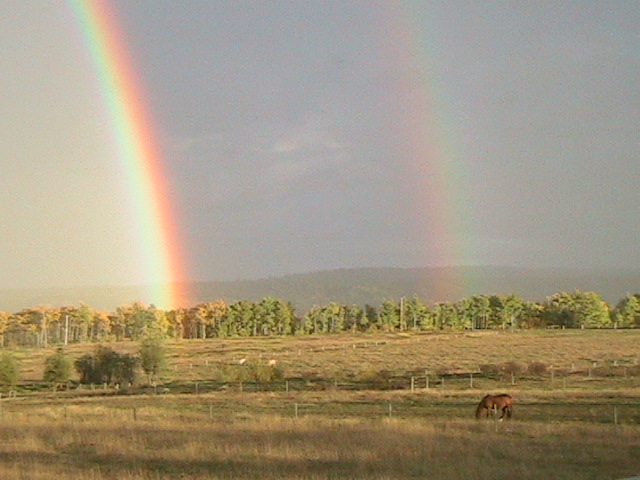
    The picture below here is what I see from my backyard when mist and rain has fallen.


    So here you have it. A couple of views of nature that have been exemplifed in our search for understanding. What does this all reveal to you? Well, that's the continung saga of what the depth of perception has endowed all us human beings, as we look ever deeper into the nature of the cosmo, and the beginning of this universe.

    While we had been given the Sun to look at in one of it's diverse ways, I wanted and did show that meeting the views of how we look at things. That it had been extended, by understanding the "valuation of the energy" as it has ensued from the very heart of what that burning sun is. How we gain immediate results, not ony in the particle showers, but of what evidence we have lain before us, as the physical outcome, as we look from space, and how, we look from earth.

    See:

  • SOLAR B and Van Ellen Belts
  • Tuesday, October 17, 2006

    A new LHC experiment is born!

    The LHC experiments are mostly on a very grand scale, with huge detectors and collaborations of as many as 2000 people; however, LHCf, like TOTEM, is quite special. The detectors are much smaller and LHCf has an equally small collaboration of just 22 people. The collaboration led by Yasushi Muraki, with members from Japan, Italy and the US, has just finished testing its detectors.

    The focus of the experiment is to study the forward moving particles in the proton-proton collisions at the LHC. This will be used to compare the various shower models widely used to estimate the primary energy of ultra high-energy cosmic rays, with energy in the region of 1019 eV (10 billion billion electronvolts). When the proton-proton collisions occur at the LHC pions are produced just as in a cosmic ray air shower. The amount of these secondary particles produced at the LHC can be measured accurately with the LHCf detectors, since the energy and direction of the primary beam is well known. The data will then be compared with the models used by the cosmic ray community.

    Although discovered as long ago as 1912 by the Austrian physicist, Victor Hess, cosmic rays remain mysterious. In particular, physicists would like to know more about the origins of the very high energy cosmic rays, up to 1020 eV that have been observed during recent decades. Some important experiments, such as the Pierre Auger Cosmic Ray Observatory in Argentina (See CERN Courier, July/August 2006), the Telescope Array experiment in the US and the HESS experiment in Namibia are dedicated to this research (See CERN Courier, February 2005). The LHCf experiment aims to give some valuable data to input into these studies; many of the physicists participating in LHCf are also involved in these and other projects related to cosmic rays.

    The detectors of LHCf will be placed on either side at 140 m from the ATLAS interaction point. This location will allow for observation of particles at nearly zero degrees to the proton beam direction. The detectors consist of two towers of sampling calorimeters designed by Katsuaki Kasahara from the Shibaura Institute of Technology. Each of them is made of tungsten plates and plastic scintillators of 3 mm thickness for sampling.

    Many of the physicists from LHCf have reunited from the former SPS experiment UA7, which also focused on forward physics. The LHCf experiment will be simulating cosmic ray collisions nearly 1000 times more energetic than UA7 was able to access. The energy of proton collisions in the LHC will be equivalent to a cosmic ray of 1017 eV smashing into the atmosphere. Therefore, LHCf will use the LHC beams to test the interaction models of cosmic rays to higher accuracy.

    Did you know?

    Cosmic rays are charged particles, mainly protons, but also alpha particles (helium nuclei) or heavier nuclei that bombard the Earth's atmosphere from outer space. These nuclei collide with the nuclei in the upper atmosphere producing many secondary particles, which in turn collide with other nuclei in the lower atmosphere. This process continues in a cascade, producing a shower of billions of particles reaching the ground.

    Cosmic rays show a wide range of energy. The low energy cosmic rays are plentiful (many thousand per square metre every second), many of which come from the sun. The highest energy cosmic rays, up to 1020 electronvolts, are very rare, arriving at a rate of one per square kilometre per century! The source of ultra high energy cosmic rays remains a mystery, as the primary ray seems to come from all directions.


    This, when we had thought science was at an end?