Sunday, August 23, 2015

Shut Up and Calculate

I think its the Feynman approached the work of Dirac by using Feyman diagrams to illustrate a mapping of the interactions. Now to me the visualization techniques are much as Feynman puts it, where okay you are an alien, how would you approach the world and you see Feynman comes up with the method.....I think reiterating what his Father said to him.


Paul Dirac

When one is doing mathematical work, there are essentially two different ways of thinking about the subject: the algebraic way, and the geometric way. With the algebraic way, one is all the time writing down equations and following rules of deduction, and interpreting these equations to get more equations. With the geometric way, one is thinking in terms of pictures; pictures which one imagines in space in some way, and one just tries to get a feeling for the relationships between the quantities occurring in those pictures. Now, a good mathematician has to be a master of both ways of those ways of thinking, but even so, he will have a preference for one or the other; I don't think he can avoid it. In my own case, my own preference is especially for the geometrical way.
http://atomicprecision.com/Topics/Pa...20Geometry.pdf
So Feynman's series sort of helps you to set your self up in such a way in order to see that perception has to be ignited in such a way as to ask question in a the approach he discusses.


I always used these geometrical ideas for getting clear notions about relationships in relativity although I didn’t refer to them in my published works.Oral History Transcript — Dr. P. A. M. Dirac
So for Dirac to to help us understand anti-matter as symbol within the matrices, beauty in the analytical way, also needs as good way to visualize what he was doing. IN the same breathe Penrose uses Riemann sphere to elucidate the geometry as a sister approach to developing his thoughts regarding the universe. A geometrical underpinning.


[ROGER PENROSE]

"One particular thing that struck me... [LAUGHTER]...is the fact that he found it necessary to translate all the results that he had achieved with such methods into algebraic notation. It struck me particularly, because remember I am told of Newton, when he wrote up his work, it was always exactly the opposite, in that he obtained so much of his results, so many of his results using analytical techniques and because of the general way in which things at that time had to be explained to people, he found it necessary to translate his results into the language of geometry, so his contemporaries could understand him. Well, I guess geometry… [INAUDIBLE] not quite the same topic as to whether one thinks theoretically or analytically, algebraically perhaps. This rule is perhaps touched upon at the beginning of Professor Dirac's talk, and I think it is a very interesting topic."
http://atomicprecision.com/Topics/Pa...20Geometry.pdf
So this is my suspicion and I am not sure many share it. It goes back to when Penrose's talks about cohomology and he illustrates, Penrose's triangle. How would he get anyone to see the way he does and point out the difficulties and say, maybe you have an answer, because I do not know? Your invited?


So you develop a model, and lets call it a virtual reality. Once you climb on board how will your world view have changed that the things you answer seem so different, had you not answer the question without such a bias? A alien really, I think this was quite suggestive of Feynman to help others see away into what he was doing.


Feynman:

‘Maxwell discussed … in terms of a model in which the vacuum was like an elastic … what counts are the equations themselves and not the model used to get them. We may only question whether the equations are true or false … If we take away the model he used to build it, Maxwell’s beautiful edifice stands…’ – Richard P. Feynman, Feynman Lectures on Physics, v3, c18, p2.
Shut Up and Calculate, you get what was meant.

Maybe, you will invoke different models with analytical functions in order to help you see differently, add perspectives that without considering Feynman's approach, this advancement in thinking would not take place. We get to these points and move the goal post(we get stuck), in order to see where the ole timers left off, and prepares for the next generation of thinkers? Feynman came to the realization on his own by correlating insights over a span of hundreds of years, by himself, not with others, so how did he do that? He is telling us. Like Penrose is telling us, requires visualization capabilities that have already been mapped and can be mapped to higher dimensions? What purpose to see Adinkras that will light the way toward.....???????


Beauty is understood then, when it came to pass, Dirac's equations lead the way, and Little did we know how Dirac actually used his perception. It propelled him forward, as it does for Penrose, but the beauty remains, and how far forward will somebody else with vision help us toward the next step?

 So cosmological you are looking to the past? You look up at the night sky and when were all these messages received in the classical sense but to be an observer of what happened a long time ago.

Synchronicity

In his book Synchronicity (1952), Jung tells the following story as an example of a synchronistic event:

My example concerns a young woman patient who, in spite of efforts made on both sides, proved to be psychologically inaccessible. The difficulty lay in the fact that she always knew better about everything. Her excellent education had provided her with a weapon ideally suited to this purpose, namely a highly polished Cartesian rationalism with an impeccably “geometrical” idea of reality. After several fruitless attempts to sweeten her rationalism with a somewhat more human understanding, I had to confine myself to the hope that something unexpected and irrational would turn up, something that would burst the intellectual retort into which she had sealed herself. Well, I was sitting opposite her one day, with my back to the window, listening to her flow of rhetoric. She had an impressive dream the night before, in which someone had given her a golden scarab — a costly piece of jewellery. While she was still telling me this dream, I heard something behind me gently tapping on the window. I turned round and saw that it was a fairly large flying insect that was knocking against the window-pane from outside in the obvious effort to get into the dark room. This seemed to me very strange. I opened the window immediately and caught the insect in the air as it flew in. It was a scarabaeid beetle, or common rose-chafer (Cetonia aurata), whose gold-green colour most nearly resembles that of a golden scarab. I handed the beetle to my patient with the words, "Here is your scarab." This experience punctured the desired hole in her rationalism and broke the ice of her intellectual resistance. The treatment could now be continued with satisfactory results.[16]
and:

...events are "meaningful coincidences" if they occur with no apparent causal relationship, yet seem to be meaningfully related.
Bold and underlined added by me for emphasis.

Yes you can see how the world of the woman by an event, knocked her out of her orbit?

.......in events given by deja Vu, this is a lining up of the information that exists in the mathematical/dream world to events as a classical description? The causal connection can seem totally unrelated, in the case that natural world described as the classical, can intercede with the mental realm of ones thought with such precision as to its timing.

I had an event, given that I was lost in the mental realm of deep thought, and the correlation of cognition as to an event, did happen and materialized in that same exact moment. You have to understand that you are aware of this deeper level of action going on underneath the existence of the material world.


Immanuel Kant, in the Critique of Pure Reason, described time as an a priori intuition that allows us (together with the other a priori intuition, space) to comprehend sense experience.[60] With Kant, neither space nor time are conceived as substances, but rather both are elements of a systematic mental framework that necessarily structures the experiences of any rational agent, or observing subject. Kant thought of time as a fundamental part of an abstract conceptual framework, together with space and number, within which we sequence events, quantify their duration, and compare the motions of objects. In this view, time does not refer to any kind of entity that "flows," that objects "move through," or that is a "container" for events. Spatial measurements are used to quantify the extent of and distances between objects, and temporal measurements are used to quantify the durations of and between events. Time was designated by Kant as the purest possible schema of a pure concept or category. Time
If we examined the nature of time in regards to what can exist in two places at one time what would relegated the experience so as to confirm a connection with nature's animal with one's internal experience?

So one perceives experience in life as lining up with other people blending with them, but the true value of the synchronize event is not really understood this way. What is the scarab's role "as a another group of people," following the same path way to merge with yours? Do we say the scarab and people, are the same thing?

 Now of course as I think deeper on this subject questions arise as to how one may see the world of dream time? This is so as to suggest that patterns are arising from a different world then the one we awaken too. So how do such patterns in seeing allow us to see and have precognitive events of what is to come? Just some thoughts then in regard to what happens in a irrational state so as to suggest that quantum cognition is operating in these areas where patterns are emerging?

Can such an allocation of the mathematical realm ensue into the world of the classical in such a way as to describe that the mathematical world and dream time are on the same plain? As consciousness is exploring what affects could contain the idea of a mathematical realm distant from the affect of emotions that hold consciousness close, and in such an inspiration state allow consciousness to move beyond the containment aspect of a negative emotion?

So elements of the expression of the physical world are being manipulated if I am to say, that would lead some to believe that there is no free will, yet we live lives that are not always synchronized with the pattern developed, so as having chosen a different Path?


Jung, in conjunction with the physicist Wolfgang Pauli, explored the possibility that his concepts of the archetype and synchronicity might be related to the unus mundus - the archetype being an expression of unus mundus; synchronicity, or "meaningful coincidence", being made possible by the fact that both the observer and connected phenomenon ultimately stem from the same source, the unus mundus.[2]
https://en.m.wikipedia.org/wiki/Unus_mundus


In 1952, he(Jung)published a paper "Synchronizität als ein Prinzip akausaler Zusammenhänge" (Synchronicity – An Acausal Connecting Principle)[4] in a volume which also contained a related study by the physicist and Nobel laureate Wolfgang Pauli.[5]
How is causality a connect in the case of the meaning of our experiences? The example given of the woman in OP and the scarab? Maybe, it could be explained away as coincidence? See also : https://en.m.wikipedia.org/wiki/Caus...ng_(Psychology)

***

Feynman used his cognition skills to invent things that already happened in order to develop his skill as a scientist. He had to teach himself how discoveries were arrived at, without following the trajectory of the discoverers. This correlation of cognition sets up his confidence skills so as to pursue how he saw the world, and how he could simplify the interaction of such particles, as to say, these are feynman diagrams.


Regarding the quote of Einstein's reminded me of Dirac and what he had to say.


You can picture all the directions in Minkowski space as the points in a three-dimensional projective space. The relationships between vectors, null-vectors and so on - - and you get at once just the relationships between points in a three-dimensional vector space. I always used these geometrical ideas for getting clear notions about relationships in relativity although I didn’t refer to them in my published works.Oral History Transcript — Dr. P. A. M. Dirac -https://www.aip.org/history/ohilist/4575_2.html


Yes I was looking into Jim Gate's Adinkras. But regarding your observations I am looking.( https://youtu.be/b6w0K5FIgsU?t=29m22s ) What beauty emerges and you understand what a story does to helping to change perspective about a topic. That this is totally devoid of the materialistic notion that art can bring toward our understanding of what lies in the realm of ideas, all of a sudden blossoms on screen as color.

Such shifts in perspective have been understood with regard to sonification, as color. While it has a history this bend toward the mystical, it is a valid correlation when see light as a chaldni plate recording shape with sound. Such distinctions, in there own right serve to illustrate a collapse of the wave function?


"When I see equations, I see the letters in colors – I don't know why. As I'm talking, I see vague pictures of Bessel functions from Jahnke and Emde's book, with light-tan j's, slightly violet-bluish n's, and dark brown x's flying around. And I wonder what the hell it must look like to the students." Feynman, Richard. 1988. What Do You Care What Other People Think? New York: Norton. P. 59.
So what is needed to step outside the box figuratively?? What did Jim Gates and the crew do?

So, here are nice youtube interview videos of Feynmen that you might enjoy.

Feynman: Take the world from another point of view (1/4)

https://youtu.be/PsgBtOVzHKI
https://youtu.be/xnzB_IHGyjg
https://youtu.be/uNOghidK2TY
https://youtu.be/mvqwm6RbxcQ

 The point(This is synesthesia-yes I know) is that when you look from different perspective and remain open to information you get insights as to the way in which the storyteller provides a new platform for you. Same as Jim Gates and the Adinkras. You do not have to believe its real or not but the ideas arise out of a place that we may call irrationality, but the beauty of information does now settle into the mind. Do you understand what I am saying....I am using synesthesia as an example. Its not a vase, but a face. A cube, can shift your perspective.

Cross wiring in the brain allows this attribute of synesthesia to bring a new perspective to the reality, yet, it is still a sensual example of our participation in the real world of senses. You have to be able to shift perspective, to be able to garner new points of view.


The quantum-like brain on the cognitive and subcognitive time scales Khrennikov, Andrei Växjö University, Faculty of Mathematics/Science/Technology, School of Mathematics and Systems Engineering. Matematik. (Matematik) 2008 (Swedish)In: Journal of consciousness studies, ISSN 1355-8250, Vol. 15, no 7, 39-77Article in journal (Refereed) Published


This article takes as its point of departure the view that the discovery of the mathematical formalism of quantum mechanics (QM) was not merely a discovery of a new mathematical way of dealing with physical, and specifically quantum, processes in nature. It was also a discovery of a general mathematical formalism (in part discovered in mathematics itself earlier), which, supplemented by certain additional rules, consistently described the processing of incomplete information about certain events and contexts in which these events occur. This article proposes a quantum-like (QL) model of the functioning of the brain based on the (Hilbert-space) formalism of quantum mechanics, but now used as part of a QL mathematical model of neural processes in the brain, rather than for describing quantum physical processes. This model is, thus, fundamentally different from the (reductionist) quantum model of the brain and consciousness, according to which cognition arises by virtue of physical quantum processes in the brain. In the present view, the brain is an advanced biological system that developed the ability to create a QL representation of contexts, which, thus, allows one to describe a significant part of its functioning by the QM mathematical formalism. The possibility of such a description has nothing to do with the constitution and workings of the brain as a quantum system (composed of photons, electrons, protons, and so forth). The QL model offered here is based instead on conventional neurophysiological model of the functioning of the brain, even though the brain, the article suggests, does use the QL rule (given by von Neumann trace formula, used in QM) for the calculation of approximate averages for mental functions. The QL model developed in this article has a temporal basis, based on a (hypothetical) argument that cognitive processes are based on at least two time scales: a (very fine) subcognitive one and a (much coarser) cognitive one.
I see the Quantum Cognition community as being different then the one examining quantum mechanics in biology. Remember Quantum Robin? In this respect I may be mistaken, is where Penrose and Hameroff operate as to identifying an operation in the biology, yet, the neurological affect is an attribute of the erasure experiment in observation, versus not observing. The experiment is recording whether you are aware or not.

 If your animal is a scarab(not a drunk) or really a life's event is a "collision course with an animal" at the exact same time you are thinking about it? A collision course with the real world was inevitable given that you were unaware of the significance of the association between what happens in the mental realm and what is seen as irrationality given that we can see beyond the classical modern day experience. You are establishing patterns beyond ones everyday association with reality in the classical way. So, what came first?


The QL model developed in this article has a temporal basis, based on a (hypothetical) argument that cognitive processes are based on at least two time scales: a (very fine) subcognitive one and a (much coarser) cognitive one. -http://lnu.diva-portal.org/smash/record.jsf;jsessionid=qJt9jdFI-202NxWQUAnl3qzjYQAuLs7RROnBiNiU.diva2-search1?pid=diva2%3A203825&dswid=781
Jung had already referenced the Unus Mundus, and what value a archetype, as a messenger of what is created by you to help reveal such a pattern?

Tuesday, August 04, 2015

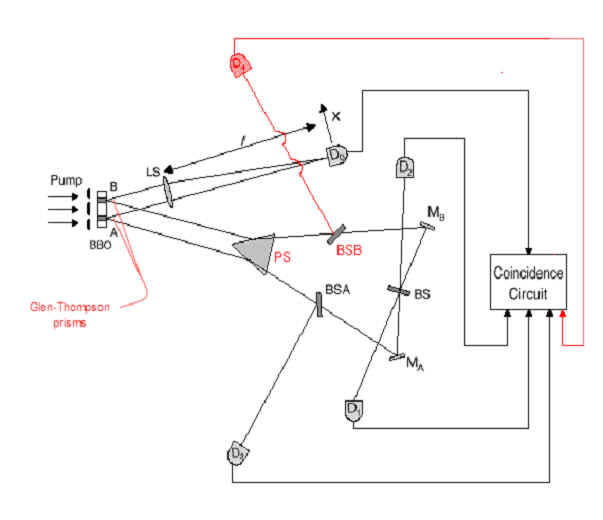
Quantum Cognition further explained?


Click the image to open in full size.
This paper reports a "delayed choice quantum eraser" experiment proposed by Scully and Drühl in 1982. The experimental results demonstrated the possibility of simultaneously observing both particle-like and wave-like behavior of a quantum via quantum entanglement. The which-path or both-path information of a quantum can be erased or marked by its entangled twin even after the registration of the quantum. -http://www.bottomlayer.com/bottom/kim-scully/kim-scully-web.htm#fig2
Bold added by me for emphasis


So you keep this diagram in mind. We then go to looking at this other linked video.

The understanding of the word "erasure," needs to be clarified in relation too, diagrams.

Yes, since sub-atomic particles are actually 'probability distributions' prior to being measured - all possible positions and states are part of their potential until the 'collapse' of the wave function. https://en.wikipedia.org/wiki/Path_integral_formulation -comment section of video
So consider this for example. Space time arises from a 5d world. Unification of quantum gravity and light, allow us to have a 4 dimensional understanding of the classical world. If you assume that a 2d screen is a 5D world, then what happens behind the screen?


Similarly, the laws of gravity and light seem totally dissimilar. They obey different physical assumptions and different mathematics. Attempts to splice these two forces have always failed. However, if we add one more dimension, a fifth dimension, to the previous four dimensions of space and time, then equations governing light and gravity appear to merge together like two pieces of a jigsaw puzzle. Light, in fact, can be explained in the fifth dimension. In this way, we see the laws of light and gravity become simpler in five dimensions.Kaku's preface of Hyperspace, page ix para 3
Is it a materialistic view you encounter, or perhaps a point of view you establish by your choice of perceptible qualities that exist for you now?? Given there is a potential for meaning, then, one "same" meaning could not have been encountered by all, for it leaves room for probability encounters, that reveal different views of the world.....yet, some will get the probable meaning, as to what exactly I am saying.

Quantum Theory, is not a materialistic point of view.

***

 The path of least resistance from a the path of probable outcomes?

What would this look like if we were to say such traveling paths through the cosmos were defined by the paths of least resistance versus a probability paths. Clumping, or interference. If you understand what I am writing then please comment. I would like my thinking to be destroyed by your reason and your science, or you can help clear up misconceptions that are forming wrongly as a Bad idea.


In non-relativistic physics, the principle of least action – or, more accurately, the principle of stationary action – is a variational principle that, when applied to the action of a mechanical system, can be used to obtain the equations of motion for that system by stating a system follows the path where the average difference between the kinetic energy and potential energy is minimized or maximized over any time period. It is called stable if minimized. In relativity, a different average must be minimized or maximized. The principle can be used to derive Newtonian, Lagrangian, and Hamiltonian equations of motion. It was historically called "least" because its solution requires finding the path that has the least change from nearby paths.[1] Its classical mechanics and electromagnetic expressions are a consequence of quantum mechanics, but the stationary action method helped in the development of quantum mechanics.-https://en.wikipedia.org/wiki/Principle_of_least_action

***


Maybe I should insert here how we might look at gravitational lensing and gravitation field influences as to how that lensing can distort or divert the photon's path.......just another way to look at the way gravitational influences affect the photon's path.....to see that the least resistance could as a affect not deviate speed of light in one of those tunnels as a way in which to determine satellite travel? Should there be a correction here?

My assumptions are generalizations, so I needed to look further to understand this relationship in regards to abstractions and how one can see in different ways. I wanted to see as far as I could in correspondence with the physics, to understand what quantum theory may mean if and when united with gravity as to a correspondence to dimensional references.
Today, however, we do have the opportunity not only to observe phenomena in four and higher dimensions, but we can also interact with them. The medium for such interaction is computer graphics. Computer graphic devices produce images on two-dimensional screens. Each point on the screen has two real numbers as coordinates, and the computer stores the locations of points and lists of pairs of points which are to be connected by line segments or more complicated curves. In this way a diagram of great complexity can be developed on the screen and saved for later viewing or further manipulation From Flatland to Hypergraphics: Interacting with Higher Dimensions -http://www.geom.uiuc.edu/~banchoff/ISR/ISR.html
The simulation argument for me needed to be understood better as well, so the 2d screen needed for me to be further explained as pixels are used to highlight the depth of our abstractions. Banchoff demonstrations in terms of the geometry as an abstraction in geometry for instance. Topology.


Similarly, the laws of gravity and light seem totally dissimilar. They obey different physical assumptions and different mathematics. Attempts to splice these two forces have always failed. However, if we add one more dimension, a fifth dimension, to the previous four dimensions of space and time, then equations governing light and gravity appear to merge together like two pieces of a jigsaw puzzle. Light, in fact, can be explained in the fifth dimension. In this way, we see the laws of light and gravity become simpler in five dimensions.Kaku's preface of Hyperspace, page ix para 3
There is then this being incompatible with each other( gravity and Quantum Theory) that has been talked about that Einstein was after in explaining things in terms of materialism, and to find, that Quantum theory is not a materialist explanation. So I find Einsteins attempts and recognition in later life as a step toward the need for such unification.

As an example, your screen you are working on is a 2d example of a 5d reality. Can we indeed create mathematical reality of higher abstractions? What does that mean anyway? Thomas Banchoff demonstrates geometrical imaging on 2d screens?


Where would these other universes be in relation to ours? Is there a way to envision it? Well, we live in three spatial dimensions: We move back and forth, up and down, left to right. And then there's time, so that's our four-dimensional universe. Another universe might be essentially right next to ours by going in another direction that's not one of those four. We might call it "another kind of sideways." See: Riddles of the Multiverse
-http://www.pbs.org/wgbh/nova/physics/johnson-multiverse.html
This screen has no depth other then the representations that we see are on this screen. You can call them pixels. What does a 5d world mean? In essence this is not about materialism anymore but a grasp for uniting space time with quantum theory? The 2d screen is derived from a 5d reality.

The understanding then sought for is that gravity and light are connected in a 5d world. Is a photon affected as it travels through a gravity field? What did Einstein mean as to a slide of light?


"Yet I exist in the hope that these memoirs, in some manner, I know not how, may find their way to the minds of humanity in Some Dimensionality, and may stir up a race of rebels who shall refuse to be confined to limited Dimensionality." from Flatland, by E. A. Abbott

Friday, June 26, 2015

Neurobiological Affect of Quantum Processes

I am assuming the neurobiology affect of quantum processes already is an an example of the process itself, if it uses quantum mechanical processes as interference.


Abstract:
Processes undergoing quantum mechanics, exhibit quantum interference effects.In this case quantum probabilities result to be different from classical probabilities because they contain an additional main point that in fact is called the quantum interference term. We use ambiguous figures to analyse if during perception cognition of human subjects we have violation of the classical probability field and quantum interference. The experiments, conducted on a group of 256 subjects, evidence that we have such quantum effect. Therefore, mental states, during perception cognition of ambiguous figures, follow quantum mechanics.
pg 2 -Mental states follow quantum mechanics during perception and cognition of ambiguous figures. -


The use of eeg machinery is already established as interferences patterns, hence, brain wave patterns?

However neuroscience finds it hard to identify the crucial link existing between empirical studies that are currently described in psychological terms and the data that arise instead described in neurophysiological terms. Mental states follow quantum mechanics during perception and cognition of ambiguous figures


A question that may arise is, as to the definitive state of entanglement as an ambiguous figure. While interference affects as ambiguous perceptions, which arise as mental patterns as wave forms prior too? Thus, the collapse of the wave function, as an entanglement.


An indication arises from quantum mechanics. Quantum theory represents the most confirmed and celebrated theory of science. Started in 1927 by founder fathers as Bohr, Heisenberg, Schrödinger, and Pauli, it has revolutionized our understanding of the physical reality in both scientific and epistemological fields. pg 5


The image recognition could be characterized by synchronization of firings in a neural network responsible for image recognition. Such a synchronization may be conceived as a stabilization to a fixed frequency of firings, and thus can be considered as a version of the collapse of the wave function. pg 8

Ambiguous Perception


Ambiguous perception. A good example is bistable perception, which concerns alternating views of ambiguous figures, such as the Necker cube. Atmanspacher, Filk, and R€omer (2004) and Atmanspacher and Filk (2010) developed a detailed model describing a number of psychophysical features of bistable perception that have been experimentally demonstrated. In addition, Atmanspacher and Filk (2010, 2013) predicted that particular distinguished states in bistable perception may violate the temporal Bell inequalities—a litmus test for quantum behavior. Other research applying quantum theory to perception of ambiguous figures has been carried out by Conte et al. (2009).pg 9 -http://www.thedocc.com/wp-content/uploads/2015/02/J18.-Wang-et-al-2013-quantum-cognition.pdf


The lines can change perspective and position.... as if the cube is protruding outward or inward(The orientation of the Necker cube can also be altered by shifting the observer's point of view. When seen from apparent above, one face tends to be seen closer; and in contrast, when seen from a subjective viewpoint that is below, a different face comes to the fore) as to describe it's geometric shape. Other examples here can be found(Rubin's vase -(These types of stimuli are both interesting and useful because they provide an excellent and intuitive demonstration of the figure–ground distinction the brain makes during visual perception.).


The Necker cube is used in epistemology (the study of knowledge) and provides a counter-attack against naïve realism. Naïve realism (also known as direct or common-sense realism) states that the way we perceive the world is the way the world actually is. The Necker cube seems to disprove this claim because we see one or the other of two cubes, but really, there is no cube there at all: only a two-dimensional drawing of twelve lines. We see something which is not really there, thus (allegedly) disproving naïve realism. This criticism of naïve realism supports representative realism. Necker cube -http://en.wikipedia.org/wiki/Necker_cube#Epistemology


Bold added to emphasize, direct and indirect realism- a dualism I believe occurs here, points toward the foundation, as Bohr looking at William James which lead to Heisenberg Uncertainty principal(Quantum Cognition and Bounded Rationality PG 27 to Pg 30)....and other assumptions.

There are no phenomenological experiments to suggest quantum cognition is real other then to see how the model works in relation too, questions and answers, or, to declare entanglement as a self evident state in my view.

The Necker cube is a paradigmatic example for bistable perception where pattern reversal obeys a particular probability distribution. Atmanspacher, Filk and Römer (2004) discussed this switching dynamics in terms of the quantum Zeno effect where “observation” (here attending to a percept) increases the dwell-time of an otherwise fast decaying unobserved state. Quantum Cognition, Bistable perception


Regarding consciousness then.

For example, subjects who stare continuously at a Necker cube usually report that they experience it "flipping" between two 3D configurations, even though the stimulus itself remains the same.[72] The objective is to understand the relationship between the conscious awareness of stimuli (as indicated by verbal report) and the effects the stimuli have on brain activity and behavior. In several paradigms, such as the technique of response priming,.[73] the behavior of subjects is clearly influenced by stimuli for which they report no awarenessConsciousness -


Awareness as irrationality shows then, that such information as to reaching our cognitive status as irrationality, can move to identify with a self evident position. This may help to show the process of inductive deductive relationship which leads to an over arching position as to being self evident. Aristotle, did not jettison Plato.

Wednesday, June 24, 2015

Contextualization and Ambigous Perception

The first, “contextuality,” is a way to understand interference effects found with inferences and decisions under conditions of uncertainty. The second, “quantum entanglement,” allows cognitive phenomena to be modelled in non-reductionist ways. Quantum Models of Cognition and Decision (PDF)


Yes contextualization matters, and it is not just the math, but avenues to understanding depth psychology. This distinction was pointed out twice on rationality with regard perception and Jung, as it was written by Blutner ( -http://www.blutner.de ) One might find some information on his personal interests that I presented as a paper written by him that might help.

I did not mention his interest to music for further research (Modelling tonal attraction: Tonal hierarchies, interval cycles, and quantum probabilities.) I mentioned the Necker Cube for a reason. If it is not an entangle state what does contextual mean? "Spread out" as if a parable? What is the essence of the parable as it is taken to mean to you becomes the entangled state. What did you get from it? Alternating back and forth the Necker Cube becomes an example of this process to say, how one can transfer back and forth between contextualize and the entanglement.
In the present literature, there are several approaches that seek for a general justification of quantum probabilities in the context of cognitive science. For example, Kitto (2008) considers very complex systems such as the growth and evolution of natural languages and other cultural systems and argues that the description of such systems cannot be separated from their context of interaction. She argues that quantum interaction formalisms provide a natural model of these systems “because a mechanism for dealing with such contextual dependency is inbuilt into the quantum formalism itself”. Hence, the question of why quantum interaction is necessary in modelling cognitive phenomena is answered by referring to its nature as a complex epistemic system. Quantum Cognition -

Bold and underline added by me for emphasis

See also videos at ICI Berlin by Harald Atmanspacher as listed. https://www.ici-berlin.org/videos/atmanspacher/part/1/
It is widely accepted that consciousness or, more generally, mental activity is in some way correlated to the behavior of the material brain. Since quantum theory is the most fundamental theory of matter that is currently available, it is a legitimate question to ask whether quantum theory can help us to understand consciousness. Several programmatic approaches answering this question affirmatively, proposed in recent decades, will be surveyed. It will be pointed out that they make different epistemological assumptions, refer to different neurophysiological levels of description, and use quantum theory in different ways. For each of the approaches discussed, problematic and promising features will be equally highlighted.Quantum Approaches to Consciousness -


As related earlier, if it's not in the brain where and how is quantum theory being used?

Tuesday, June 09, 2015

Peering into a Blackhole


See:Peering Into a Blackhole

Before Making a descision

Thinking means evaluating information or ideas rationally and logically. Jung called this a rational function, meaning that it involves decision making or judging, rather than the simple intake of information. Feeling, like thinking, is a matter of evaluating information, this time by weighing one’s overall emotional response. Sensing means what it says: getting information by means of the senses. A sensing person is good at looking and listening and generally getting to know the world. Jung called this an irrational function, meaning that it involved perception rather than judgment of information. INtuiting is a kind of perception that works outside of the usual conscious processes. It is irrational or perceptual, like sensing, but comes from the complex integration of large amounts of information, rather than simple seeing or hearing. Jung said it was like seeing around corners.4 Two qubits for C.G. Jung’s theory of personality R. Blutner, E. Hochnadel / Cognitive Systems Research 11 (2010) 243–259 (pdf)

The contextualization of this example above in quote may help to see how Quantum Cognition is understood from my perspective. If you are aware of such a state as INtuiting, and if irrationality is to be discerned from such an examination, how is it possible to receive the understanding as, "judgement and decision, and even belief, before it is made. Before one becomes entangled? To withhold Judgement, as if to exist in such a state, means that information, is retained,  as if a parable, and while holding the information "in that state," aware of what can happen if you become entangled?

Fig. 1. Two pairs of opposite psychological functions: Thinking and Feeling [rational opposites], Sensation/iNtuition [irrational opposites]. Jung takes this two-dimensional representation in order to demonstrate the dependencies between the psychological functions. For example, Thinking and Feeling are opposites and conflict with each other (assuming one fixed attitude). However, their effect can be modified by using the irrational functions (Sensation and iNtuition, respectively). The numbers enumerate eight sectors in dependence of what are the two dominant functions (see Table 1 and the associated text for more explanations). See Paper above for information

One has to know in advance that such a decision entangles and that the understanding of the Necker cube in advance, gives an alternating relation of the parable and entanglement, as a choice before the entanglement happens.
***

In abstraction, information is liken too, the ability to gather information. You are not making a decision other then to present the equation as a source of information. This is currently be described as the quantifiable. It is a parable of sorts,  until,  the equation leads to a pure state. A self evident state. Then,  you are entangled.


So are people just incapable of thinking logically? Maybe. But in recent years a number of investigators have developed the view that those supposedly irrational choices merely reflect the fact that people’s brains are guided by the mathematical principles of quantum physics. Quantum math makes human irrationality more sensible

***


See Also:


Thursday, June 04, 2015

Holographic Universe, The Secret beyond Matter.

Now you must understand while this supposed question of the understanding behind a Platonist heaven has some place here in the conversation, I had been pushing forward.  I am of course interested in the science, so as to understand reality. So what follows has been on the books of metaphysics for sometime it seems. I want to clarify these thoughts and ideas in context of today's science. What is truth and what is not.


This video had been cut to form "another video." It is important to see how this was done. Go to the time of the original video on display of 20:15 and see where this continues in second video.

Perception, is an interesting subject.


Yet logically another non-dual option remains, namely virtualism, that a mind-independent, non-physical reality outputs the physical world by processing. In this admittedly radical view, the "ghostly" world of quantum theory is real and the physical world is like a screen image thrown up The Virtual Reality Conjecture -http://arxiv.org/ftp/arxiv/papers/1110/1110.3307.pdf


On page 16 of VR conjecture I noticed a link at bottom of page that lead me to a video that I thought interesting. But, at the same time, the end, was quite shocking( See: The Real Absolute Being at 20:15)

The shift over to a universal permanence by name, had me wondering how many had jumped the gun, to have given this reality, a name? Advanced the issue of religion, as was entitled by name to see that it occupied, as if a place. A place in Plato's Heaven. So you choose who by name your (Absolute Real Being), Metaphysics has then lead us to this?

But honestly, you have to see the first part up to 20:15 and especially at 15:26 with regard to the perceived. Now, how guilty should I have been to see that I held some similar belief, that I may refer to the Platonist heaven as a function of the wave, now sees some Islamic fundamentalism that takes hold. No, it does not have to go by the name of Allah as it is spoke of by inference as that of the Holy Grail, in original video?

So while having been deflected as to follow a link on a page, the real issue here is what the first part of the video is speaking too. Any problems with this to help identify the Self?

Now of course how this video was used is important.  The issue of Quantum cognition is important to see some perspectives as they have been revealed  as metaphysical as well an understanding that we are in need of qualifying the process of sight, as issues of Quantum Theory?

***


Quantum Models of Cognition and Decision Much of our understanding of human thinking is based on probabilistic models. This innovative book by Jerome R. Busemeyer and Peter D. Bruza argues that, actually, the underlying mathematical structures from quantum theory provide a much better account of human thinking than traditional models. They introduce the foundations for modelling probabilistic-dynamic systems using two aspects of quantum theory. The first, “contextuality,” is a way to understand interference effects found with inferences and decisions under conditions of uncertainty. The second, “quantum entanglement,” allows cognitive phenomena to be modelled in non-reductionist ways. Employing these principles drawn from quantum theory allows us to view human cognition and decision in a totally new light. Introducing the basic principles in an easy-to-follow way, this book does not assume a physics background or a quantum brain and comes complete with a tutorial and fully worked-out applications in important areas of cognition and decision. Quantum Models of Cognition and Decision -
Also see here (Quantum Models of Cognition and Decision -  Bold and underlined added for emphasis by me.

In relation to the parable and what is distinct in the parable, was an example that I thought to bring forward as I understood it. This help me to see how quantum cognition is used(contextualized and entangled") and are looked at. Without a reductionist view, entangled takes on new meaning as to make a judgement or a decision. To make a distinction, means that in the parable you have decided, while interference, is a type of wave. The necker Cube is important here.

The Necker cube is used in epistemology (the study of knowledge) and provides a counter-attack against naïve realism. Naïve realism (also known as direct or common-sense realism) states that the way we perceive the world is the way the world actually is. The Necker cube seems to disprove this claim because we see one or the other of two cubes, but really, there is no cube there at all: only a two-dimensional drawing of twelve lines. We see something which is not really there, thus (allegedly) disproving naïve realism. This criticism of naïve realism supports representative realism. Necker cube -
Bold added to emphasize, direct and indirect realism. Again, I am not qualified to the extent to say parable is a good example, but, I think this will help greatly to look at as an example and the Necker cube, as given in the following quotes.

The Necker cube is a paradigmatic example for bistable perception where pattern reversal obeys a particular probability distribution. Atmanspacher, Filk and Römer (2004) discussed this switching dynamics in terms of the quantum Zeno effect where “observation” (here attending to a percept) increases the dwell-time of an otherwise fast decaying unobserved state. Quantum Cognition, Bistable perception -
I think by giving examples one might understand this better, and I wonder if there are others who understand, who can help describe the physics of, in the way it was here. Quantum theory is essential here then. Judgement and decisions, are entangled states.

Sunday, May 31, 2015

Quantum Cognition

Niels Bohr, one of the founding fathers of quantum physics, suspected that it could provide insights into human psychology. Now a new field called quantum cognition is exploring how quantum math can explain some seemingly irrational human behavior. See: Quantum math makes human irrationality more sensible


Quantum cognition community states that the activity of such neural networks can produce effects which are formally described as interference (of probabilities) and entanglement. In principle, the community does not try to create the concrete models of quantum (-like) representation of information in the brain
I would take note of ,"in the brain."

Saturday, May 30, 2015

Quantum Realism and Physical realism.


Experiments at RHIC and the LHC have complementary strengths in studying the quark-gluon plasma, a state of matter in which quarks come unbound. Image: Brookhaven National Laboratory. See also:
Experiments reveal new techniques in studying quark-gluon plasma

To an empiricist, reality means to make use of the sensory world and you have to be able to understand what rationality is to you. Rationality make uses of other ways in which to recognize that such pure states,  as they have been studied, help to see that such derivations do have a logical end.

In the form of the good,  there is no need to add anything else, but to wait and see how such pure states become an empiricists dream of reality. How does one divorce themselves of that other side of the reality of a quantum realism but to understand the physical realism is derived from that state? To understand a beautiful equation this understanding is necessary.

So what does it mean for an equation to be beautiful or elegant?

***

Monday, May 25, 2015

Consciousness as a Pure State


Life must be understood backwards; but... it must be lived forward.
Soren Kierkegaard

If consciousness is able to abstract, then consciousness is able to survive a heat death by going back to the beginning of the universe with those abstractions? Consciousness, is able to survive a heat death by mathematically abstracting, then ones consciousness can indeed reach a Pure State.


Since entropy gives information about the evolution of an isolated system with time, it is said to give us the direction of "time's arrow" . If snapshots of a system at two different times shows one state which is more disordered, then it could be implied that this state came later in time. For an isolated system, the natural course of events takes the system to a more disordered (higher entropy) state. -http://hyperphysics.phy-astr.gsu.edu/hbase/thermo/seclaw.html


The concept of entropy and the second law of thermodynamics suggests that systems naturally progress from order to disorder. If so, how do biological systems develop and maintain such a high degree of order? Is this a violation of the second law of thermodynamics? -http://hyperphysics.phy-astr.gsu.edu/hbase/thermo/bioentropy.html#c1

SeeChicken or the Egg Dilemma

***


Found a video for reference and posted for examination.Interesting comment at this moment?


So, what does Sir Roger Penrose say about consciousness?

So I may talk about a gap, but what is Stuart saying. So as a Platonist, we do not just see mathematics, but we see other things.

In a logical process, objective reductionism(ORCH) takes you to a certain point. Your aware of this point, and you can go back and look at the theory so as to suggest what consciousness is actually doing in that state. Penrose is actually telling us about the differences, regarding use of consciousness versus the computational view.

So with regard to this phenomenological association between two people, as Stuart and Sir Roger, they are melding "the abstract" to the biology. I asked if one could see a contradiction and I think if you look at what Stuart is saying here how does this fit with ideas about entropy?

So both of them were attack by philosophers, and by many others about their ideas.

Saturday, May 23, 2015

Dr. Amanda Peet on String Theory


Published on May 8, 2015
Dr. Amanda Peet (University of Toronto) delivers a public lecture on how string theory can provide the "Legos" of the universe to understand phenomena like black holes. The talk was held at Perimeter Institute on May 6, 2015. See: Perimeter Public Lecture: String Theory Legos for Black Holes

Friday, May 22, 2015

Pure States

The direct realist view [11] is incredible because it suggests that we can have experience of objects out in the world directly, beyond the sensory surface, as if bypassing the chain of sensory processing. The pattern of electrochemical activity that corresponds to our conscious experience can take a form that reflects the properties of external objects, but our consciousness is necessarily confined to the experience of those internal effigies of external objects, rather than of external objects themselves. Unless the principle of direct perception can be demonstrated in a simple artificial sensory system, this explanation remains as mysterious as the property of consciousness it is supposed to explain.[1] But the indirect realist view is also incredible, for it suggests that the world that we perceive is merely a pattern of energy in the physical brain inside our head. This could only mean that the head we have come to know as our own is not our true physical head, but merely a miniature copy of it inside a copy of the world contained within our true physical skull. outside.The external world and its phenomenal replica cannot be spatially superimposed, for one is inside your physical head, and the other is The existential vertigo occasioned by this concept of perception is so disorienting that only a handful of researchers have seriously entertained this notion or pursued its implications to its logical conclusion. (Kant 1781/1991, Koffka 1935, Köhler 1971 p. 125, Russell 1927 pp 137–143, Smythies 1989, 1994, current, Harrison 1989, Hoffman 1998, Lehar current, Hameroff current)"[1]
Direct and indirect realism

What is the value of an awareness of "a construct" that we would assign as a background a formulation of the perceived by the perceiver? An archetype, created? A top down recognition in the square of opposition's use of the transcendent which could reveal an understanding of the essence of universals in face of "statistical prediction" in today's world? Symmetry.

A digital manifestation perhaps then that is clearly marked as to a recognition of a type of realism, or is it just noise(coherence as a contradiction). I might say that the realism here suggests to me a underlying recognition of the ability to perceive, to recognize facets of it own creation as to suggest, that it is quite capable of its ability to perceive beyond the confines of the construct given as a reality.

 The connection between superfluidity and symmetry breaking has had a glorious history. It has left us a rich legacy of fertile ideas, that seems far from exhaustion. PG 60 Superfluidity and Symmetry Breaking
***

Yes there were thoughts about the nature of the gap and you had asked to me to define this. I had trouble doing so even though the nature of the reduction was a gap with which information to me was accessible.
"Penrose Physics, Microtubules & Consciousness
psyche-d / March 15, 1995 According to the arguments for OR put forth in Penrose (1994), superposed states each have their own space-time geometries (see Shadows of the Mind, p. 338). When the degree of coherent mass-energy difference leads to sufficient separation of space-time geometry, the system must choose and decay (reduce, collapse) to a single universe state [avoiding the need for multiple universes as discussed by, for example, Everett (1957) and Wheeler (1957)]. In this way, a transient superposition of slightly differing space-time geometries persists until an abrupt quantum to classical reduction occurs. If as various philosophers claim (cf. Chalmers, 1994; 1996) the nature of conscious experience is somehow embedded in the nature of reality, self-selections in fundamental space-time geometry may address the "hard problem" of consciousness.
Unlike the random, "subjective reduction" (SR, or R) of standard quantum theory caused by observation or environmental entanglement, the OR we propose in microtubules is a self-collapse and it results in particular patterns of microtubule-tubulin conformational ("eigen-") states that regulate neuronal activities including synaptic functions. Possibilities and probabilities for post-reduction tubulin states are influenced by factors including attachments of microtubule-associated proteins (MAPs) acting as "nodes" which tune and "orchestrate" the quantum oscillations. We thus term the particular self-tuning OR process in microtubules "orchestrated objective reduction" ("Orch OR"), and calculate an estimate for the number of tubulins (and neurons) whose coherence for relevant time periods (e.g. 500 milliseconds) will elicit Orch OR. Stuart Hameroff"
The Platonist reality to me was a recognition of a informational reality where all information exists as energy, and that such integration with the physical body was a connection through the synapse as a reductionist ability to form through wave length function.

The point I wanted to make was that it is was as if there are two heads, that if it could be seen, one head moves through a whole wave length function potential as if walking through an ocean of wavelength like reality called information and such reduction of that information had to have a link between the material world in the brain/mind. I am trying to gather my thoughts here. Be clearer.

My thought of a glass of water was analogous here to what can exist in between a space , and have solid matter added to the glass without raising the water, somehow had me envision the gap in the water, as revealing the potential of that matter as filling a space that was not immediately obvious, but exists.

Matter then is not a solid.....but a potential realization of a condensation of that wave function. I am not altogether clear here.....so I am working on this.

 I think it is right to point out universal permeate of that energy as information. Think of the pattern of the quasi-crystal as consolidating wavelength like pattern. A pure state. How much closer are we then to recognize a wavelike pattern(chaldni) as an emergent product pattern of the idea?

I am having some difficulties here in solidifying a position here as to it being completely sound, so I am open to having philosophical interaction to help make this so.

***

 Knowing Penrose's attribute toward a Platonist ideal, the Goldberg idea may have come from how he saw what could be happening within the cosmic background as demonstration cyclical to the universe as always being born in certain locations(CCC). While now showing this theory to be false as defined as circles and located in WMAP, one gets a sense of his thinking of a Platonist.

The answer lies in the fact that the high entropy of the microwave background refers only to the matter content of the universe and not to the gravitation field, as would be encoded in its space-time geometry in accordance with Einstein’s general relativity. What we find, in the early universe, is an extraordinary uniformity, and this can be interpreted as the gravitational degrees of freedom that are potentially available to the universe being not excited at all. As time progresses, the entropy rises as the initially uniform distribution of matter begins to clump, as the gravitational degrees of freedom begin to be taken up. BEFORE THE BIG BANG: ;AN OUTRAGEOUS NEW PERSPECTIVE AND ITS IMPLICATIONS FOR PARTICLE PHYSICS
Sir Roger Penrose was really fond of Escher .How might on see a relationship to Goldberg?
Penrose's Influence on Escher
During the later half of the 1950’s, Maurits Cornelius Escher received a letter from Lionel and Roger Penrose. This letter consisted of a report by the father and son team that focused on impossible figures. By this time, Escher had begun exploring impossible worlds. He had recently produced the lithograph Belvedere based on the “rib-cube,” an impossible cuboid named by Escher (Teuber 161). However, the letter by the Penroses, which would later appear in the British Journal of Psychology, enlightened Escher to two new impossible objects; the Penrose triangle and the Penrose stairs. With these figures, Escher went on to create further impossible worlds that break the laws of three-dimensional space, mystify one’s mind, and give a window to the artist heart.
***

How does one recognize "pure states?" There is a lot of science that is attached to this, and if one has not done their homework they might never understand exactly what this means. To relate self in this picture would somehow seem contradictory, but, as an idea regarding symmetry, one has to be able to speak about this possibility as well too.

While seemingly lost in history as to thinking its all Greek and not worth the time, there is more now to this realization having given some perspective about the Platonist that is current.

Well in today's world we might know what that might mean, not given time to further inspect what is being said. So we might call it this "other thing," a metaphysics. As a Platonist, I see the third realm as informational energy, so getting to that "as a pure state[a Form of the Good]," would in my view reveal something quite intrinsic about how we use that information. How we get to that information.

My question for you, recognizing that we are quite capable of getting to that informational energy, how do you resolve the quote given by Sir Roger Penrose given the Second law of thermodynamics with regards to entropy? You see the contradiction?


 See: Order and Chaos, by Escher (lithograph, 1950)

 You see Sir Roger Penrose had to be able say that such mini big bangs happen all the time.......and they do. Do you know where such pure states are given when considering this idea? Its happening in nature all around us right now. So if you assume this, how do we recognize it? While I hint here at (more then)one demonstration of a pure state, there is another.

***

See Also:


Wednesday, May 20, 2015

Are you a Platonist?

Kant, however, is correct in that we inevitably try and conceive of transcendent, which means unconditioned, objects. This generates "dialectical illusion" in the Antinomies of reason. Kant thought that some Antinomies could be resolved as "postulates of practical reason" (God, freedom, and immortality); but the arguments for the postulates are not very strong (except for freedom), and discarding them helps guard against the temptation of critics to interpret Kant in terms of a kind of Cartesian "transcendental realism" (i.e. real objects are "out there," but it is not clear how or that we know them). If phenomenal objects, as individuals, are real, then the abstract structure (fallibly) conceived by us within them is also real. Empirical realism for phenomenal objects means that an initial Kantian Conceputalism turn into a Realism for universals. See:
Meaning and the Problem of Universals, A Kant-Friesian Approach

It s always interesting for me to see what constitutes a Platonist in the world today. So I had to look at this question.  There always seems to be help when you need it most, so information in the truest sense,  is never lacking, but readily available as if taken from some construct we create of the transcendent.

***


Platonism, rendered as a proper noun, is the philosophy of Plato or the name of other philosophical systems considered closely derived from it. In narrower usage, platonism, rendered as a common noun (with a lower case 'p', subject to sentence case), refers to the philosophy that affirms the existence of abstract objects, which are asserted to "exist" in a "third realm" distinct both from the sensible external world and from the internal world of consciousness, and is the opposite of nominalism (with a lower case "n").[1] Lower case "platonists" need not accept any of the doctrines of Plato.[1]

In a narrower sense, the term might indicate the doctrine of Platonic realism. The central concept of Platonism, a distinction essential to the Theory of Forms, is the distinction between the reality which is perceptible but unintelligible, and the reality which is imperceptible but intelligible. The forms are typically described in dialogues such as the Phaedo, Symposium and Republic as transcendent, perfect archetypes, of which objects in the everyday world are imperfect copies. In the Republic the highest form is identified as the Form of the Good, the source of all other forms, which could be known by reason. In the Sophist, a later work, the forms being, sameness and difference are listed among the primordial "Great Kinds". In the 3rd century BC, Arcesilaus adopted skepticism, which became a central tenet of the school until 90 BC when Antiochus added Stoic elements, rejected skepticism, and began a period known as Middle Platonism. In the 3rd century AD, Plotinus added mystical elements, establishing Neoplatonism, in which the summit of existence was the One or the Good, the source of all things; in virtue and meditation the soul had the power to elevate itself to attain union with the One. Platonism had a profound effect on Western thought, and many Platonic notions were adopted by the Christian church which understood Plato's forms as God's thoughts, while Neoplatonism became a major influence on Christian mysticism, in the West through St Augustine, Doctor of the Catholic Church whose Christian writings were heavily influenced by Plotinus' Enneads,[2] and in turn were foundations for the whole of Western Christian thought
Platonism

***

Now beauty, as we said, shone bright among those visions, and in this world below we apprehend it through the clearest of our senses, clear and resplendent. For sight is the keenest of the physical senses, though wisdom is not seen by it -- how passionate would be our desire for it, if such a clear image of wisdom were granted as would come through sight -- and the same is true of the other beloved objects; but beauty alone has this privilege, to be most clearly seen and most lovely of them all. [Phaedrus, 250D, after R. Hackford, Plato's Phaedrus, Library of the Liberal Arts, 1952, p. 93, and the Loeb Classical Library, Euthryphro Apology Crito Phaedo Phaedrus, Harvard University Press, 1914-1966, p.485, boldface added]

For example, thought cannot be attributed to the One because thought implies distinction between a thinker and an object of thought (again dyad). Even the self-contemplating intelligence (the noesis of the nous) must contain duality. "Once you have uttered 'The Good,' add no further thought: by any addition, and in proportion to that addition, you introduce a deficiency." [III.8.10] Plotinus denies sentience, self-awareness or any other action (ergon) to the One [V.6.6]. Rather, if we insist on describing it further, we must call the One a sheer Dynamis or potentiality without which nothing could exist. [III.8.10] As Plotinus explains in both places and elsewhere [e.g. V.6.3], it is impossible for the One to be Being or a self-aware Creator God. At [V.6.4], Plotinus compared the One to "light", the Divine Nous (first will towards Good) to the "Sun", and lastly the Soul to the "Moon" whose light is merely a "derivative conglomeration of light from the 'Sun'". The first light could exist without any celestial body. Plotinus -

***

"...underwriting the form languages of ever more domains of mathematics is a set of deep patterns which not only offer access to a kind of ideality that Plato claimed to see the universe as created with in the Timaeus; more than this, the realm of Platonic forms is itself subsumed in this new set of design elements-- and their most general instances are not the regular solids, but crystallographic reflection groups. You know, those things the non-professionals call . . . kaleidoscopes! * (In the next exciting episode, we'll see how Derrida claims mathematics is the key to freeing us from 'logocentrism'-- then ask him why, then, he jettisoned the deepest structures of mathematical patterning just to make his name...)

* H. S. M. Coxeter, Regular Polytopes (New York: Dover, 1973) is the great classic text by a great creative force in this beautiful area of geometry (A polytope is an n-dimensional analog of a polygon or polyhedron. Chapter V of this book is entitled 'The Kaleidoscope'....)"

So what is Coxeter saying in relation to Derrida? I think this is more the central issue. On the one hand images speak to what perception is capable of, beyond normal eyesight and without concepts,  reiterated in the nature of the discussion about animals. This is what animals lack, given they do not have this conceptual ability, just that they are able to deduct, was what I was looking for as that discussion emerged and evolved.


If there is a Platonic Ideal Form then there must be an ideal representation of such a form. According to logocentrism, this ideal representation is the logos.

Think of what the Good means again here that it cannot decay into anything else when it is recognized, and that any other wording degrades. If you can draw from experience then in a way one is able to understand this. I had mention an archetype as a medium toward which one could meet the good, and in that find that the archetype itself, contain in the good, allows this insight to be shared. The whole scene is the transmission of the idea, can become the ideal in life. This is an immediate realization of the form of the good. It needs no further clarification......at the deepest levels you recognize it. You know, and you know it as a truth.

Understanding the foundations of Mathematics is important.

So I relay an instance where one is able to access the good.......also in having mentioned that abstraction can lead to the good. This distinction may have been settle in regard to the way in which Coxeter sees and Derrida sees, in regards to the word, or how Coxeter sees geometrically.

This is a crucial point in my view that such work could see the pattern in the form of the good. This is as to say, and has been said, that such freedom in realization is to know that the fifth postulate changed the course of geometrical understandings. This set the future for how such geometries would become significant in pushing not only Einstein forward, but all that had followed him, by what Grossman learned of Riemann. What Riemann learned from Gauss.

See: Prof. Dan Shechtman 2011 Nobel Prize Chemistry Interview with ATS


***

See Also: