Saturday, January 13, 2007

Gravity Free Environment on Earth

It's taken some time from a layman perspective to try and "place this experiment" in a setting that helps orientate views. Well, at least in my case. :)

So here is a "guide below" that may seem trivial to some, yet, directed to the "microperspective" on this experiment, speak to cosmology as well. While it may seem easy from a "cosmological standpoint" gravities "effect" is of some importance in "condense matter views."

A "Top/down approach" pointing you toward LHC and the "anomaly of relativity" in the perfect fluid, seems like going "full circle?"

See:"Cosmic Variance"

Anyway to the essence of what has been instigated by the post of Seans, and what came about from the "Aerogel and Stardust" Post.


Microgravity Science Glove Box-The MSG will enable astronauts on board the ISS to perform a wide variety of materials, combustion, fluids and biotechnology experiments as well as investigations in the microgravity environment. It can also accommodate minor repairs and servicing of hardware requiring a controlled working environment. The facility offers users a wide range of innovative, utilization alternatives from manual control by astronauts via laptop computers to fully automated and remote control from Earth (telescience). A permanent data exchange link with ground stations is also ensured.The MSG will be integrated and used in the US Destiny Laboratory for a projected operational period of ten years.ESA is planning to use the facility for European experiments. The first time MSG will be used by a European astronaut to perform European experiments will be during a Soyuz taxi flight mission in October 2002. ESA's Belgian astronaut Frank De Winne will perform four different experiments in the MSG in the field of protein crystallization, zeolites crystallization, combustion and fluid science.
Frank De Winne works with the Microgravity Science Glovebox(MSG)Credits: ESA


Why is it we cannot create this environment, other then, the method described in terms of the drop tower, or, out in space? What ways do you know that such simulation can be developed to move the ideas of product development "done there in space." To make it feasible to create the condense matter states that are purer free from the effect of gravity on earth.

“On Earth, buoyancy continuously deforms and moves fluids in complex manners, making it difficult to study how materials that solidify from the melt form semiconductors and other products,” said Dr. Aleksandar Ostrogorsky, the SUBSA principal investigator who also teaches and conducts research at the Rensselaer Polytechnic Institute in Troy, N.Y. “In microgravity, the fluids are almost stagnant, resembling solids. The absence of motion makes it easier to observe and mathematically describe what is occurring when the crystals are melted, and how the materials solidify to form a new crystal.”


The idea occurred to me today to find a way in which to "create the environment" that is conducive to perfecting the "purity of alignment of substances" in a gravity free environment. I mentioned the aerogel in the previous article and how developing that product in space gives the product superior qualities, that one might not have here on earth.


Aircraft: A two-engine turbofan aircraft similar to the McDonnell-Douglas DC-9
A typical mission is 2 to 3 hours long and consists of 40 to 50 parabolas. These parabolas can be flown in succession or with short breaks between maneuvers to reconfigure test equipment. The Reduced Gravity Office provides scheduling, test coordination, and in-flight direction for the test programs.


So, we create the conditions for it. Whether it be the Space Shuttle, the Airplane or the Miniature Drop Tower.

NASA's "Weightless Wonder" KC-135a Reduced Gravity Laboratory

By comparing the results from fuel vaporization in a reduced-gravity environment with those under normal conditions, the students aim to gain a better understanding of how fuel droplets behave under different conditions to optimize the fuel injection process. The findings may be used in helping promote changes in engine design while improving efficiency and reducing emissions.


By understanding the process from "space to earth" we see where ingenuity of mind applies the differences of "time clocks" and such.


As one of the fields which obey the general inverse square law, the gravity field can be put in the form shown above, showing that the acceleration of gravity, g, is an expression of the intensity of the gravity field.


In a manner that "it's effects" in relation to gravity may be considered from a cosmological and micro-gravity perspective, in relation to "Inverse Square law( I use sound in the example, but click on the image provided)" and "Inverse Fourth Power Law."


This miniature drop tower is used by Microgravity man and others to demonstrate the effects of reduced gravity on physical and chemical phenomena that are normally masked by Earth's gravity.


So here we are "to the experiment" in a microperspective that is currently being explored.

Eric Adelberger on Aug 12th, 2005 at 2:37 pm

Please don’t get too excited yet about rumors concerning the Eot-Wash test of the 1/r^2 law. We can exclude gravitational strength (|alpha|=1) Yukawa violations of the 1/r^2 law for lambda>80 microns at 95% confidence. It is true that we are seeing an anomaly at shorter length scales but we have to show first that the anomaly is not some experimental artifact. Then, if it holds up, we have to check if the anomaly is due to new fundamental physics or to some subtle electromagnetic effect that penetrates our conducting shield. We are now checking for experimental artifacts by making a small change to our apparatus that causes a big change in the Newtonian signal but should have essentially no effect on a short-range anomaly. Then we will replace our molybdenum detector ring with an aluminum one. This will reduce any signal from interactions coupled to mass, but will have little effect on subtle electromagnetic backgrounds. These experiments are tricky and measure very small forces. It takes time to get them right. We will not be able to say anything definite about the anomaly for several months at least.


Update:

Check out Backreaction's Water in Zero Gravity

Aerogels and Stardust


IN a previous post on "Stardust," I was enamoured with "the product," that could do all the things that it said it could do.

-It is 99.8% Air

-Provides 39 times more insulating than the best fiberglass insulation

-Is 1,000 times less dense than glass

-Was used on the Mars Pathfinder rover


So having understood what "less gravity can do" in organizing of chemicals in space, it is of course of interest when such a chemical can be made into a product in it's "pure form," to have it "almost clear" in it's constitution and strong to hold weight.

It sort of opens the idea for me of manufacturing processes in space, and the construction of and use of those same products to build in space, and on, "planets of the future"

Almost as light as air, capable of withstanding a direct flame or catching speeding comet dust like a baseball mitt stops a hardball, aerogels are some of the strangest solids in the world. This "Space Age Styrofoam" was developed in a chemistry lab decades ago but is now appearing in snowsuits, explosives and even energy storage technology.

Aerogels are the lightest and lowest-density class of materials in the world. Up to 99 percent of the dry, rigid gels are air, while the rest consists of silica, carbon, metals and other substances; it feels like a Styrofoam peanut. Yet, some formulations can support close to two thousand times their weight (if it is lowered onto them slowly). "Enough force to crush a Rice Krispie will crush an aerogel," states Stephen Steiner, a nanomaterials graduate student at the Massachusetts Institute of Technology and aerogel researcher.


<Image: COURTESY OF LAWRENCE BERKELEY NATIONAL NATIONAL LABORATORIES-Aerogels are poor thermal conductors and therefore exceptional insulators for windows, snowsuits and spacecraft


Image: COURTESY OF NASA/JPL-CALTECH-Translucent silica aerogel is mostly air but two grams of the material is strong enough to hold a 2.5 kilogram brick

I was less then kind in my statements about stardust, as the images of dust in the air were given for introspection, about how we might see that dust in the universe.

"Last Sunday, after seven years in space traveling nearly three billion miles, Stardust landed in the Great Salt Lake Desert with a treasure from when the solar system formed 4.6 billion years ago," says astronomer Donald Brownlee of the University of Washington, who led the Stardust team. "We should have more than one million particles larger than one micron in diameter."


Image: D. BROWNLEE / NASA-Collecting of Stardust

Friday, January 12, 2007

Music of Hemispheres

Hearing Colors, Tasting Shapes By Vilayanur S. Ramachandran and Edward M. Hubbard

Modern scientists have known about synesthesia since 1880, when Francis Galton, a cousin of Charles Darwin, published a paper in Nature on the phenomenon. But most have brushed it aside as fakery, an artifact of drug use (LSD and mescaline can produce similar effects) or a mere curiosity. About four years ago, however, we and others began to uncover brain processes that could account for synesthesia. Along the way, we also found new clues to some of the most mysterious aspects of the human mind, such as the emergence of abstract thought, metaphor and perhaps even language.
See here.

Who would have thought to present such an "overlapping of the senses," to think, that our life is much better defined in all that we can become. While we "concretize" our views about the matter states . "IN principle, in our convictions, and no less, then the "what of change" in our human constitutions.


Images courtesy of Vinod Menon (Stanford University)-Images from an experiment to locate the neural regions of the brain involved in listening to music. Daniel Levitin and another scientist scanned the brains of 13 people as they listened to scrambled and unscrambled versions of a tune.
“By the age of 5 we are all musical experts, so this stuff is clearly wired really deeply into us,” said Dr. Levitin, an eerily youthful-looking 49, surrounded by the pianos, guitars and enormous 16-track mixers that make his lab look more like a recording studio.

This summer he published “This Is Your Brain on Music” (Dutton), a layperson’s guide to the emerging neuroscience of music. Dr. Levitin is an unusually deft interpreter, full of striking scientific trivia. For example we learn that babies begin life with synesthesia, the trippy confusion that makes people experience sounds as smells or tastes as colors. Or that the cerebellum, a part of the brain that helps govern movement, is also wired to the ears and produces some of our emotional responses to music. His experiments have even suggested that watching a musician perform affects brain chemistry differently from listening to a recording.


Of course these are "matter states" defined and "of measure."

Synesthesia (Greek, syn = together + aisthesis = perception) is the involuntary physical experience of a cross-modal association. That is, the stimulation of one sensory modality reliably causes a perception in one or more different senses.


But yes indeed, what of a more "quantumly defined view" about what is not seen? Least I say, with "conclusive proof" that all these states of being in our human structure, and without measure are "not true?" Then what use "any method" that I would say and develop of value to "other defines states" of being, other then the "physical?" Emotional, Mental, or spiritual?

Sir Isaac Newton

It is true without lying, certain and most true. That which is Below is like that which is Above and that which is Above is like that which is Below to do the miracles of the Only Thing. And as all things have been and arose from One by the mediation of One, so all things have their birth from this One Thing by adaptation.


Babies Begin Life with Synesthesia

It is not without wonder then, that the child in us all, was in a better defined state of existance? Before, the "focus of structure" along with the views of the physical body, could have "pronounced the reality" with "all the things" that make each of us human to our reality now.

Whilst it "may have been" less complicated then "before," we assigned each of our senses accordingly to what stimulai will activate the "different regions of our brain?" These are learnt and developed states, that has "past our meddling", to have now become engrained in our physical makeup? What then, are we to evolve too?

Society with the way it now is, is focused in the "communication era of computers" and such. What attribute of the mind/brain is being developed, as we physically type on the keynoard in front of us, whilst we communicate on a level of mind that is less then the verbal sound communications our mouth's manifest in relations?

Clock Work Universe


Fig 1.4 A two-dimensional coordinate system can be used to locate the position of any point in terms of its x- and y-coordinates
Figure 1.4 shows the two-dimensional case, with a grid extending over part of the page. The grid is calibrated (in centimetres) so the position of any point can be specified by giving its x- and y- coordinates on the grid. For example, the coordinates of point A are x = 3cm and y = 4cm.

This idea becomes more powerful when we consider lines and geometrical shapes. The straight line shown in Figure 1.5 is characterized by the fact that, at each
point along the line, the y-coordinate is half the -coordinate. Thus, the x- and
y- coordinates of each point on the line obey the equation y = 0.5x, and this is
said to be the equation of the line.


This is the beginning of a branch of mathematics, called coordinate geometry, which represents geometrical shapes by equations, and which establishes geometrical truths by combining and rearranging those equations.

Monday, January 08, 2007

Hubble Maps the Cosmic Web of "Clumpy" Dark Matter in 3-D


Three-Dimensional Distribution of Dark Matter in the Universe
This three-dimensional map offers a first look at the web-like large-scale distribution of dark matter, an invisible form of matter that accounts for most of the universe's mass. This milestone takes astronomers from inference to direct observation of dark matter's influence in the universe. Because of the finite speed of light, regions furthest away are also seen as they existed a long time ago. The map stretches halfway back in time to the beginning of the universe.

The map reveals a loose network of dark matter filaments, gradually collapsing under the relentless pull of gravity, and growing clumpier over time. This confirms theories of how structure formed in our evolving universe, which has transitioned from a comparatively smooth distribution of matter at the time of the big bang. The dark matter filaments began to form first and provided an underlying scaffolding for the subsequent construction of stars and galaxies from ordinary matter. Without dark matter, there would have been insufficient mass in the universe for structures to collapse and galaxies to form.


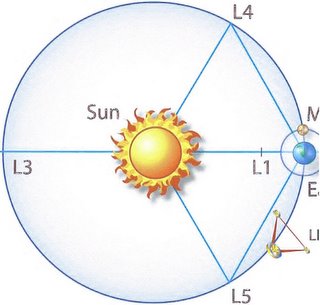
Part of this reporting is the way in which one could look at the Cosmos and see the gravitational relationships, as one might see it in relation to "Lagrangian views" in the Sun Earth Relation.


Diagram of the Lagrange Point gravitational forces associated with the Sun-Earth system.


Make sure you click on the image for further information. Mouseovers as your cursor is placed over images or worded links are equally important. You learn about satellites and the way they travel through these holes.

While one can see "dark matter" in terms of it's constraints, what of "dark energy" as it makes it way through those holes? This reveals the expansionary nature in terms of dark energy being repelled, whether you like to think so or not. This explains the dark energy developing free of the dark matter constraints and explains the state of our universe.


LSST Homepage background image. (Image credit: LSST Corporation, Bryn Feldman) Design of LSST Telescope dome and local facilities, current as of January 2007. Google Inc. has joined with nineteen other organizations to build the Large Synoptic Survey Telescope, scheduled to see first light atop Cerro Pachón in Chile in 2013.
The Large Synoptic Survey Telescope (LSST) is a proposed ground-based 8.4-meter, 10 square-degree-field telescope that will provide digital imaging of faint astronomical objects across the entire sky, night after night. In a relentless campaign of 15 second exposures, LSST will cover the available sky every three nights, opening a movie-like window on objects that change or move on rapid timescales: exploding supernovae, potentially hazardous near-Earth asteroids, and distant Kuiper Belt Objects. The superb images from the LSST will also be used to trace billions of remote galaxies and measure the distortions in their shapes produced by lumps of Dark Matter, providing multiple tests of the mysterious Dark Energy.


Two simulations of strong lensing by a massive cluster of galaxies. In the upper image, all the dark matter is clumped around individual cluster galaxies (orange), causing a particular distortion of the background galaxies (white and blue). In the lower image, the same amount of mass is more smoothly distributed over the cluster, causing a very different distortion pattern.


Here in this post the example of "how one may see" is further expounded upon to show how dark matter and dark energy are in action as a 90% aspect of the cosmos, while the remaining 10% is a discrete measure of what is cosmologically matter orientated. We don't loose sight of these relationships, but are helped to further develope them in terms of this gravitational relationship.

See:
  • Dark Matter in 3D
  • COSMOS Reveals the Cosmos
  • Sunday, January 07, 2007

    PLATO:Mathematician or Mystic ?

    Mathematics, rightly viewed, possesses not only truth, but supreme beauty, a beauty cold and austere, like that of sculpture, without appeal to any part of our weaker nature, without the gorgeous trappings of painting or music, yet sublimely pure, and capable of a stern perfection such as only the greatest art can show. The true spirit of delight, the exaltation, the sense of being more than Man, which is the touchstone of the highest excellence, is to be found in mathematics as surely as in poetry.--BERTRAND RUSSELL, Study of Mathematics


    One should not conclude that such a bloggery as this is not without a heartfelt devotion to learning. That I had made no great claims to what science should be. other then what a layman point of view in learning has become excited about. What may be a natural conclusion to one who has spent a long time in science. Do not think me so wanting to knock on your door to enforce the asking of education that may be sent my way was truly as a student waiting for some teacher to appear.

    This did not mean I should not engage the world of science. Not become enamoured with it. Or, that seeing the teachers at their bloggeries, were "as if" that teacher did appear many times. This is what is good about it.

    I did not care how young you were, or that I, "too old" to listen to what scientists knew, or were theoretically endowed with in certain model selections.

    More from the Heart?


    "Let no one destitute of geometry enter my doors."


    You know that by the very namesake of Plato used here, that I am indeed interested how Plato thought and his eventual conclusions about what "ideas" mean. So, of course there is this learning that has to take place with mathematics.

    If I may, and if I were allowed to fast forward any thought in this regard, it would be to say, that the evolution of the human being is much appreciated in what can transfer very quickly "between minds" while a dialogue takes place. Hence the title of this bloggery.

    Science demands clarity, and being deficient in this transference of "pure thought" would be less then ideal speaking amongst those scientists without that mathematics. Yet, I do espouse that such intuitiveness can be gained from the simple experiment, by distilling information, from the "general concepts" which have been mention many times now by scientists.

    So it is of interest to me that the roads to mathematical understanding through it's development would be quick to point out this immediate working in the "world of the abstract imaging" is to know that such methods are deduced by it's numbers and their greater meaning.

    That such meaning can be assign to a "natural objector function" and still unbeknownst to the thinking and learning individual "a numerical pattern that lies underneath it. A "schematics" if you like, of what can become the form in reality.

    No reader of Plato can fail to recognize the important role which mathematics plays in his writing, as would indeed be expected for an author about whom the ancient tradition maintains that he had hung over the entry to his school the words "Let No One Un-versed in Geometry Enter". Presumably it was the level of ability to work with abstract concepts that Plato was interested in primarily, but if the student really had never studied Greek geometric materials there would be many passages in the lectures which would be scarcely intelligible to him. Modern readers, versed in a much higher level of mathematical abstraction which our society can offer, have sometimes felt that Plato's famous "mathematical examples'" were illustrations rather than central to his arguments, and some of Plato's mathematical excursuses have remained obscure to the present time.


    A Musical Interlude


    Plato's Academy-Academy was a suburb of Athens, named after the hero Academos or Ecademos.

    I can't help but say that I am indeed affected by the views of our universe. In a way that encompasses some very intriguing nodal points about our universe in the way that I see it.

    While I may not have shown the distinct lines of the Platonic solids, it is within context of a balloon with dye around it, that it could be so expressive of the Chaldni plate, that I couldn't resist that "harmonics flavour" as to how one might see the patterns underneath reality. How some gaussian coordinates interpretation of the "uv" lines, that were distinctive of an image in abstract spaces.

    Saturday, January 06, 2007

    Mersenne Prime: One < the Power of two


    It looks as though primes tend to concentrate in certain curves that swoop away to the northwest and southwest, like the curve marked by the blue arrow. (The numbers on that curve are of the form x(x+1) + 41, the famous prime-generating formula discovered by Euler in 1774.)


    This is part of the education of my learning to understand the implications of the work of Riemann in context of the Riemann Hypothesis. Part of understanding what this application can do in terms helping us to see what has developed "from abstractions of mathematics," to have us now engaged in the "real world" of computation.

    In mathematics, a power of two is any of the nonnegative integer powers of the number two; in other words, two multiplied by itself a certain number of times. Note that one is a power (the zeroth power) of two. Written in binary, a power of two always has the form 10000...0, just like a power of ten in the decimal system.

    Because two is the base of the binary system, powers of two are important to computer science. Specifically, two to the power of n is the number of ways the bits in a binary integer of length n can be arranged, and thus numbers that are one less than a power of two denote the upper bounds of integers in binary computers (one less because 0, not 1, is used as the lower bound). As a consequence, numbers of this form show up frequently in computer software. As an example, a video game running on an 8-bit system, might limit the score or the number of items the player can hold to 255 — the result of a byte, which is 8 bits long, being used to store the number, giving a maximum value of 28−1 = 255.


    I look forward to the help in terms of learning to understand this "ability of the mind" to envision the dynamical nature of the abstract. To help us develop, "the models of physics" in our thinking. To learn, about what is natural in our world, and the "mathematical patterns" that lie underneath them.

    What use the mind's attempt to see mathematics in such models?

    "Brane world thinking" that has a basis in Ramanujan modular forms, as a depiction of those brane surface workings? That such a diversion would "force the mind" into other "abstract realms" to ask, "what curvatures could do" in terms of a "negative expressive" state in that abstract world.

    Are our minds forced to cope with the "quantum dynamical world of cosmology" while we think about what was plain in Einstein's world of GR, while we witness the large scale "curvature parameters" being demonstrated for us, on such gravitational look to the cosmological scale.

    Mersenne Prime


    Marin Mersenne, 1588 - 1648


    In mathematics, a Mersenne number is a number that is one less than a power of two.

    Mn = 2n − 1.
    A Mersenne prime is a Mersenne number that is a prime number. It is necessary for n to be prime for 2n − 1 to be prime, but the converse is not true. Many mathematicians prefer the definition that n has to be a prime number.

    For example, 31 = 25 − 1, and 5 is a prime number, so 31 is a Mersenne number; and 31 is also a Mersenne prime because it is a prime number. But the Mersenne number 2047 = 211 − 1 is not a prime because it is divisible by 89 and 23. And 24 -1 = 15 can be shown to be composite because 4 is not prime.

    Throughout modern times, the largest known prime number has very often been a Mersenne prime. Most sources restrict the term Mersenne number to where n is prime, as all Mersenne primes must be of this form as seen below.

    Mersenne primes have a close connection to perfect numbers, which are numbers equal to the sum of their proper divisors. Historically, the study of Mersenne primes was motivated by this connection; in the 4th century BC Euclid demonstrated that if M is a Mersenne prime then M(M+1)/2 is a perfect number. In the 18th century, Leonhard Euler proved that all even perfect numbers have this form. No odd perfect numbers are known, and it is suspected that none exist (any that do have to belong to a significant number of special forms).

    It is currently unknown whether there is an infinite number of Mersenne primes.

    The binary representation of 2n − 1 is n repetitions of the digit 1, making it a base-2 repunit. For example, 25 − 1 = 11111 in binary


    So while we have learnt from Ulam's Spiral, that the discussion could lead too a greater comprehension. It is by dialogue, that one can move forward, and that lack of direction seems to hold one's world to limits, not seen and known beyond what's it like apart from the safe and security of home.

    Friday, January 05, 2007

    Images or Numbers By Themself

    “Mathematicians have tried in vain to this day to discover some order in the sequence of prime numbers, and we have reason to believe that it is a mystery into which the mind will never penetrate” (cited by Ivars Peterson in Science News, 5/4/2002).


    I have an idea in mind here that will be slow to show because I am not sure how it is supposed to be laid out. So maybe by showing these numbers by them self? What use, if one did not, or was not able to see in another way?


    Figure 22.10: Double slit diffraction


    I looked at the "straight lines" of Thomas Young's trajectories of photon emission and while quite understandably shown to be of consequence in this post "Interference." I was more interested in how something could start off in one place and do this rotation of sorts, and then come back for examination again in the real world. The Spectrum

    Plato:
    What a novel idea to have the methods used by the predecessors like Maxwell, to have been united from Faraday's principals? To have Maxwell's equation Gaussian in interpretation of Riemann geometry, somehow, united by the geometries of Einstein and defined as gravity?


    But it is also in mind "that the image" has to be put here also before the numbers can show them self. What use these numbers if I do not transcend them to what they can imply in images, to know that the thinking here has to be orientated in such a way that what was simple and straight forward, could have non-euclidean orientations about it?


    Michael Faraday (September 22, 1791 – August 25, 1867) was a British scientist (a physicist and chemist) who contributed significantly to the fields of electromagnetism and electrochemistry.


    So one reads history in a lot of ways to learn of what has manifested into todays thinking. What lead from "Gaussian coordinates in an "non-euclidean way" to know that it had it's relation in today's physics. To have it included in how we see the consequences of GR in the world. It had been brought together for our eyes in what the photon can do in the gravitational field.

    Our Evolution to Images


    The Albrecht Durer's Magic Square


    Ulam's Spiral


    Pascal's Triangle


    Evolve to What?

    Who was to know what Leonard Susskind was thinking when his mathematical mind was engaged in seeing this "rubber band" had some other comparative abstraction, as something of consequence in our world. Yet, people focus on what they like to focus on, other then what "lead the mind" to think the way they do?


    Poincaré Conjecture
    If we stretch a rubber band around the surface of an apple, then we can shrink it down to a point by moving it slowly, without tearing it and without allowing it to leave the surface. On the other hand, if we imagine that the same rubber band has somehow been stretched in the appropriate direction around a doughnut......


    I have to rest now.

    Wednesday, January 03, 2007

    Latex Rendering

    Andrew Roberts:Here are some tutorials I have written for getting up to speed with this excellent document processing system. If you are not sure why Latex is any good, find out the benefits. I wouldn't consider myself an expert, but I'm learning all the time. I recall finding it quite taxing when I start to learn Latex, which is why I have started these tutorials. However, I hope that my experiences plays to your advantage, since I hope I can let you into the sort of questions and problems I had when I first learning Latex.


    While preparing myself for the intricacies of PDF or science documents, which is a requirement of science people, I went back of course to what Robert and Clifford had found in the science community.

    I am of course least in terms of the science education as I go through these bloggeries, yet the message has not fallen on a deaf ear in my case. So working toward helping others in science, is no less important then being given the skill to express myself/yourself properly.

    So this is a beginning for me then, of what I had said I would do for the coming year.


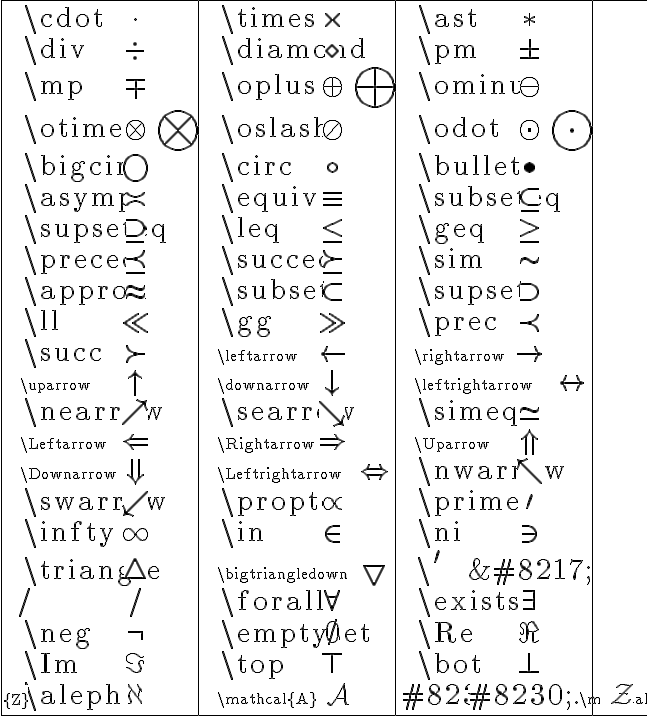
    Latex Symbol Latex language
    {times} \times
    {div} \div
    {diamond} \diamond
    {pm} \mp
    {ominus} \ominus \Big oplus
    {otimes} \otimes
    {oslash} \oslash
    {odot} \odot
    {bigcirc} \bigcirc
    {circ} \circ
    {bullet} \bullet
    {asymp} \asymp
    {}....and so on.... \


    [tex]{times}[/tex]= Latex symbology examples

    In the "above link" to John Forkosh Associates, I used the pre "enclosed html brackets and /pre to finish article link even though it had been redone, as a demonstration to illustrate the symbolizations in latex rendering.

    Click on Image for a larger size


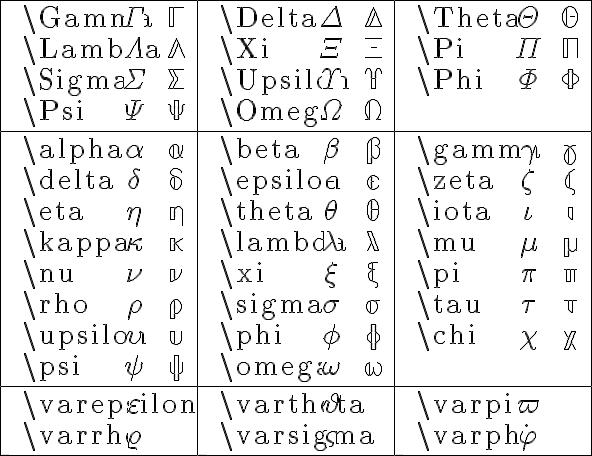
    Click on Image for a larger size


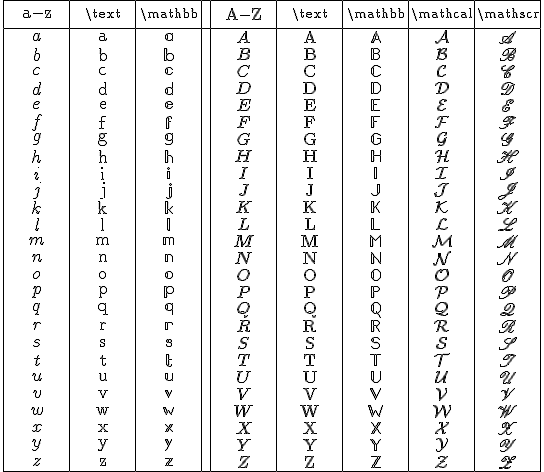
    Click on Image for a larger size


    Above, Clifford has laid it out for demonstration within his Sandbox to help others within his bloggery. Hope people use it. I am a little shy when it comes to demonstrating my ignorance, so having my "own sand box" would be nice without polluting someone else.

    Imaging in Latex
    Clifford:This is a space, easily accessible from the front page, where you can practice your LaTeX/MimeTeX commands for writing equations for adding to discussions, etc. You can see several people’s experiments at the earlier post here.


    1st generation plotted according to weak hypercharge and weak isospin. Suggestive that the antiparticles are defined rather arbitrarily, and that the structure of idempotents of Clifford algebras (hypercubes) be used to model internal symmetries.


    So having the understanding of what is necessary in the language development of latex, I am still far beneath those who I have linked in terms of that development. But, what ever the case, anything that can help, should not be so far beneath us that we ignore what had been found wanting in those who live the life as a scientist.

    Tuesday, January 02, 2007

    The Sun's Before Us

    The Cosmic Ray of Creation

    We are "shadows" of the Sun's creations.


    Sometimes it good to go back to "the beginning" so that one can see the context of what exists in reality, has a much "greater story to tell" then what we of the real world live under.

    Those of science, have been focused in their own worlds. We just had to understand why they were so absorbed.

    "String theory and other possibilities can distort the relative numbers of 'down' and 'up' neutrinos," said Jonathan Feng, associate professor in the Department of Physics and Astronomy at UC Irvine. "For example, extra dimensions may cause neutrinos to create microscopic black holes, which instantly evaporate and create spectacular showers of particles in the Earth's atmosphere and in the Antarctic ice cap. This increases the number of 'down' neutrinos detected. At the same time, the creation of black holes causes 'up' neutrinos to be caught in the Earth's crust, reducing the number of 'up' neutrinos. The relative 'up' and 'down' rates provide evidence for distortions in neutrino properties that are predicted by new theories."


    Who is to know of what is sent to earth, and not understand, that what happens above us, also happens within the LHC?


    Jacque Distler:

    Travis Stewart reports that the LHC’s ATLAS detector has seen cosmic ray events, an excellent sign that things are working as they should.


    One does not have to think, or be insulted by "such stories" that have captured minds in our history. The "ideas of cultures" are pervaded by such religious practises and context, by the fascination of some greater being? Having worked with them long enough?

    As a scientist, you know your place in the world. Yet, you dream of such "fantastical stories." About things travelling through the little towns in Europe, as if, seeing the "Overlords of Science." Like some futuristic God making it's way through the town of some primitive era on earth. "Shocked people" looking from windows, as this enormous object in the "war of the worlds," has finally come upon us.

    The article traces in non-technical language the historical development of our understanding of nuclear fusion reactions as the source of stellar energy, beginning with the controversy over the age of the sun and earth between Darwin and Kelvin, and including the discovery of radioactivity, the experimental demonstration that four hydrogen nuclei are heavier than a helium nucleus, and the theoretical insights provided by Einstein, Gamow, and Bethe. The concluding sections concern solar neutrino experiments that were designed to test the theory of stellar evolution and which, in the process, apparently revealed new aspects of microscopic physics.


    It is important that one understands that such a thing having been studied by our scientists, is still a "noble thing." Where we learn to understand what these things could represent symbolically? Enlightenment possibly? When all the understanding of the "Neutrino overlords" are understood in their place and time.


    The winged sun was an ancient (3rd millennium BC) symbol of Horus, later identified with Ra.
    A solar deity is a god or goddess who represents the sun, or an aspect of it. People have worshipped the sun and solar deities for all of recorded history; sun worship is also known as heliolatry. Hence, many beliefs and legends have been formed around this worship, most notably the various myths containing the "missing sun" motif from around the world. Although many sources contend that solar deities are generally male, and the brother, father, husband and/or enemy of the lunar deity (usually female), this is not cross-culturally upheld, as sun goddesses are found on every continent. Some mythologists, such as Brian Branston, therefore contend that sun goddesses are more common worldwide than their male counterparts. They also claim that the belief that solar deities are primarily male is linked to the fact that a few better known mythologies (such as those of ancient Greece and Egypt) sometimes break from this rule. The dualism of sun/male/light and moon/female/darkness is found in many (but not all) European traditions that derive from Orphic and Gnostic philosophies, with a notable exception being Germanic mythology, where the Sun is female and the Moon is male.

    Sun worship is a possible origin of henotheism and ultimately monotheism. In ancient Egypt's Eighteenth Dynasty, Akhenaten's heretical Atenism used the old Aten solar deity as a symbol of a single god. The neolithic concept of a solar barge, the sun as traversing the sky in a boat, is found in ancient Egypt, with Ra and Horus. Proto-Indo-European religion has a solar chariot, the sun as traversing the sky in a chariot. At Roman Empire, a festival of the birth of the Unconquered Sun (or Dies Natalis Solis Invicti) was celebrated when the duration of daylight first begins to increase after the winter solstice, — the "rebirth" of the sun. In Germanic mythology this is Sol, in Vedic Surya and in Greek Helios and (sometimes) Apollo. Mesopotamian Shamash plays an important role during the Bronze Age, and "my Sun" is eventually used as an address to royalty. Similarly, South American cultures have emphatic Sun worship, see Inti. See also Sol Invictus.

    Monday, January 01, 2007

    Symmetries Can be Chaotically Complex


    Imagine in an "action of a kind" you start off from one place. A photon travelling through a slit of Thomas Young's, to get through "a world" to the other side. Sounds like some fairy tale doesn't it? Yet, "the backdrop" is where you started?


    Thomas Young (June 14, 1773 – †May 10,1829)
    was an English scientist, researcher, physician and polymath. He is sometimes considered to be "the last person to know everything": that is, he was familiar with virtually all the contemporary Western academic knowledge at that point in history. Clearly this can never be verified, and other claimants to this title are Gottfried Leibniz, Leonardo da Vinci, Samuel Taylor Coleridge, Johann Wolfgang Goethe and Francis Bacon, among others. Young also wrote about various subjects to contemporary editions of the Encyclopedia Britannica. His learning was so prodigious in scope and breadth that he was popularly known as "Phenomenon Young."


    Simplistically this "massless entity" is affected by the "geometrics of gravity?" Is affected from it's "first light." All the way to some "other point in reality" to some image, called the spectrum.

    I am dreaming. I am walking down the street and there is this "N category cafe."

    Imagine walking off the street into this very public venue and seeing the philosophy shared is also held to certain constraints. :)Philosophy? Yes, we all have our "points of view."

    Travelling the Good Life with Ease

    So in this travel how is one to see this "curve of light" or "slide" and we get this sense of what gravity can do.

    Imagine indeed, "a hole cosmological related" in the three body problem, it has to travel through, and we get this sense of "lensing and distortion," abstractually gravitationally induced?


    So as we look at the cosmos what illusion is perpetrated on our minds as we look into the "great distance of measure" that somehow looking to the journey of "an event local," from our place on and about earth, has not been "chaotically entrained in some way, as we look deep into space?


    The Magic Square
    Plato:Like Pascal, one finds Albrecht has a unique trick, used by mathematicians to hide information and help, to exemplify greater contextual meaning. Now you have to remember I am a junior here in pre-established halls of learning, so later life does not allow me to venture into, and only allows intuitive trials poining to this solid understanding. I hope I am doing justice to learning.


    Moving in abstract spaces

    It was necessary to explain why I added "the image" to the right in my index.

    Some would think me so "esoteric" that I had somehow lost touch with the realities of science? That to follow any further discussion here "has to be announced" to save one's dignity? What ever?:)I am esoteric in that my views of the world come from a different place, not unlike your expression of where you had come from living your life. How would I come to know all that you are in a "single sentence." A single and very short equation? It's really not that easy is it?:)

    So I read you from all the things that you say and get the sense of who you are no different then what is implied in the language of poetic art implied carefully from choosing your words?

    Artistically Inclined?

    I tried to give some hint of the "ideas floating" around in my head. I understand quite well that my challenge has been to get those "images in my head" transmitted onto paper, in a way that one would not become confused as to what is being implied.

    So a good writer I may not be, a "not so good scientist" whose mathematics very ill equipped.

    Thus I am faced with these challenges in the new year? A "recognition" of trying to produce that clarity. Whether in "latex" the symbols of mathematics, it is quite a challenge for me, whilst all these things are still engaged in abstract views of reality.

    So someone like Clifford, may look at Robert by what he has written and say, "hey, my fellow scientists are indeed in trouble" from what Robert has learnt. So I Clifford will provide "the latex sandbox" for you to play in?

    It "appears" I am not alone. My struggle, are to be many a struggle.

    Art and the Abstract

    But to my amazement this morning in checking up the links associated of Clifford's, I was amazed to see the article of, Hooking Up Manifolds

    Now how interesting that what is being displayed there in terms of fun, mathematics, art, could have been so abstractly appealing? "Moving over these surfaces" in ways that one might never appreciated, had you not known about how one can look at the universe in the "two ways mentioned previously," and by simple experiment, transcend such things to art.

    Saturday, December 30, 2006

    N category and the Hydrogen spectrum


    Picture of the 1913 Bohr model of the atom showing the Balmer transition from n=3 to n=2. The electronic orbitals (shown as dashed black circles) are drawn to scale, with 1 inch = 1 Angstrom; note that the radius of the orbital increases quadratically with n. The electron is shown in blue, the nucleus in green, and the photon in red. The frequency ν of the photon can be determined from Planck's constant h and the change in energy ΔE between the two orbitals. For the 3-2 Balmer transition depicted here, the wavelength of the emitted photon is 656 nm.
    In atomic physics, the Bohr model depicts the atom as a small, positively charged nucleus surrounded by electrons that travel in circular orbits around the nucleus — similar in structure to the solar system, but with electrostatic forces providing attraction, rather than gravity.

    Introduced by Niels Bohr in 1913, the model's key success was in explaining the Rydberg formula for the spectral emission lines of atomic hydrogen; while the Rydberg formula had been known experimentally, it did not gain a theoretical underpinning until the Bohr model was introduced.

    The Bohr model is a primitive model of the hydrogen atom. As a theory, it can be derived as a first-order approximation of the hydrogen atom using the broader and much more accurate quantum mechanics, and thus may be considered to be an obsolete scientific theory. However, because of its simplicity, and its correct results for selected systems (see below for application), the Bohr model is still commonly taught to introduce students to quantum mechanics.


    For one to picture events in the cosmos, it is important that the spectral understanding of the events as they reveal themselves. So you look at these beautiful pictures and information taken from them allow us to see the elemental considerations of let's say the blue giants demise. What was that blue giant made up of in term sof it's elemental structure

    The quantum leaps are explained on the basis of Bohr's theory of atomic structure. From the Lyman series to the Brackett series, it can be seen that the energy applied forces the hydrogen electrons to a higher energy level by a quantum leap. They remain at this level very briefly and, after about 10-8s, they return to their initial or a lower level, emitting the excess energy in the form of photons (once again by a quantum leap).


    Lyman series
    Hydrogen atoms excited to luminescence emit characteristic spectra. On excitation, the electron of the hydrogen atom reaches a higher energy level. In this case, the electron is excited from the base state, with a principal quantum number of n = 1, to a level with a principal quantum number of n = 4. After an average dwell time of only about 10-8s, the electron returns to its initial state, releasing the excess energy in the form of a photon.
    The various transitions result in characteristic spectral lines with frequencies which can be calculated by f=R( 1/n2 - 1/m2 ) R = Rydberg constant.
    The lines of the Lyman series (n = 1) are located in the ultraviolet range of the spectrum. In this example, m can reach values of 2, 3 and 4 in succession.


    Balmer series
    Hydrogen atoms excited to luminescence emit characteristic spectra. On excitation, the electron of the hydrogen atom reaches a higher energy level. In this case, the electron is excited from the base state, with a principal quantum number of n = 1, to a level with a principal quantum number of n = 4. The Balmer series becomes visible if the electron first falls to an excited state with the principal quantum number of n = 2 before returning to its initial state.
    The various transitions result in characteristic spectral lines with frequencies which can be calculated by f=R( 1/n2 - 1/m2 ) R = Rydberg constant.
    The lines of the Balmer series (n = 2) are located in the visible range of the spectrum. In this example, m can reach values of 3, 4, 5, 6 and 7 in succession.


    Paschen series
    Hydrogen atoms excited to luminescence emit characteristic spectra. On excitation, the electron of the hydrogen atom reaches a higher energy level. In this case, the electron is excited from the base state, with a principal quantum number of n = 1, to a level with a principal quantum number of n = 7. The Paschen series becomes visible if the electron first falls to an excited state with the principal quantum number of n = 3 before returning to its initial state.
    The various transitions result in characteristic spectral lines with frequencies which can be calculated by f=R( 1/n2 - 1/m2 ) R = Rydberg constant.
    The lines of the Paschen series (n = 3) are located in the near infrared range of the spectrum. In this example, m can reach values of 4, 5, 6 and 7 in succession.


    Brackett series
    Hydrogen atoms excited to luminescence emit characteristic spectra. On excitation, the electron of the hydrogen atom reaches a higher energy level. In this case, the electron is excited from the base state, with a principal quantum number of n = 1, to a level with a principal quantum number of n = 8. The Brackett series becomes visible if the electron first falls to an excited state with the principal quantum number of n = 4 before returning to its initial state.
    The lines of the Brackett series (n = 4) are located in the infrared range of the spectrum. In this example, m can reach values of 5, 6, 7 and 8 in succession.

    Friday, December 29, 2006

    Wolf-Rayet star

    While I have started off with the definition of the Wolf-Rayet star, the post ends in understanding the aspects of gravity and it's affects, as we look at what has become of these Wolf-Rayet stars in their desimination of it's constituent properties.

    Similar, "in my thinking" to the expansion of our universe?


    Artist's impression of a Wolf-Rayet star
    About 150 Wolf-Rayets are known in our own Milky Way Galaxy, about 100 are known in the Large Magellanic Cloud, while only 12 have been identified in the Small Magellanic Cloud. Wolf-Rayet stars were discovered spectroscopically in 1867 by the French astronomers Charles Wolf and Georges Rayet using visual spectrometery at Paris Observatory.


    There are some thoughts manifesting about how one may have see this energy of the Blue giant. It's as if the examples of what began with great force can loose it's momentum and dissipate very quickly(cosmic winds that blow the dust to different places)?


    Illustration of Cosmic Forces-Credit: NASA, ESA, and A. Feild (STScI)
    Scientists using NASA's Hubble Space Telescope have discovered that dark energy is not a new constituent of space, but rather has been present for most of the universe's history. Dark energy is a mysterious repulsive force that causes the universe to expand at an increasing rate.


    What if the Wolf-Rayet star does not produce the jets that are exemplified in the ideas which begin blackhole creation. Is this part of blackhole development somehow in it's demise, that we may see examples of the 150 Wolf-Rayets known in our own Milky Way as example of what they can become as blackholes, or not.

    Quark to quark Distance and the Metric

    If on such a grand scale how is it thoughts are held in my mind to microscopic proportions may not dominate as well within the periods of time the geometrics develop in the stars now known as Wolf-Rayet. So you use this cosmological model to exemplify micro perspective views in relation to high energy cosmological geometrics.


    Plato:
    "Lagrangian views" in relation may have been one result that comes quickly to my mind. Taking that chaldni plate and applying it to the universe today.


    While I had in the previous post talked about how Lagrangian views could dominate "two aspects of the universe," it is not without linking the idea of what begins as a strong gravitational force to hold the universe together, that over time, as the universe became dominated by the dark energy that the speeding up of inflation could have become pronounced by discovering the holes created in the distances between the planets and their moons. Between galaxies.


    I make fun above with the understanding of satellites travelling in our current universe in relation to planets and moons, as well as galaxies. To have taken this view down to WMAP proportions is just part of what I am trying to convey using very simplistic examples of how one may look at the universe, when gravity dominated the universe's expansion versus what has happened to the universe today in terms of speeding up.


    LOOP-DE-LOOP. The Genesis spacecraft's superhighway path took it to the Earth-sun gravitational-equilibrium point L1, where it made five "halo" orbits before swinging around L2 and heading home.Ross


    If the distances between galaxies have become greater, then what saids that that the ease with which the speeding up occurs is not without understanding that an equilibrium has been attained, from what was once dominate in gravity, to what becomes rapid expansion?

    This book describes a revolutionary new approach to determining low energy routes for spacecraft and comets by exploiting regions in space where motion is very sensitive (or chaotic). It also represents an ideal introductory text to celestial mechanics, dynamical systems, and dynamical astronomy. Bringing together wide-ranging research by others with his own original work, much of it new or previously unpublished, Edward Belbruno argues that regions supporting chaotic motions, termed weak stability boundaries, can be estimated. Although controversial until quite recently, this method was in fact first applied in 1991, when Belbruno used a new route developed from this theory to get a stray Japanese satellite back on course to the moon. This application provided a major verification of his theory, representing the first application of chaos to space travel.
    Since that time, the theory has been used in other space missions, and NASA is implementing new applications under Belbruno's direction. The use of invariant manifolds to find low energy orbits is another method here addressed. Recent work on estimating weak stability boundaries and related regions has also given mathematical insight into chaotic motion in the three-body problem. Belbruno further considers different capture and escape mechanisms, and resonance transitions.

    Providing a rigorous theoretical framework that incorporates both recent developments such as Aubrey-Mather theory and established fundamentals like Kolmogorov-Arnold-Moser theory, this book represents an indispensable resource for graduate students and researchers in the disciplines concerned as well as practitioners in fields such as aerospace engineering.

    Thursday, December 28, 2006

    First Stars Behind the Scene

    There are several recognized processes from the early universe that leave relic effects setting the stage for galaxy formation and evolution. We deal here with the first generarion of stars, primordial nucleosynthesis, the epoch of recombination, and the thermal history of various cosmic backgrounds.


    Part of understanding the time line is first knowing where the Pregalactic Universe exists in that time line.

    Plato:
    So given the standard information one would have to postulate something different then what is currently classified?

    A new Type III (what ever one shall attribute this to definition), versus Type I, Type IIa?


    The idea is to place the distant measure in relation to what is assumed of TYPE I, TypeIIa. It assumes all these things, but has to been defined further, to be a Type III. That's the point of setting the values of where this measure can be taken from.

    I wrote someplace else the thought generated above. It is nice that the world of scientists are not so arrogant in some places, while some have been willing to allow the speculation to continue. Even amidst their understanding, that I was less then the scientist that they are, yet recognizing, I am deeply motivated to understanding this strange world of cosmology and it's physics.

    When I wrote this title above I was actually thinking of two scenarios that are challenging the way I am seeing it.


    Credit: NASA/WMAP Science Team
    WMAP has produced a new, more detailed picture of the infant universe. Colors indicate "warmer" (red) and "cooler" (blue) spots. The white bars show the "polarization" direction of the oldest light. This new information helps to pinpoint when the first stars formed and provides new clues about events that transpired in the first trillionth of a second of the universe.


    First of these, was in terms of the time line and what we know of the WMAP demonstration given to us of that early universe. I of course inject some of what I know by past research to help the general public understand what is being demonstrated from another perspective.

    This is what happens as you move through different scientists(Wayne Hu) thoughts to see the world in the way they may see it. This concept can be quite revealing sometimes giving a profound effect to moving the mind to consider the universe in new ways.


    "Lagrangian views" in relation may have been one result that comes quickly to my mind. Taking that chaldni plate and applying it to the universe today.


    Even though in the context of this post, we may see the universe in a "simple experiment" not just demonstrating the "early universe," but the universe in it's "gravitational effect" from that evolution to matter defined now.

    The Time Line


    Credit: NASA/WMAP Science Team
    The expansion of the universe over most of its history has been relatively gradual. The notion that a rapid period "inflation" preceded the Big Bang expansion was first put forth 25 years ago. The new WMAP observations favor specific inflation scenarios over other long held ideas.


    Looking to the "far left" of the image we see the place where the cosmic background is being demonstrated, while to the "far right" we see the satellite which has helped measure what we know of the early universe. So this "distant measure" has allowed us to understand what is behind the scene of what we know of cosmology today of events, galaxies and such.

    Second, what comes to mind is the Massive Blue Star of 100 Solar masses that would have been further out in terms of the billions of years that we may of sought in terms of our measures. So this would be of value I would assume in relation to model perspective and measures?

    So the distance measure has been defined then by understanding the location of the cosmic background and the place where the Blue giants will have unfolded in their demise, to the creation of blackholes.


    The processes in the Universe after the Big Bang. The radio waves are much older than the light of galaxies. From the distortion of the images (curved lines) - caused by the gravitation of material between us and the light sources - it is possible to calculate and map the entire foreground mass.Image: Max Planck Institute of Astrophysics
    We don't have to wait for the giant telescope to get unparalleled results from this technique, however. One of the most pressing issues in current physics is to gain a better understanding of the mysterious Dark Energy which currently drives the accelerated expansion of the Universe. Metcalf and White show that mass maps of a large fraction of the sky made with an instrument like SKA could measure the properties of Dark Energy more precisely than any previously suggested method, more than 10 times as accurately as mass maps of similar size based on gravitational distortions of the optical images of galaxies.

    Wednesday, December 27, 2006

    The Geometrics Behind the Supernova and it's History


    It is not always easy for people to see what lies behind the wonderful beauty of images that we take from the satellite measures of space, and it's dynamical events illustrated in Cassiopeia A. There before you is this majestic image of beauty, as we wonder about it's dynamics.


    These Spitzer Space Telescope images, taken one year apart, show the supernova remnant Cassiopeia A (yellow ball) and surrounding clouds of dust (reddish orange). The pictures illustrate that a blast of light from Cassiopeia A is waltzing outward through the dusty skies. This dance, called an "infrared echo," began when the remnant erupted about 50 years ago. Image credit: NASA/JPL-Caltech/Univ. of Ariz.
    An enormous light echo etched in the sky by a fitful dead star was spotted by the infrared eyes of NASA's Spitzer Space Telescope.

    The surprising finding indicates Cassiopeia A, the remnant of a star that died in a supernova explosion 325 years ago, is not resting peacefully. Instead, this dead star likely shot out at least one burst of energy as recently as 50 years ago.


    How is it such information arrives to us, and we would have to consider the impulse's behind such geometrical explanations. Which we are lucky to see in other ways. So, of course we needed to see the impulse as dynamically driven by the geometrical inclinations of that collapse, and all it's information spread outward by the description in images painted.


    Credit: Weiqun Zhang and Stan Woosley
    This image is from a computer simulation of the beginning of a gamma-ray burst. Here we see the jet 9 seconds after its creation at the center of a Wolf Rayet star by the newly formed, accreting black hole within. The jet is now just erupting through the surface of the Wolf Rayet star, which has a radius comparable to that of the sun. Blue represents regions of low mass concentration, red is denser, and yellow denser still. Note the blue and red striations behind the head of the jet. These are bounded by internal shocks.


    If I had approached you early on and suggested that you look at "bubble geometrodynamics" would it have seemed so real that I would have presented a experiment to you, that would help "by analogies" to see what is happening? Might I then be called the one spreading such information that it was not of value to scientists to consider, that I was seeing in ways that I can only now give to you as example? What science has done so far with using the physics with cosmological views?


    Image Credit: NASA/JPL-Caltech/STScI/CXC/SAO
    This stunning false-color picture shows off the many sides of the supernova remnant Cassiopeia A, which is made up of images taken by three of NASA's Great Observatories, using three different wavebands of light. Infrared data from the Spitzer Space Telescope are colored red; visible data from the Hubble Space Telescope are yellow; and X-ray data from the Chandra X-ray Observatory are green and blue.

    Located 10,000 light-years away in the northern constellation Cassiopeia, Cassiopeia A is the remnant of a once massive star that died in a violent supernova explosion 325 years ago. It consists of a dead star, called a neutron star, and a surrounding shell of material that was blasted off as the star died. The neutron star can be seen in the Chandra data as a sharp turquoise dot in the center of the shimmering shell.


    In this image above we learn of what manifests in "jet production lines," and such examples are beautiful examples to me of what the geometrics are doing. You needed some way to be able to explain this within context of the universe's incidences "as events." We say this action is one with which we may speak to this "corner of the universe." Yet it is very dynamical in it's expression as we see it multiplied from various perspectives.


    The structure of Model J32 as the jet nears the surface 7820 seconds after core collapse.


    So by experiment(?) I saw such relations, but what use such analogies if they are laid waste to speculation that what was initiated such ideas had been the inclination of geometrics detailed as underlying the basis of all expression as an example of some non euclidean views of Riemann perspectives leading shapes and dynamics of our universe by comparison within the local actions of stars and galaxies?

    Gamma Rays?


    So we get this information in one way or another and it was from such geometrical impulse that such examples are spread throughout the universe in ways that were not understood to well.


    X-ray image of the gamma-ray burst GRB 060614 taken by the XRT instrument on Swift. The burst glowed in X-ray light for more than a week following the gamma-ray burst. This so-called "afterglow" gave an accurate position of the burst on the sky and enabled the deep optical observations made by ground-based observatories and the Hubble Space Telescope. Credit: NASA/Swift Team
    A year ago scientists thought they had figured out the nature of gamma-ray bursts. They signal the birth of black holes and traditionally, fall into one of two categories: long or short. A newly discovered hybrid burst has properties of both known classes of gamma-ray bursts yet possesses features that remain unexplained.

    The long bursts are those that last more than two seconds. It is believed that they are ejected by massive stars at the furthest edge of the universe as they collapse to form black holes.


    So looking back to this timeline it is important to locate the ideas spread out before us. Have "some place" inclusive in the reality of that distance from the origins of the stars of our earliest times. 13.7 billions years imagine!


    Fig. 1: Sketchy supernova classification scheme
    A supernova is the most luminous event known. Its luminosity matches those of whole galaxies. The name derives from the works of Walter Baade and Fritz Zwicky who studied supernovae intensively in the early 1930s and used the term supernova therein.
    Nowadays supernova is a collective term for different classes of objects, that exhibit a sudden rise in luminosity that drops again on a timescale of weeks.
    Those objects are subdivided into two classes, supernovae of type I or II (SNe I and SNe II). The distinguishing feature is the absence or the presence of spectral lines of hydrogen. SNe I show no such lines as SNe II do. The class of SNe I is further subdivided in the classes a, b and c. This time the distinguishing feature are spectral features of helium and silicon. SN Ia show silicon features, SN Ib show helium but no silicon features and SN Ic show both no silicon and no helium spectral features.
    The class of SN II is further subdivided in two classes. Those are distinguished by the decline of the lightcurve. Those SN II that show a linear decline are named SN II-L and those that pass through a plateau-phase are referred to as SN II-P.


    So given the standard information one would have to postulate something different then what is currently classified?

    A new Type III (what ever one shall attribute this to definition, versus Type I, Type IIa?


    ssc2006-22b: Brief History of the Universe
    Credit: NASA/JPL-Caltech/A. Kashlinsky (GSFC)
    This artist's timeline chronicles the history of the universe, from its explosive beginning to its mature, present-day state.

    Our universe began in a tremendous explosion known as the Big Bang about 13.7 billion years ago (left side of strip). Observations by NASA's Cosmic Background Explorer and Wilkinson Anisotropy Microwave Probe revealed microwave light from this very early epoch, about 400,000 years after the Big Bang, providing strong evidence that our universe did blast into existence. Results from the Cosmic Background Explorer were honored with the 2006 Nobel Prize for Physics.

    A period of darkness ensued, until about a few hundred million years later, when the first objects flooded the universe with light. This first light is believed to have been captured in data from NASA's Spitzer Space Telescope. The light detected by Spitzer would have originated as visible and ultraviolet light, then stretched, or redshifted, to lower-energy infrared wavelengths during its long voyage to reach us across expanding space. The light detected by the Cosmic Background Explorer and the Wilkinson Anisotropy Microwave Probe from our very young universe traveled farther to reach us, and stretched to even lower-energy microwave wavelengths.

    Astronomers do not know if the very first objects were either stars or quasars. The first stars, called Population III stars (our star is a Population I star), were much bigger and brighter than any in our nearby universe, with masses about 1,000 times that of our sun. These stars first grouped together into mini-galaxies. By about a few billion years after the Big Bang, the mini-galaxies had merged to form mature galaxies, including spiral galaxies like our own Milky Way. The first quasars ultimately became the centers of powerful galaxies that are more common in the distant universe.

    NASA's Hubble Space Telescope has captured stunning pictures of earlier galaxies, as far back as ten billion light-years away.


    Would sort of set up the challenge?