
PLato said,"Look to the perfection of the heavens for truth," while Aristotle said "look around you at what is, if you would know the truth" To Remember: Eskesthai
Wednesday, August 22, 2018

Hey LIGO
 |
| Hey LIGO |
***
How’s it going, LIGO?
Members of the public can use Hey LIGO; they just might be disappointed if they’re looking for the kind of quippy, vocalized replies we’ve come to expect from our digital assistants. Hey LIGO is more likely to spit out links to technical reports and schematics. But for researchers, that’s just fine
The Laser Interferometer Gravitational-Wave Observatory has a new digital assistant. Symmetry Magazine
Wednesday, August 01, 2018
Cohl Furey on the Octonions and Particle Physics
Video by Susannah Ireland for Quanta Magazine
See: The Peculiar Math That Could Underlie the Laws of Nature by Natalie Wolchover
***
See Also:

Wednesday, June 13, 2018
Dimensions Inbetween
"Yet I exist in the hope that these memoirs, in some manner, I know not how, may find their way to the minds of humanity in Some Dimensionality, and may stir up a race of rebels who shall refuse to be confined to limited Dimensionality." from Flatland, by E. A. Abbott - Flat Land: A Romance of Many Dimensions

 See: Analysis and Assessment of Gateway Process
There has been a lot of talk over the years about extra dimensions. It has never been totally clear to me how to define that rigorously and effectively. A matter dominated world, it becomes scientifically accredited when it is repeated, or, it has been falsified.

The concept of dimension is not restricted to physical objects. High-dimensional spaces occur in mathematics and the sciences for many reasons, frequently as configuration spaces such as in Lagrangian or Hamiltonian mechanics; these are abstract spaces, independent of the physical space we live in.
The thinking here in regards to the scientific explanation, is that in place of space-time, consciousness becomes capable. The brain, in context of this article, is functioning with regards to how consciousness amplifies it's use of energy?
Albert Einstein
The surface of a marble table is spread out in front of me. I can get from any one point on this table to any other point by passing continuously from one point to a "neighboring" one, and repeating this process a (large) number of times, or, in other words, by going from point to point without executing "jumps." I am sure the reader will appreciate with sufficient clearness what I mean here by "neighbouring" and by "jumps" (if he is not too pedantic). We express this property of the surface by describing the latter as a continuum. http://www.bartleby.com/173/24.html
It always nice to have a smile on your face while you debunk.:-)
A Model for Science
Science is growing more complex, and so are the problems scientists face. A growing number of researchers argue that changing not just how we do science, but how we share it as well, would unlock vast new opportunities. A recent conference at Perimeter Institute asked: Is the time right for open source science? See:Can open-source software be a model for science?
Friday, May 04, 2018
The Tao of Life

Wholeness implies a circular function and integration of these active and passive forces within the individual them-self. Active and passive features in the way we objectively and subjectively interact with the world around us and within us.
While bold in the application of active and passive forces the degrees of this participation is represented. Hard and soft, movement and resistance. While in opposition these are never apart as wholeness implies.
These do have psychological associations in mind, as represented in the active and passive understanding of information access and transmission. These are also represented in the eeg associations of an active and passive mind. Heart like, these can be rated in pulse.(see Mandelbrot and Seth Cohen) These are bio-metric markers, much as cell phone antenna's are specific to your phone. Algorithmic written as a debit card signature.
The range and application of the understanding here in relation to the processes of science was a development characteristic I gained over the years while developing an understanding of the nature of the active and passive features within our world. Superconductors, the nature of viscosity in the science processes and active transmission of information within that science development. These were developed as an understanding of energy particulates that make there way into earth's medium environment. AS well as, an understanding in the nature of crystallization, as represented in the idea of sound as cymatics.
The intuitive framework has to recognize that you have already worked the angles and that such intuition is gathered from all that has been worked.......I am not saying it is right just that I have seen this perspective in development with regard to scientists as they push through the wall that has separated them from moving on. This then details a whole set of new parameters in which the thinking mind can move forward with proposals. Fractals and Antennas and The Economy
Thursday, April 12, 2018
Artificial Intelligence and the Complexity Frontier - Public Lecture Trailer at Perimeter
Watch live online May. 2 here:
A Tour of the Moon
Credit: NASA's Goddard Space Flight Center/David Ladd
This video is public domain and along with other supporting visualizations can be downloaded from the Scientific Visualization Studio at: http://svs.gsfc.nasa.gov/4619
This video is public domain and along with other supporting visualizations can be downloaded from the Scientific Visualization Studio at: http://svs.gsfc.nasa.gov/4619
Monday, March 26, 2018
"Into the Night: Portraits of Life and Death"
Hear intimate stories of nine men and women changed by their encounters with mortality.
See Also: Why Not Talk About Death? by Adam Frank
Tuesday, March 06, 2018
Thursday, March 01, 2018
Friday, February 23, 2018
Thursday, February 22, 2018
Illustris Simulation
See: Illustris Simulation
***

This movie shows the formation of one of the Aquarius halos we simulated, over nearly the full age of the Universe from redshift z~50 to z=0. The camera position moves slowly around the forming galactic halo, pointing towards its centre at all times. The movie is based on our Aq-A-2 simulation. See: Aquarius Project Visualizations
***
***
See Also:
Time Travelers
 |
| By Unknown - Netflix, Public Domain, https://commons.wikimedia.org/w/index.php?curid=62395143 |
Travelers is a science fiction television series created by Brad Wright, starring Eric McCormack, Mackenzie Porter, Jared Abrahamson, Nesta Cooper, Reilly Dolman and Patrick Gilmore.[1][2] The series is a co-production between Netflix and Showcase. The first season comprises 12 episodes and premiered on Showcase on October 17, 2016; the entire series premiered globally on Netflix on December 23, 2016.[3] On February 8, 2017, Netflix and Showcase renewed the series for a second season, which premiered on Showcase in Canada on October 16, 2017. The second season was then released worldwide, outside Canada, on Netflix on December 26, 2017.[4][5]
***
See Also:
Can We Change The Past? by Marcelo Gleiser
Wednesday, February 21, 2018
Tuesday, February 20, 2018
What Reality Is.
***
The Necker cube is used in epistemology (the study of knowledge) and provides a counter-attack against naïve realism.
Naïve realism (also known as direct or common-sense realism) states
that the way we perceive the world is the way the world actually is. The
Necker cube seems to disprove this claim because we see one or the
other of two cubes, but really, there is no cube there at all: only a
two-dimensional drawing of twelve lines. We see something which is not
really there, thus (allegedly) disproving naïve realism. This criticism
of naïve realism supports representative realism. Necker cube -http://en.wikipedia.org/wiki/Necker_cube#Epistemology

The Necker cube is a paradigmatic example for bistable perception where pattern reversal obeys a particular probability distribution. Atmanspacher, Filk and Römer (2004) discussed this switching dynamics in terms of the quantum Zeno effect where “observation” (here attending to a percept) increases the dwell-time of an otherwise fast decaying unobserved state. Quantum Cognition, Bistable perception
***
See Also:
Friday, February 09, 2018
Simulation Theory 2018 What is the Truth?
Testing Simulation hypothesis physically
A long-shot method to test one type of simulation hypothesis was proposed in 2012 in a joint paper by physicists Silas R. Beane from the University of Bonn (now at the University of Washington, Seattle), and Zohreh Davoudi and Martin J. Savage from the University of Washington, Seattle.[11] Under the assumption of finite computational resources, the simulation of the universe would be performed by dividing the continuum space-time into a discrete set of points. In analogy with the mini-simulations that lattice-gauge theorists run today to build up nuclei from the underlying theory of strong interactions (known as Quantum chromodynamics), several observational consequences of a grid-like space-time have been studied in their work. Among proposed signatures is an anisotropy in the distribution of ultra-high-energy cosmic rays, that, if observed, would be consistent with the simulation hypothesis according to these physicists.[12
Thursday, February 08, 2018
The Riddle of the Quantum Sphinx: Robert Spekkens Public Lecture
In his Feb. 7 public lecture at Perimeter Institute, Robert Spekkens will explain why he believes that many quantum mysteries are a result of a category mistake concerning the nature of quantum states.
Wednesday, February 07, 2018
Sack's and Ulam Spiral

Numbers on the marked curve are of the form
x2 + x + 41,
the famous prime-generating formula discovered by Euler in 1772. http://www.numberspiral.com/index.html

Riemann discovered a geometric landscape, the contours of which held the secret to the way primes are distributed through the universe of numbers.
It seemed the patterns Montgomery was predicting for the way zeros were distributed on Riemann’s critical line were the same as those predicted by quantum physicists for energy levels in the nucleus of heavy atoms. The implications of a connection were immense: If one could understand the mathematics describing the structure of the atomic nucleus in quantum physics, maybe the same math could solve the Riemann Hypothesis. http://seedmagazine.com/content/article/prime_numbers_get_hitched/
Sack's spiral-a version of the Ulam spiral
 Sift the Two's and Sift the Three's,
The Sieve of Eratosthenes.
When the multiples sublime,
The numbers that remain are Prime.

Anonymous[5]
Tuesday, February 06, 2018
Albrecht Durer's Magic Square
Albrecht Dürer (/ˈdʊərər, ˈdjʊərər/;[1] German: [ˈalbʁɛçt ˈdyːʁɐ]; 21 May 1471 – 6 April 1528)[2] was a painter, printmaker, and theorist of the German Renaissance. Born in Nuremberg, Dürer established his reputation and influence across Europe when he was still in his twenties due to his high-quality woodcut prints. He was in communication with the major Italian artists of his time, including Raphael, Giovanni Bellini and Leonardo da Vinci, and from 1512 he was patronized by emperor Maximilian I. Dürer is commemorated by both the Lutheran and Episcopal Churches. The Expulsion From Paradise by Albrecht Dürer Dürer's vast body of work includes engravings, his preferred technique in his later prints, altarpieces, portraits and self-portraits, watercolours and books. The woodcuts, such as the Apocalypse series (1498), are more Gothic than the rest of his work. His well-known engravings include the Knight, Death, and the Devil (1513), Saint Jerome in his Study (1514) and Melencolia I (1514), which has been the subject of extensive analysis and interpretation. His watercolours also mark him as one of the first European landscape artists, while his ambitious woodcuts revolutionized the potential of that medium. Dürer's introduction of classical motifs into Northern art, through his knowledge of Italian artists and German humanists, has secured his reputation as one of the most important figures of the Northern Renaissance. This is reinforced by his theoretical treatises, which involve principles of mathematics, perspective, and ideal proportions.
.jpg/471px-Albrecht_D%C3%BCrer_-_Melencolia_I_-_Google_Art_Project_(427760).jpg)
Melencolia I 1514
Albrecht Dürer's magic square
.jpg)
Detail of Melencolia I
The order-4 magic square Albrecht Dürer immortalized in his 1514 engraving Melencolia I, referred to above, is believed to be the first seen in European art. It is very similar to Yang Hui's square, which was created in China about 250 years before Dürer's time. The sum 34 can be found in the rows, columns, diagonals, each of the quadrants, the center four squares, and the corner squares (of the 4×4 as well as the four contained 3×3 grids). This sum can also be found in the four outer numbers clockwise from the corners (3+8+14+9) and likewise the four counter-clockwise (the locations of four queens in the two solutions of the 4 queens puzzle[36]), the two sets of four symmetrical numbers (2+8+9+15 and 3+5+12+14), the sum of the middle two entries of the two outer columns and rows (5+9+8+12 and 3+2+15+14), and in four kite or cross shaped quartets (3+5+11+15, 2+10+8+14, 3+9+7+15, and 2+6+12+14). The two numbers in the middle of the bottom row give the date of the engraving: 1514. The numbers 1 and 4 at either side of the date correspond respectively to the letters "A" and "D," which are the initials of the artist.


Monday, February 05, 2018
Memories of a Theoretical Physicist
 By The original uploader was Lumidek at English Wikipedia - Transferred from en.wikipedia to Commons by Magnus Manske using CommonsHelper., Public Domain, Link
While I was dealing with a brain injury and finding it difficult to work, two friends (Derek Westen, a friend of the KITP, and Steve Shenker, with whom I was recently collaborating), suggested that a new direction might be good. Steve in particular regarded me as a good writer and suggested that I try that. I quickly took to Steve's suggestion. Having only two bodies of knowledge, myself and physics, I decided to write an autobiography about my development as a theoretical physicist. This is not written for any particular audience, but just to give myself a goal. It will probably have too much physics for a nontechnical reader, and too little for a physicist, but perhaps there with be different things for each. Parts may be tedious. But it is somewhat unique, I think, a blow-by-blow history of where I started and where I got to. Probably the target audience is theoretical physicists, especially young ones, who may enjoy comparing my struggles with their own. Some disclaimers: This is based on my own memories, jogged by the arXiv and Inspire. There will surely be errors and omissions. And note the title: this is about my memories, which will be different for other people. Also, it would not be possible for me to mention all the authors whose work might intersect mine, so this should not be treated as a reference work.See: Memories of a Theoretical Physicist by Joseph Polchinski
Simulation Hypotheses
The simulation hypothesis proposes that all of reality, including the earth and the universe, is in fact an artificial simulation, most likely a computer simulation. Some versions rely on the development of a simulated reality, a proposed technology that would seem realistic enough to convince its inhabitants the simulation was real. The hypothesis has been a central plot device of many science fiction stories and films.
Sunday, February 04, 2018
Are We living in a Virtual Reality
Here is the referenced paper in the video.
http://users.cms.caltech.edu/~owhadi/index_htm_files/IJQF2017.pdf
I am wondering about International Journal of Quantum Foundations link on top of paper. ah here it is. http://www.ijqf.org/
Monday, October 30, 2017
What is Fundamental?
We have many different ways to talk about the things in the physical universe. Some of those ways we think of as more fundamental, and some as “emergent” or “effective”. But what does it mean to be more or less “fundamental”? Are fundamental things smaller, simpler, more elegant, more economical? Are less-fundamental things always made from more-fundamental? How do less-fundamental descriptions relate to more-fundamental ones? FQXi Administrator Brendan Foster
 |
240 E₈ polytope vertices using 5D orthographic_projection to 2D using 5-cube (Penteract) Petrie_polygon basis_vectors overlaid on electron diffraction pattern of an Icosahedron Zn-Mg-Ho Quasicrystal.
|
This is an interesting question for me. Because in a sense it is closely related to what is foundational. Let me explain. The foundational attribute of any perspective has to have a fundamental basis for an understanding of what comes next. The immediacy is recognition of the fundamental, is its beauty.
The 2011 Nobel Prize in Chemistry was awarded to Dan Shechtman for his experimental breakthrough that changed our thinking about possible forms of matter. More recently, colleagues and I have found evidence that quasicrystals may have been among the first minerals to have formed in the solar system. Paul Steinhardt 2012 : WHAT IS YOUR FAVORITE DEEP, ELEGANT, OR BEAUTIFUL EXPLANATION?
So this leads me backwards to the idea expressed as the, "smaller, simpler, more elegant and more economical." Everyone wants to know when matter begins, and if such an expression is to realize matter is emergent, then it would require an explanation for what that matter may be as being fundamental. That all matter then, is a measure of the now "as a parameter of existence" of our current reality.
 |
| "From future structural and kinematical studies of known quasicrystals, such as AlNiCo, these principles may be established providing a new understanding of and new control over the formation and structure of quasicrystals. See: A New Paradigm for the Structure of Quasicrystals |
After working though the years gathering information and learning from many who I had come across in the pursuit of science and its understanding, I have been lead to believe that an answer to this question is like going back in time to the beginning of our cosmos. How the universe has been clocked according to the discoveries that have been made. It has been a leading insight to push further back to realize that such an idea of geometry at the basis of the existence is an old attribute given toward as the idea Plato had according to his solids.
"...underwriting the form languages of ever more domains of mathematics is a set of deep patterns which not only offer access to a kind of ideality that Plato claimed to see the universe as created with in the Timaeus; more than this, the realm of Platonic forms is itself subsumed in this new set of design elements-- and their most general instances are not the regular solids, but crystallographic reflection groups. You know, those things the non-professionals call . . . kaleidoscopes! * (In the next exciting episode, we'll see how Derrida claims mathematics is the key to freeing us from 'logocentrism'-- then ask him why, then, he jettisoned the deepest structures of mathematical patterning just to make his name...)
* H. S. M. Coxeter, Regular Polytopes (New York: Dover, 1973) is the great classic text by a great creative force in this beautiful area of geometry (A polytope is an n-dimensional analog of a polygon or polyhedron. Chapter V of this book is entitled 'The Kaleidoscope'....)"
One should neither be fooled that I focus on the matter as being fundamental then, and as a substance,it is less then a desired result of any measure when I speak of that geometry. So how is it possible then to say that something is fundamental here if I say the geometry? The space-time emergence, is as from a liquid that the collision process extols the lighthouse affect and I am blinded by it.? This is given as an expression of the new ways in which we measure particulates outwardly expressed from the beginnings of that "collision process" only of in a configured in space, but within the LHC too?
***
See also:
Friday, October 20, 2017
Can a Computer Be Conscious?
Neuroscience hypothesizes that consciousness is generated by the interoperation of various parts of the brain, called the neural correlates of consciousness or NCC, though there are challenges to that perspective. Proponents of Artificial consciousness (AC)believe it is possible to construct systems (e.g., computer systems) that can emulate this NCC interoperation.[2]

Can you imagine what the one computer your sitting in front of is connected too? Frankenly, it would have consciousness?
Upon hearing this, one might be inclined to ask, “If a computer can’t be conscious, then how can a brain?” After all, it is a purely physical object that works according to physical law. It even uses electrical activity to process information, just like a computer. Yet somehow we experience the world subjectively—from a first person perspective where inner, qualitative and ineffable sensations occur that are only accessible to us. Take for example the way it feels when you see a pretty girl, drink a beer, step on a nail, or hear a moody orchestra.
The truth is, scientists are still trying to figure all this out. How physical phenomena, like biochemical and electrical processes, create sensation and unified experience is known as the “Hard Problem of Consciousness”, and is widely recognized by neuroscientists and philosophers. Even neuroscientist and popular author Sam Harris—who shares Musk’s robot-rebellion concerns—acknowledges the hard problem when stating that whether a machine could be conscious is “an open question”. Unfortunately he doesn’t seem to fully realize that for machines to pose an existential threat arising from their own self-interests, conscious is required. See: Why Digital Computers Can’t Have Consciousness By Bobby Azarian
Wednesday, September 20, 2017
Tuesday, May 30, 2017
Janna Levin: Black Hole Blues and Other Songs from Outer Space

Janna Levin: Black Hole Blues and Other Songs from Outer Space
Speaker(s): Janna Levin
Abstract:
More than a billion years ago, two black holes collided. In the final second of their long life together, the black holes banged out a rhythm like mallets on a drum, creating gravitational waves – ripples in the shape of spacetime. One hundred years ago, Albert Einstein predicted the existence of such waves, though it seemed improbable – if not outright impossible – that we’d ever be able to actually detect them. They were long considered too faint for any earthbound experiment to measure. Undaunted, experimentalists were determined to measure these Lilliputian ripples, and after many decades of work and collaboration, they built LIGO – the Laser Interferometer Gravitational-Wave Observatory. This incredible sophisticated and sensitive instrument was made to listen for the beat of that distant drum. In 2015, a billion years after the two black holes collided, their waves rippled through the LIGO detectors in Louisiana and Washington. With these remarkable new observatories, we can now capture the soundtrack to accompany the silent movie of the history of our universe.
Tuesday, May 16, 2017
Being is an Objectification of the EGO
Is 'Being' The Same For Everyone?

Being is an Objectification of the EGO
So what do I mean. The commonality of the question posted by Ala Noe is to suggest that there is something that is the same between all of us. I pondered this, as I look at what becomes self-evident in our pursuit of meaning "as being" is the same.
A first principle is a basic, foundational, self-evident proposition or assumption that cannot be deduced from any other proposition or assumption.
I descend to the objectified state, as the same being. What does this mean then that any self evident position must realize that we move from first principles. Hence, establish an apriore existence as to our being "as more" then the commonality that we exist "as the EGO" modifies to become the objectification as us all being. A construct of this reality then? You see how much more we have in common then what was first believe as "being the same," for everyone?
We are confined to the outward marks, the mere behavior — and that's just not enough to know another, to really understand him or her, or to trust.So then the reality of an objectified existence placed as the outward language of appearance preceded by, an understanding of our EGO manufactured. A materialist definition of all action as a dire result of the expression of being, as our "measure of being." But we are more are we not, then by its appearance and the question of skepticism, of there being more then?
So yes there is more then the social constructed fabrication as the outward appearance of the commonality of our being. The measure, of our being. So we must look past outward appearance to a more soulful understanding of the projection of an objectified world. The relation of Virtues toward our relation with regard to first principle "is" an inherent relation to being more soulful. A more soulful country then as a more soulful world rests in our being a more soulful person?
René Descartes
For the Rationalist philosopher René Descartes, virtue consists in the correct reasoning that should guide our actions. Men should seek the sovereign good that Descartes, following Zeno, identifies with virtue, as this produces a solid blessedness or pleasure. For Epicurus the sovereign good was pleasure, and Descartes says that in fact this is not in contradiction with Zeno's teaching, because virtue produces a spiritual pleasure, that is better than bodily pleasure. Regarding Aristotle's opinion that happiness depends on the goods of fortune, Descartes does not deny that these goods contribute to happiness, but remarks that they are in great proportion outside one's own control, whereas one's mind is under one's complete control. https://en.wikipedia.org/wiki/Virtue#Ren.C3.A9_Descartes
Sunday, April 16, 2017
The Sound of Blackholes?
During her live public lecture webcast at Perimeter Institute on May 3, 2017, Janna Levin of Columbia University will explain LIGO's “discovery of the century” and what it means for the future of science.
See: Black Hole Blues and Other Songs from Outer Space: Janna Levin Public Lecture
Mysterious Cosmic Explosion Puzzles Astronomers
A Quick Look at CDF-S XTI
***
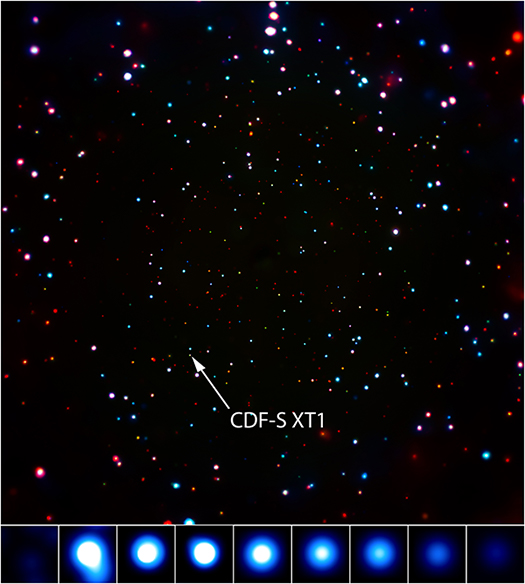 |
| Credit: NASA/CXC/Pontifical Catholic Univ./F.Bauer et al. |
***
We report on the detection of a remarkable new fast high-energy transient found in the Chandra Deep Field-South, robustly associated with a faint (mR=27.5 mag,zph ∼ 2.2) host in the CANDELS survey. The X-ray event is comprised of 115+12−11 net 0.3-7.0 keV counts, with a light curve characterised by a≈ 100 s rise time, a peak 0.3-10 keV flux of≈ 5× 10⁻¹² erg s−1 cm−2 , and a power-law decay time slope of−1.53±0.27 . The average spectral slope isΓ=1.43+0.23−0.13 , with no clear spectral variations. The \hbox{X-ray} and multi-wavelength properties effectively rule out the vast majority of previously observed high-energy transients. A few theoretical possibilities remain: an "orphan" X-ray afterglow from an off-axis short-duration Gamma-ray Burst (GRB) with weak optical emission; a low-luminosity GRB at high redshift with no prompt emission below∼ 20 keV rest-frame; or a highly beamed Tidal Disruption Event (TDE) involving an intermediate-mass black hole and a white dwarf with little variability. However, none of the above scenarios can completely explain all observed properties. Although large uncertainties exist, the implied rate of such events is comparable to those of orphan and low-luminosity GRBs as well as rare TDEs, implying the discovery of an untapped regime for a known transient class, or a new type of variable phenomena whose nature remains to be determined. See: A New, Faint Population of X-ray Transients
Subscribe to:
Posts (Atom)