PLato said,"Look to the perfection of the heavens for truth," while Aristotle said "look around you at what is, if you would know the truth" To Remember: Eskesthai
The first, “contextuality,” is a way to understand interference effects found with inferences and decisions under conditions of uncertainty. The second, “quantum entanglement,” allows cognitive phenomena to be modelled in non-reductionist ways. Quantum Models of Cognition and Decision (PDF)
Yes contextualization matters, and it is not just the math, but avenues to understanding depth psychology. This distinction was pointed out twice on rationality with regard perception and Jung, as it was written by Blutner ( -http://www.blutner.de ) One might find some information on his personal interests that I presented as a paper written by him that might help.
I did not mention his interest to music for further research (Modelling tonal attraction: Tonal hierarchies, interval cycles, and quantum probabilities.)
I mentioned the Necker Cube for a reason. If it is not an entangle state what does contextual mean? "Spread out" as if a parable? What is the essence of the parable as it is taken to mean to you becomes the entangled state. What did you get from it? Alternating back and forth the Necker Cube becomes an example of this process to say, how one can transfer back and forth between contextualize and the entanglement.
In the present literature, there are several approaches that seek for a general justification of quantum probabilities in the context of cognitive science. For example, Kitto (2008) considers very complex systems such as the growth and evolution of natural languages and other cultural systems and argues that the description of such systems cannot be separated from their context of interaction. She argues that quantum interaction formalisms provide a natural model of these systems “because a mechanism for dealing with such contextual dependency is inbuilt into the quantum formalism itself”. Hence, the question of why quantum interaction is necessary in modelling cognitive phenomena is answered by referring to its nature as a complex epistemic system.Quantum Cognition -
It is widely accepted that consciousness or, more generally, mental activity is in some way correlated to the behavior of the material brain. Since quantum theory is the most fundamental theory of matter that is currently available, it is a legitimate question to ask whether quantum theory can help us to understand consciousness. Several programmatic approaches answering this question affirmatively, proposed in recent decades, will be surveyed. It will be pointed out that they make different epistemological assumptions, refer to different neurophysiological levels of description, and use quantum theory in different ways. For each of the approaches discussed, problematic and promising features will be equally highlighted.Quantum Approaches to Consciousness -
As related earlier, if it's not in the brain where and how is quantum theory being used?
Thinking means evaluating information or ideas rationally and logically. Jung called this a rational function, meaning that it involves decision making or judging, rather than the simple intake of information. Feeling, like thinking, is a matter of evaluating information, this time by weighing one’s overall emotional response. Sensing means what it says: getting information by means of the senses. A sensing person is good at looking and listening and generally getting to know the world. Jung called this an irrational function, meaning that it involved perception rather than judgment of information. INtuiting is a kind of perception that works outside of the usual conscious processes. It is irrational or perceptual, like sensing, but comes from the complex integration of large amounts of information, rather than simple seeing or hearing. Jung said it was like seeing around corners.4 Two qubits for C.G. Jung’s theory of personality R. Blutner, E. Hochnadel / Cognitive Systems Research 11 (2010) 243–259 (pdf)
The contextualization of this example above in quote may help to see how
Quantum Cognition is understood from my perspective. If you are aware
of such a state as INtuiting, and if irrationality is to be
discerned from such an examination, how is it possible to receive the
understanding as, "judgement and decision, and even belief, before it
is made. Before one becomes entangled? To withhold Judgement, as if to
exist in such a state, means that information, is retained, as if a
parable, and while holding the information "in that state," aware of
what can happen if you become entangled?
Fig. 1. Two pairs of opposite psychological functions: Thinking and
Feeling [rational opposites], Sensation/iNtuition [irrational opposites].
Jung takes this two-dimensional representation in order to demonstrate
the dependencies between the psychological functions. For example,
Thinking and Feeling are opposites and conflict with each other (assuming
one fixed attitude). However, their effect can be modified by using the
irrational functions (Sensation and iNtuition, respectively). The numbers
enumerate eight sectors in dependence of what are the two dominant
functions (see Table 1 and the associated text for more explanations). See Paper above for information
One has to know in advance that such a decision entangles and that the understanding of the Necker cube in advance, gives an alternating relation of the parable and entanglement, as a choice before the entanglement happens.
***
In abstraction, information is liken too, the ability to gather information. You are not making a decision other then to present the equation as a source of information. This is currently be described as the quantifiable. It is a parable of sorts, until, the equation leads to a pure state. A self evident state. Then, you are entangled.
So are people just incapable of thinking logically? Maybe. But in recent years a number of investigators have developed the view that those supposedly irrational choices merely reflect the fact that people’s brains are guided by the mathematical principles of quantum physics. Quantum math makes human irrationality more sensible
Now you must understand while this supposed question of the understanding behind a Platonist heaven has some place here in the conversation, I had been pushing forward. I am of course interested in the science, so as to understand reality. So what follows has been on the books of metaphysics for sometime it seems. I want to clarify these thoughts and ideas in context of today's science. What is truth and what is not.
This video had been cut to form "another video." It is important to see how this was done. Go to the time of the original video on display of 20:15 and see where this continues in second video.
Perception, is an interesting subject.
Yet
logically another non-dual option remains, namely virtualism, that a
mind-independent, non-physical reality outputs the physical world
by processing. In this admittedly radical view, the "ghostly" world of quantum theory is
real and the physical world is like a screen image thrown up The Virtual Reality Conjecture -http://arxiv.org/ftp/arxiv/papers/1110/1110.3307.pdf
On page 16 of VR conjecture I noticed a link at bottom of page that lead me to a video that I thought interesting. But, at the same time, the end, was quite shocking( See: The Real Absolute Being at 20:15)
The shift over to a universal permanence by name, had me wondering how
many had jumped the gun, to have given this reality, a name? Advanced
the issue of religion, as was entitled by name to see that it occupied,
as if a place. A place in Plato's Heaven. So you choose who by name
your (Absolute Real Being), Metaphysics has then lead us to this?
But honestly, you have to see the first part up to 20:15 and especially
at 15:26 with regard to the perceived. Now, how guilty should I have
been to see that I held some similar belief, that I may refer to the
Platonist heaven as a function of the wave, now sees some Islamic
fundamentalism that takes hold. No, it does not have to go by the name
of Allah as it is spoke of by inference as that of the Holy Grail, in
original video?
So while having been deflected as to follow a link on a page, the real
issue here is what the first part of the video is speaking too. Any
problems with this to help identify the Self?
Now of course how this video was used is important. The issue of Quantum cognition is important to see some perspectives as they have been revealed as metaphysical as well an understanding that we are in need of qualifying the process of sight, as issues of Quantum Theory?
***
Quantum Models of Cognition and Decision
Much of our understanding of human thinking is based on probabilistic models. This innovative book by Jerome R. Busemeyer and Peter D. Bruza argues that, actually, the underlying mathematical structures from quantum theory provide a much better account of human thinking than traditional models. They introduce the foundations for modelling probabilistic-dynamic systems using two aspects of quantum theory. The first, “contextuality,” is a
way to understand interference effects found with inferences and decisions under conditions of uncertainty. The second, “quantum entanglement,” allows cognitive phenomena to be modelled in non-reductionist ways. Employing these principles drawn from quantum theory allows us to view human cognition and decision in a totally new light. Introducing the basic principles in an easy-to-follow way, this book does not assume a physics background or a
quantum brain and comes complete with a tutorial and fully worked-out applications in important areas of cognition and decision.Quantum Models of Cognition and Decision -
In relation to the parable and what is distinct in the parable, was an example that I thought to bring forward as I understood it. This help me to see how quantum cognition is used(contextualized and entangled") and are looked at. Without a reductionist view, entangled takes on new meaning as to make a judgement or a decision. To make a distinction, means that in the parable you have decided, while interference, is a type of wave.
The necker Cube is important here.
The Necker cube is used in epistemology (the study of knowledge) and provides a counter-attack against naïve realism. Naïve realism (also known as direct or common-sense realism) states that the way we perceive the world is the way the world actually is. The Necker cube seems to disprove this claim because we see one or the other of two cubes, but really, there is no cube there at all: only a two-dimensional drawing of twelve lines. We see something which is not really there, thus (allegedly) disproving naïve realism. This criticism of naïve realism supports representative realism. Necker cube -
Bold added to emphasize, direct and indirect realism.
Again, I am not qualified to the extent to say parable is a good example, but, I think this will help greatly to look at as an example and the Necker cube, as given in the following quotes.
The Necker cube is a paradigmatic example for bistable perception where pattern reversal obeys a particular probability distribution. Atmanspacher, Filk and Römer (2004) discussed this switching dynamics in terms of the quantum Zeno effect where “observation” (here attending to a percept) increases the dwell-time of an otherwise fast decaying unobserved state. Quantum Cognition, Bistable perception -
I think by giving examples one might understand this better, and I wonder if there are others who understand, who can help describe the physics of, in the way it was here. Quantum theory is essential here then. Judgement and decisions, are entangled states.
Niels Bohr, one of the founding fathers of quantum physics, suspected
that it could provide insights into human psychology. Now a new field
called quantum cognition is exploring how quantum math can explain some
seemingly irrational human behavior. See: Quantum math makes human irrationality more sensible
Quantum cognition community states that the activity of such neural networks can produce effects which are formally described as interference (of probabilities) and entanglement. In principle, the community does not try to create the concrete models of quantum (-like) representation of information in the brain
Experiments at RHIC and the LHC have complementary strengths in studying
the quark-gluon plasma, a state of matter in which quarks come unbound.
Image: Brookhaven National Laboratory. See also: Experiments reveal new techniques in studying quark-gluon plasma
To an empiricist, reality means to make use of the sensory world and you have to be able to understand what rationality is to you. Rationality make uses of other ways in which to recognize that such pure states, as they have been studied, help to see that such derivations do have a logical end.
In the form of the good, there is no need to add anything else, but to wait and see how such pure states become an empiricists dream of reality. How does one divorce themselves of that other side of the reality of a quantum realism but to understand the physical realism is derived from that state? To understand a beautiful equation this understanding is necessary.
Life must be understood backwards; but... it must be lived forward. Soren Kierkegaard
If consciousness is able to abstract, then consciousness is able to survive a heat death by going back to the beginning of the universe with those abstractions? Consciousness, is able to survive a heat death by mathematically abstracting, then ones consciousness can indeed reach a Pure State.
Since
entropy gives information about the evolution of an isolated system
with time, it is said to give us the direction of "time's arrow" . If
snapshots of a system at two different times shows one state which is
more disordered, then it could be implied that this state came later in
time. For an isolated system, the natural course of events takes the
system to a more disordered (higher entropy) state. -http://hyperphysics.phy-astr.gsu.edu/hbase/thermo/seclaw.html
The
concept of entropy and the second law of thermodynamics suggests that
systems naturally progress from order to disorder. If so, how do
biological systems develop and maintain such a high degree of order? Is
this a violation of the second law of thermodynamics? -http://hyperphysics.phy-astr.gsu.edu/hbase/thermo/bioentropy.html#c1
So I may talk about a gap, but what is Stuart saying. So as a Platonist, we do not just see mathematics, but we see other things.
In a logical process, objective reductionism(ORCH) takes you to a certain point. Your aware of this point, and you can go back and look at the theory so as to suggest what consciousness is actually doing in that state. Penrose is actually telling us about the differences, regarding use of consciousness versus the computational view.
So with regard to this phenomenological association between two people, as Stuart and Sir Roger, they are melding "the abstract" to the biology.
I asked if one could see a contradiction and I think if you look at what Stuart is saying here how does this fit with ideas about entropy?
Dr.
Amanda Peet (University of Toronto) delivers a public lecture on how
string theory can provide the "Legos" of the universe to understand
phenomena like black holes. The talk was held at Perimeter Institute on
May 6, 2015. See: Perimeter Public Lecture: String Theory Legos for Black Holes
The direct realist view [11] is incredible because it suggests that we can have experience of objects out in the world directly, beyond the sensory surface, as if bypassing the chain of sensory processing.
The pattern of electrochemical activity that corresponds to our
conscious experience can take a form that reflects the properties of
external objects, but our consciousness is necessarily confined to the experience of those internal effigies of external objects,
rather than of external objects themselves. Unless the principle of
direct perception can be demonstrated in a simple artificial sensory
system, this explanation remains as mysterious as the property of
consciousness it is supposed to explain.[1] But the indirect realist
view is also incredible, for it suggests that the world that we perceive
is merely a pattern of energy in the physical brain inside our head.
This could only mean that the head we have come to know as our own is
not our true physical head, but merely a miniature copy of it inside a
copy of the world contained within our true physical skull. outside.The
external world and its phenomenal replica cannot be spatially
superimposed, for one is inside your physical head, and the other is
The existential vertigo occasioned by this concept of perception is so
disorienting that only a handful of researchers have seriously
entertained this notion or pursued its implications to its logical
conclusion. (Kant 1781/1991, Koffka 1935, Köhler 1971 p. 125, Russell
1927 pp 137–143, Smythies 1989, 1994, current, Harrison 1989, Hoffman
1998, Lehar current, Hameroff current)"[1] Direct and indirect realism
What is the value of an awareness of "a construct"
that we would assign as a background a formulation of the perceived by
the perceiver? An archetype, created? A top down recognition in the square of opposition's use of the transcendent which could reveal an
understanding of the essence of universals in face of "statistical
prediction" in today's world? Symmetry.
A digital manifestation perhaps then that is clearly marked as to a
recognition of a type of realism, or is it just noise(coherence as a
contradiction). I might say that the realism here suggests to me a
underlying recognition of the ability to perceive, to recognize facets
of it own creation as to suggest, that it is quite capable of its
ability to perceive beyond the confines of the construct given as a
reality.
The
connection between superfluidity and symmetry breaking has had a
glorious history. It has left us a rich legacy of fertile ideas, that
seems far from exhaustion. PG 60 Superfluidity and Symmetry Breaking
***
Yes there were thoughts about the nature of the gap and you had asked to me to define this. I had trouble doing so even though the nature of the reduction was a gap with which information to me was accessible.
"Penrose Physics, Microtubules & Consciousness
psyche-d / March 15, 1995
According to the arguments for OR put forth in Penrose (1994),
superposed states each have their own space-time geometries (see
Shadows of the Mind, p. 338). When the degree of coherent mass-energy
difference leads to sufficient separation of space-time geometry, the
system must choose and decay (reduce, collapse) to a single universe
state [avoiding the need for multiple universes as discussed by, for
example, Everett (1957) and Wheeler (1957)]. In this way, a transient
superposition of slightly differing space-time geometries persists
until an abrupt quantum to classical reduction occurs. If as various
philosophers claim (cf. Chalmers, 1994; 1996) the nature of conscious
experience is somehow embedded in the nature of reality,
self-selections in fundamental space-time geometry may address the
"hard problem" of consciousness.
Unlike the random, "subjective reduction" (SR, or R) of standard
quantum theory caused by observation or environmental entanglement, the
OR we propose in microtubules is a self-collapse and it results in
particular patterns of microtubule-tubulin conformational ("eigen-")
states that regulate neuronal activities including synaptic functions.
Possibilities and probabilities for post-reduction tubulin states are
influenced by factors including attachments of microtubule-associated
proteins (MAPs) acting as "nodes" which tune and "orchestrate" the
quantum oscillations. We thus term the particular self-tuning OR
process in microtubules "orchestrated objective reduction" ("Orch OR"),
and calculate an estimate for the number of tubulins (and neurons)
whose coherence for relevant time periods (e.g. 500 milliseconds) will
elicit Orch OR.
Stuart Hameroff"
The Platonist reality to me was a recognition of a informational reality where all information exists as energy, and that such integration with the physical body was a connection through the synapse as a reductionist ability to form through wave length function.
The point I wanted to make was that it is was as if there are two heads, that if it could be seen, one head moves through a whole wave length function potential as if walking through an ocean of wavelength like reality called information and such reduction of that information had to have a link between the material world in the brain/mind. I am trying to gather my thoughts here. Be clearer.
My thought of a glass of water was analogous here to what can exist in between a space , and have solid matter added to the glass without raising the water, somehow had me envision the gap in the water, as revealing the potential of that matter as filling a space that was not immediately obvious, but exists.
Matter then is not a solid.....but a potential realization of a condensation of that wave function. I am not altogether clear here.....so I am working on this.
I think it is right to point out universal permeate of that energy as information. Think of the pattern of the quasi-crystal as consolidating wavelength like pattern. A pure state. How much closer are we then to recognize a wavelike pattern(chaldni) as an emergent product pattern of the idea?
I am having some difficulties here in solidifying a position here as to it being completely sound, so I am open to having philosophical interaction to help make this so.
***
Knowing Penrose's attribute toward a Platonist ideal, the Goldberg idea may have come from how he saw what could be happening within the
cosmic background as demonstration cyclical to the universe as always
being born in certain locations(CCC). While now showing this theory to be false as defined as circles and located in WMAP, one gets a sense of his thinking of a Platonist.
The answer lies in the fact that the high entropy of the microwave background refers only to the matter content of the universe and not to the gravitation field, as would be encoded in its space-time geometry in accordance with Einstein’s general relativity. What we find, in the early universe, is an extraordinary uniformity, and this can be interpreted as the gravitational degrees of freedom that are potentially available to the universe being not excited
at all. As time progresses, the entropy rises as the initially uniform distribution of matter begins to clump, as the
gravitational degrees of freedom begin to be taken up. BEFORE THE BIG BANG: ;AN OUTRAGEOUS NEW PERSPECTIVE AND ITS IMPLICATIONS FOR PARTICLE PHYSICS
Sir Roger Penrose was really fond of Escher .How might on see a relationship to Goldberg?
Penrose's Influence on Escher
During the later half of the 1950’s, Maurits Cornelius Escher received a
letter from Lionel and Roger Penrose. This letter consisted of a report
by the father and son team that focused on impossible figures. By this
time, Escher had begun exploring impossible worlds. He had recently
produced the lithograph Belvedere based on the “rib-cube,”
an impossible cuboid named by Escher (Teuber 161). However, the letter
by the Penroses, which would later appear in the British Journal of
Psychology, enlightened Escher to two new impossible objects; the
Penrose triangle and the Penrose stairs. With these figures, Escher went
on to create further impossible worlds that break the laws of
three-dimensional space, mystify one’s mind, and give a window to the
artist heart.
***
How does one recognize "pure states?" There is a lot of science that is
attached to this, and if one has not done their homework they might
never understand exactly what this means. To relate self in this picture
would somehow seem contradictory, but, as an idea regarding symmetry,
one has to be able to speak about this possibility as well too.
While seemingly lost in history as to thinking its all Greek and not
worth the time, there is more now to this realization having given some
perspective about the Platonist that is current.
Well in today's world we might know what that might mean, not given
time to further inspect what is being said. So we might call it this
"other thing," a metaphysics. As a Platonist, I see the third realm as
informational energy, so getting to that "as a pure state[a
Form of the Good]," would in my view reveal something quite intrinsic
about how we use that information. How we get to that information.
My question for you, recognizing that we are quite capable of getting
to that informational energy, how do you resolve the quote given by Sir Roger
Penrose given the Second law of thermodynamics with
regards to entropy? You see the contradiction?
You see Sir Roger Penrose had to be able say that such mini big bangs happen all
the time.......and they do. Do you know where such pure states are given
when considering this idea? Its happening in nature all around us right
now. So if you assume this, how do we recognize it? While I hint here
at (more then)one demonstration of a pure state, there is another.
Kant, however, is correct in that we inevitably try and conceive of transcendent, which means unconditioned, objects. This generates "dialectical illusion" in the Antinomies
of reason. Kant thought that some Antinomies could be resolved as
"postulates of practical reason" (God, freedom, and immortality); but
the arguments for the postulates are not very strong (except for
freedom), and discarding them helps guard against the temptation of
critics to interpret Kant in terms of a kind of Cartesian
"transcendental realism" (i.e. real objects are "out there," but it is
not clear how or that we know them). If phenomenal objects, as
individuals, are real, then the abstract structure (fallibly) conceived
by us within them is also real. Empirical realism for phenomenal
objects means that an initial Kantian Conceputalism turn into a Realism for universals. See: Meaning and the Problem of Universals, A Kant-Friesian Approach
It s always interesting for me to see what constitutes a Platonist in the world today. So I had to look at this question. There always seems to be help when you need it most, so information in the truest sense, is never lacking, but readily available as if taken from some construct we create of the transcendent.
***
Platonism,
rendered as a proper noun, is the philosophy of Plato or the name of
other philosophical systems considered closely derived from it. In
narrower usage, platonism, rendered as a common noun (with a lower case
'p', subject to sentence case), refers to the philosophy that affirms
the existence of abstract objects, which are asserted to "exist" in a
"third realm" distinct both from the sensible external world and from
the internal world of consciousness, and is the opposite of nominalism
(with a lower case "n").[1] Lower case "platonists" need not accept any
of the doctrines of Plato.[1]
In a narrower sense, the term might indicate the doctrine of Platonic
realism. The central concept of Platonism, a distinction essential to
the Theory of Forms, is the distinction between the reality which is
perceptible but unintelligible, and the reality which is imperceptible
but intelligible. The forms are typically described in dialogues such as
the Phaedo, Symposium and Republic as transcendent, perfect archetypes,
of which objects in the everyday world are imperfect copies. In the
Republic the highest form is identified as the Form of the Good, the
source of all other forms, which could be known by reason. In the
Sophist, a later work, the forms being, sameness and difference are
listed among the primordial "Great Kinds". In the 3rd century BC,
Arcesilaus adopted skepticism, which became a central tenet of the
school until 90 BC when Antiochus added Stoic elements, rejected
skepticism, and began a period known as Middle Platonism. In the 3rd
century AD, Plotinus added mystical elements, establishing Neoplatonism,
in which the summit of existence was the One or the Good, the source of
all things; in virtue and meditation the soul had the power to elevate
itself to attain union with the One. Platonism had a profound effect on
Western thought, and many Platonic notions were adopted by the Christian
church which understood Plato's forms as God's thoughts, while
Neoplatonism became a major influence on Christian mysticism, in the
West through St Augustine, Doctor of the Catholic Church whose Christian
writings were heavily influenced by Plotinus' Enneads,[2] and in turn
were foundations for the whole of Western Christian thought" Platonism
***
Now beauty, as we said, shone bright among those visions, and in this
world below we apprehend it through the clearest of our senses, clear
and resplendent. For sight is the keenest of the physical senses, though
wisdom is not seen by it -- how passionate would be our desire for it,
if such a clear image of wisdom were granted as would come through sight
-- and the same is true of the other beloved objects; but beauty alone has this privilege, to be most clearly seen and most lovely of them all.
[Phaedrus, 250D, after R. Hackford, Plato's Phaedrus, Library of the
Liberal Arts, 1952, p. 93, and the Loeb Classical Library, Euthryphro
Apology Crito Phaedo Phaedrus, Harvard University Press, 1914-1966,
p.485, boldface added]
For example, thought cannot be attributed to the One because thought
implies distinction between a thinker and an object of thought (again
dyad). Even the self-contemplating intelligence (the noesis of the nous)
must contain duality. "Once you have uttered 'The Good,' add no
further thought: by any addition, and in proportion to that addition,
you introduce a deficiency." [III.8.10] Plotinus denies sentience,
self-awareness or any other action (ergon) to the One [V.6.6]. Rather,
if we insist on describing it further, we must call the One a sheer Dynamis or potentiality without which nothing could exist. [III.8.10]
As Plotinus explains in both places and elsewhere [e.g. V.6.3], it is
impossible for the One to be Being or a self-aware Creator God. At
[V.6.4], Plotinus compared the One to "light", the Divine Nous (first
will towards Good) to the "Sun", and lastly the Soul to the "Moon"
whose light is merely a "derivative conglomeration of light from the
'Sun'". The first light could exist without any celestial body. Plotinus -
***
"...underwriting the form languages of ever more domains of
mathematics is a set of deep patterns which not only offer access to a
kind of ideality that Plato claimed to see the universe as created with
in the Timaeus; more than this, the realm of Platonic forms is itself
subsumed in this new set of design elements-- and their most general
instances are not the regular solids, but crystallographic reflection
groups. You know, those things the non-professionals call . . .
kaleidoscopes! * (In the next exciting episode, we'll see how Derrida
claims mathematics is the key to freeing us from 'logocentrism'-- then
ask him why, then, he jettisoned the deepest structures of mathematical
patterning just to make his name...)
* H. S. M. Coxeter, Regular Polytopes (New York: Dover, 1973) is the
great classic text by a great creative force in this beautiful area of
geometry (A polytope is an n-dimensional analog of a polygon or
polyhedron. Chapter V of this book is entitled 'The Kaleidoscope'....)"
So what is Coxeter saying in relation to Derrida? I think this is
more the central issue. On the one hand images speak to what perception
is capable of, beyond normal eyesight and without concepts, reiterated in the nature of the discussion about animals. This is what
animals lack, given they do not have this conceptual ability, just that
they are able to deduct, was what I was looking for as that discussion
emerged and evolved.
If
there is a Platonic Ideal Form then there must be an ideal
representation of such a form. According to logocentrism, this ideal
representation is the logos.
Think of what the Good means again here that it cannot decay into
anything else when it is recognized, and that any other wording
degrades. If you can draw from experience then in a way one is able to
understand this. I had mention an archetype as a medium toward which one
could meet the good, and in that find that the archetype itself,
contain in the good, allows this insight to be shared. The whole scene
is the transmission of the idea, can become the ideal in life. This is
an immediate realization of the form of the good. It needs no further
clarification......at the deepest levels you recognize it. You know, and
you know it as a truth.
Understanding the foundations of Mathematics is important.
So I relay an instance where one is able to access the good.......also
in having mentioned that abstraction can lead to the good. This
distinction may have been settle in regard to the way in which Coxeter
sees and Derrida sees, in regards to the word, or how Coxeter sees
geometrically.
This is a crucial point in my view that such work could see the pattern
in the form of the good. This is as to say, and has been said, that such
freedom in realization is to know that the fifth postulate changed the
course of geometrical understandings. This set the future for how such
geometries would become significant in pushing not only Einstein
forward, but all that had followed him, by what Grossman learned of
Riemann. What Riemann learned from Gauss.
SOCRATES: Tell me then, by Zeus, what is that excellent [págkalon, "all beautiful"] aim [érgon, "work, deed"] that the gods achieve, using us as their servants?
In the Republic, Plato sets aside a direct definition of the "good itself" (autò t'agathón). Socrates says that instead we will get something in the nature of the "offspring" (ékgonos) or "interest" (tókos) on the good [Republic,
506 E]. For this "offspring," Plato offers an analogy: The Good is
to the intelligible world, the world of Being and the Forms, as the sun
is to the visible world. As light makes vision possible in the material
world, and so also opinion about such objects, the Form of the Good
"gives their truth to the objects of knowledge and power of knowing to
the knower..." [Loeb Classical Library, Plato VI Republic II,
translated by Paul Shorey, Harvard University Press, 1935-1970,
pp.94-95]. Furthermore, the objects of knowledge derive from the Form
of the Good not only the power of being known, but their "very existence
and essence" (tò eînaí te kaì hè ousía) [509B], although the Good itself "transcends essence" in "dignity and power" [ibid. pp.106-107]. The word here translated "essence" is ousía, which in Aristotelian terminology is the essence (essentia)
of things, i.e. what they are. If Plato has something similar in mind,
then the objects of knowledge derive from the good both their existence
and their character. See: A Lecture on the Good, by Kelley L. Ross, Ph.D.
***
This below was a earlier attempt to define the idea of the Good and Form
in context of the painting called Betrayal of Images" by Rene Magritte.
1929 painting on which is written "This is not a Pipe"
                    Probabilties
                 (The Fifth Dimension)
                         |
                         |
                  Idea of the pipe
                        / \
                       /   \
                      /     \
                 Picture of the pipe
                    /         \
                   /           \
                  /             \
               The real pipe and form
The fifth dimension was a attempt by myself to explaining the
dimensional shift from the four dimension(space-time) to the fifth. Four
leads into three was an ancient idea(Quadrivium ad Trivium) that came to
mind that we may seek to explain as humanities attempt at perfecting.
But at the same time such a descendent from the heaven into the mind of
humanity, as the idea. A effective expression of the idea into form.
So such truths were important to me as to how we discover them. I am
saying that this is a capable feature in all of us, and it was an
attempt to explain how this is done. Deductive Logic while a
representation of Aristotle, Aristotle pointed the way toward Plato.
Aristotle pointed the way to Plato's explanation of the Good as it may
have meant to Plato and what Aristotle may of disagreed with.
Plato's use of Socrates in the dialogues was specific to Plato's
explaining what he meant by heaven. This is not a theological revelation
for Christianity in my view as to the principles of Plato, as to what
heaven meant. But something quite capable as to what heaven may mean as
we grasp the understanding of the Good and inspection as to the Theory
of Forms.
Indirectly, Aristotle then introduce the idea then of the universal and the particulars?
***
Distances” Determine Geometry
Describe an object with a table of distances between points.
Describe spacetime with a table of intervals between events
It is not my purpose in this discussion to represent the general theory
of relativity as a system that is as simple and as logical as possible,
and with the minimum number of axioms; but my main object here is to
develop this theory in such a way that the reader will feel that the
path we have entered upon is psychologically the natural one, and that
the underlying assumptions will seem to have the highest possible degree
of security.
—Albert Einstein
http://www.eftaylor.com/pub/chapter2.pdf
***
"Symmetry breaking illustrated": – high energy levels (left) the
ball settles in the center, and the result is symmetrical. At lower
energy levels (right), the overall "rules" remain symmetrical, but the
"Mexican hat" potential comes into effect: "local" symmetry inevitably
becomes broken since eventually the ball must roll one way (at random)
and not another.
If one recognizes such a state as to imply that Heaven exists in such
perfection and beauty, then what causes the asymmetry to be broken?
Moving into a dualistic notion of operation, would signify a symmetry
breaking?
The
term “symmetry” derives from the Greek words sun (meaning ‘with’ or
‘together’) and metron (‘measure’), yielding summetria, and originally
indicated a relation of commensurability (such is the meaning codified
in Euclid's Elements for example). It quickly acquired a further, more
general, meaning: that of a proportion relation, grounded on (integer)
numbers, and with the function of harmonizing the different elements
into a unitary whole. From the outset, then, symmetry was closely
related to harmony, beauty, and unity, and this was to prove decisive
for its role in theories of nature. In Plato's Timaeus, for example, the
regular polyhedra are afforded a central place in the doctrine of
natural elements for the proportions they contain and the beauty of
their forms: fire has the form of the regular tetrahedron, earth the
form of the cube, air the form of the regular octahedron, water the form
of the regular icosahedron, while the regular dodecahedron is used for
the form of the entire universe. The history of science provides another
paradigmatic example of the use of these figures as basic ingredients
in physical description: Kepler's 1596 Mysterium Cosmographicum presents
a planetary architecture grounded on the five regular solids.Symmetry and Symmetry Breaking -The Concept of Symmetry
Symmetry Breaking, means to measure.
***
One may need to recognize some aspect of consciousness and its
capabilities, and thus, the parameters by which one thinks of how their
consciousness operates, can become the limitations that that one
applies to all(deluded). This then becomes "an application" to self.
An
analogy to this situation might be what is thought to happen to the
forces of nature in modern physics, where a single, original, unified
force is separated into several forces by "spontaneous symmetry
breaking." The form of consciousness as, according to Brentano and
Husserl, the intentional relationship of subject and object, itself
represents an asymmetry, breaking the symmetry of an existence where
there is no distinction between subject and object. Existence as
such is thus broken by the form of consciousness, and it becomes the
forms of value, good and evil, right and wrong, the beautiful and the
ugly, etc., as these vary independently over and against the simple
factual existence of objects in the phenomenal world, or even against
each other in the phenomenon of moral dilemmas (i.e. doing right results
in evils, while doing wrong results in goods). A Lecture on the Good -http://www.friesian.com/good.htm
Bold added for emphasis by me.
The
connection between superfluidity and symmetry breaking has had a
glorious history. It has left us a rich legacy of fertile ideas, that
seems far from exhaustion. PG 60 Superfluidity and Symmetry Breaking
You have to know what your doing when you apply those constraints to yourself. So maybe, there is this bigger picture.
Pierre Curie (1894): “Asymmetry is what creates a phenomenon.”
So we go after the essence of things in a logical way?
A question then that comes to mind is that if equations can become
beautiful what were equations before? If taken in context of Aristotle,
Objective deduction of information from induction, reveals the self
evident principle?
The link to the following video will reveal this as a question about
beauty, and without directing you to the answer, I want to see if you
are quite capable of retrieving that answer.
Einstein was married to logic. But Einstein realized something, that
helped him see "the before," as a necessary component in order to talk
about "the nature of the equation?"
I am contending that when we think of Aristotle as we see science progress in the times, while further consider refinement in the Boolean perspective. But in essence, one needs to be able to see in the Platonist way before one can move to the understanding of what beauty actually means.
....what was the equation?
Are you currently working towards a unified field theory?
***
So the beauty of the moment had to be clarified in certain terms, so as to be seen and understand that it could be seen.
Now
beauty, as we said, shone bright among those visions, and in this world
below we apprehend it through the clearest of our senses, clear and
resplendent. For sight is the keenest of the physical senses, though
wisdom is not seen by it -- how passionate would be our desire for it,
if such a clear image of wisdom were granted as would come through sight
-- and the same is true of the other beloved objects; but beauty alone has this privilege, to be most clearly seen and most lovely of them all.
[Phaedrus, 250D, after R. Hackford, Plato's Phaedrus, Library of the
Liberal Arts, 1952, p. 93, and the Loeb Classical Library, Euthryphro
Apology Crito Phaedo Phaedrus, Harvard University Press, 1914-1966,
p.485, boldface added]
It is important to understand the basis of examination in terms of measure, requires us in this case to be able to see in a certain spectrum.
Heisenberg originally formulated his ideas in terms of a relationship between the precision of a measurement and the disturbance it must create. Although this latter relationship is not rigorously proven, it is commonly believed (and taught) as an aspect of the broader uncertainty principle. Here, we experimentally observe a violation of Heisenberg’s “measurement-disturbance relationship”, using weak measurements to characterize a quantum system before and after it interacts with a measurement apparatus. http://journals.aps.org/prl/abstract/10.1103/PhysRevLett.109.100404
The Multi-scale Entanglement Renormalization Ansatz (MERA) is a tensor
network that provides an efficient way of variationally estimating the ground
state of a critical quantum system. The network geometry resembles a
discretization of spatial slices of an AdS spacetime and "geodesics" in the
MERA reproduce the Ryu-Takayanagi formula for the entanglement entropy of a
boundary region in terms of bulk properties. It has therefore been suggested
that there could be an AdS/MERA correspondence, relating states in the Hilbert
space of the boundary quantum system to ones defined on the bulk lattice. Here
we investigate this proposal and derive necessary conditions for it to apply,
using geometric features and entropy inequalities that we expect to hold in the
bulk. We show that, perhaps unsurprisingly, the MERA lattice can only describe
physics on length scales larger than the AdS radius. Further, using the
covariant entropy bound in the bulk, we show that there are no conventional
MERA parameters that completely reproduce bulk physics even on super-AdS
scales. We suggest modifications or generalizations of this kind of tensor
network that may be able to provide a more robust correspondence. See: http://arxiv.org/abs/1504.06632
I mean the deductive logic while being objective according to being logical, to get to that point of knowing, was a exploration into the way deductive logic was being used. I think deductive logic is before Aristotelian from what I understand and to get to that point is critical.
As Plato tells it, the beautiful orderliness of the universe is not only the manifestation of Intellect; it is also the model for rational souls to understand and to emulate.
Such understanding and emulation restores those souls to their original
state of excellence, a state that was lost in their embodiment. There
is, then, an explicit ethical and religious dimension to the discourse.
Plato's Timaeus -Zeyl, Donald, "Plato's Timaeus", The Stanford
Encyclopedia of Philosophy (Spring 2014 Edition), Edward N. Zalta (ed.),
Belief and Intent are very important here as the person comes to a position of judgment. I do not need to talk about the person, their qualities as a human being other then to know that people in general what ever their profession make judgements, and these become the intent, even if they wish to connect in that moment. Why Judgement is so important as a finality to making a decision about things. This in that moment as to recognizing the intent, betrays the pursuit of what is wanted to be known, so there is this to consider.
The link to Ian I remember. Sort of brings up another point I wish to reveal in consideration of that moment. This I connected to synchronicity a long time ago, as I read Jung. As TC mentions intent is very important, and freewill in this life as the person "is" an able function while we are here. This moment is directly connected to logic and deja vu. The moment, is a parallel recognition of something forward in time, as to a recognition of the course you are following in that moment, and why you recognize it. It confirms, that you are following the correct path.
I mentioned the Park , to show that this has been with me for almost 50 years now so as to decipher the way in which I as individual could connect to the data as information from in the Larger Consciousness System( LCS.) That experience was located in the dream environment, so such a construct of images of people what ever their religion could call this philosopher a God, or, what ever their religion may be, was a time of respect in the encounter.
The point was this connection to the LCS was a method that I was able to recognize, and consequent information reveal an understanding of the point I had been referring too, after all these years. I had time then to perfect that method. While living I had no access to teachers, so I had to find the teacher in me to connect for the answers. Why I would profess that people have this ability in them to be the teacher and student at once. Why, I want to drive people to this point. It s a small moment of enlightenment if you will that had intrigue my life ever since.
Now people talk about magic, and I understand that there is this possibility that they will see something that will not follow all the rules we have come to know of in science, so this is why I engage science. Why I followed the development of quantum gravity. Go ahead quote and use any knowledgeable person you would like and you cannot change the experience( I am referring to an objective experience). A person of that ilk will know something about science that not everyone else knows. My perspective with regard to materialism was well formed before TC came along. The mystery of what is not know of consciousness, as we learn to recognize, will eventually become an ability of its use.
Newtonian
science became a central issue in the assault waged by the philosophes
in the Age of Enlightenment against a natural philosophy based on the
authority of ancient Greek or Roman naturalists or on deductive reasoning from first principles
(the method advocated by French philosopher René Descartes), rather
than on the application of mathematical reasoning to experience or
experiment. Voltaire popularised Newtonian science, including the
content of the both the Principia and the Opticks, in his Elements de la
philosophie de Newton (1738), and after about 1750 the combination of
the experimental methods exemplified by the Opticks and the mathematical
methods exemplified by the Principia were established as a unified and
comprehensive model of Newtonian science. Some of the primary adepts in
this new philosophy were such prominent figures as Benjamin Franklin,
Antoine-Laurent Lavoisier, and James Black. Reception
I find "incubation" a good term with regard to intent. Distillation, an apt term to decipher the context of one's life experience, and of the understanding emotion. Emotion, as if used in a olfactory sense, provide for the impetus for memory to be placed in existence as data. I associated the collective unconscious as a permeation of a fabric of reality as all that exists as data, as information. Water would not be understood without understand the emotive quality that one might assign to it. How fluid as a substance that flows through the body as a distillation as memory would leave nothing but the hard fact of ones experience..Ouspensky, was good and finding that point in between the moments.
After
purchasing and studying Newton's alchemical works in 1942, economist
John Maynard Keynes, for example, opined that "Newton was not the first
of the age of reason, he was the last of the magicians". Isaac Newton's occult studies
So in a sense, I may have given a glimpse of the man known as Sir Isaac Newton, as being in such a question as to understand his biology, to see that the use of distillation, was a form of deductive logic. I had come to recognize it did not lessen the ability of Sir Issac Newton to be shown as a suspected illogical side to him while he wrote his Optics, but a better understanding by him of the matters that course through him, and as matters in the earth.
Austrian-born
physicist and theoretical biologist Erwin Schrödinger, one of the
founders of quantum theory in physics, also became one of the first
scientists to suggest a study of quantum biology in his 1944 book What
Is Life?. Quantum biology
Before computers came along, we existed, and so did libraries as data banks of information, but still the cataloged data as that kind of information did not speak to what could be gained from using intent to find answers, so it had to be found somewhere.
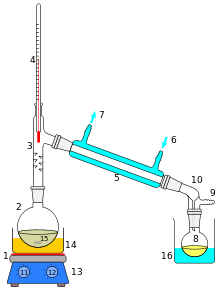
Laboratory display of distillation: 1: A source of heat 2: Still pot 3: Still head 4: Thermometer/Boiling point temperature 5: Condenser 6: Cooling water in 7: Cooling water out 8: Distillate/receiving flask 9: Vacuum/gas inlet 10: Still receiver 11: Heat control 12: Stirrer speed control 13: Stirrer/heat plate 14: Heating (Oil/sand) bath 15: Stirring means e.g. (shown), boiling chips or mechanical stirrer 16: Cooling bath.[1]
Steam to ice, water, is a fundamental examination of states as
matter? Water, can exist in varying states. Steam, is a more rarefied
form of matter.
Thales
of Miletus (/ˈθeɪliːz/; Greek: Θαλῆς (ὁ Μιλήσιος), Thalēs; c. 624 – c.
546 BC) was a pre-Socratic Greek philosopher from Miletus in Asia Minor
and one of the Seven Sages of Greece. Many, most notably Aristotle,
regard him as the first philosopher in the Greek tradition.[1] Aristotle
reported Thales' hypothesis about the [originating principle][further
explanation needed] of nature and the nature of matter – that it was a
single material substance: water.-http://en.wikipedia.org/wiki/Thales
Water then, is the basis of information, and as Thales may have
said, such a fundamental existence to such a state of reality. I
believe information can be describe as a type of matter? Some
information is much more fluid, or, some information quite rarefied.
Some such information is quite solid in its consolidation.
One could believe that by association as an analogy of the [Dung
beetle]could have relevance here, as to how its young are placed in the
middle of a ball of elephant shit. The life of the dung beetle grows
from the center outward. In this case intent, as well as the embryo for
growth, has to have information around it in order to sustain its state
of matter. But, in essence, the state of the information, was planted
as a seed. Consolidated.
Magic by definition, as a noun.....as to influencing a course of events
supernaturally or mysteriously. If taken to mean that will by choice
can be used to determine "change," then, what is so mysterious about
the outcome?
It is a mistaken notion to me to suggest that reason destroys this
ability. This is to suggest, that such a pursuit as to access
information in a fundamental way, that opens the path way to that
information works, as if, intent is cast into the oceans of
possibilities.
Fundamentally, one has to be able to believe, and by such a process
understand that such intent, as a focus, can be sent somewhere so as to
retrieve that information. Without doing this, or believing this there
is no chance of setting up the intent to gather information. This
because information needs to be able to be accessed.
So, where is this information?
I have come to believe that information is everywhere around us. That
consciousness is quite able to access information. The difference is,
that what enters awareness first is a subjective visualization of the
information in its condition, so as to say that the data has been saved
as in the information package. That such access to that data package is a
linked by the very intent, as if to understand the focus of one's
intent, has a direct connection. So you not only have to believe it is
possible, but that you understand how it is you can use your intent to
create that link.
By analogy, I had served this example as if to say, that if you go
fishing, you cast a line into the ocean of possibilities, but on your
hook you need the bait. This so as to suggest, the information is
linked to the intent of your fishing. So you send your line deep into
the waters of possibilities, to catch fish. Fish to the degree, as to
suggest soul food, is quite different then accessing memory of a
criminal case, but the idea is there that such a link in both cases can
retrieve information.
Well most know I am a layman looking at the methods of your arguments
and understanding the Traditional versus the Modern, is a understanding
of the move from Aristotelian to Boole, as a historical sense of use of
mechanics.
I had come to know about Plato's recognition of the pyramids in Egypt,
as a pattern used in the Aristotelian Square of
Opposition......Aristotle had to have learn this method, as an
opposition too, Plato's point of views about God in Heaven, without
suggesting that the way in which things flow downward.
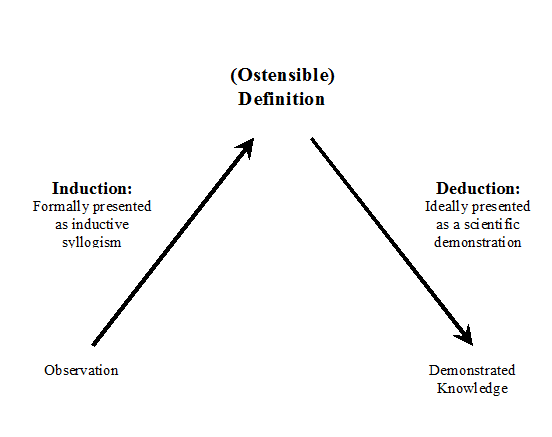
The Inductive-Deductive Method of Aristotelian Science
Aristotelian intuition supplies the first principles (archai)
of human knowledge: concepts, universal propositions, definitions, the
laws of logic, the primary principles of the specialized science, and
even moral concepts such as the various virtues. This is why, according
to Aristotle, intuition must be viewed as infallible. We cannot claim
that the first principles of human intelligence are dubious and then
turn around and use those principles to make authoritative claims about
the possibility (or impossibility) of knowledge. If we begin to doubt
intuition, that is, human intelligence at its most fundamental level of
operation, we will have to doubt everything else that is built upon this
universal foundation: science, philosophy, knowledge, logic, inference,
and so forth. Aristotle never tries to prove first principles. He
acknowledges that when it comes to the origins of human thought, there
is a point when one must simply stop asking questions. As he points
out, any attempt at absolute proof would lead to an infinite regress.
In his own words: “It is impossible that there should be demonstration
of absolutely everything; there would be an infinite regress, so that
there would still be no demonstration.” (Metaphysics, 1006a6ff,
Ross.) Aristotle does make arguments, for example, that meaningful
speech presupposes a logical axiom like the principle of
non-contradiction, but that is not, strictly speaking, a proof of the
principle. See:Aristotle: Logic
I will assign image symbology, as logica, grammatical, and rhetorica, to a triangle, the Square represents Earth. It is thoughts which fill my head that the liberal arts is defined when you look at the pattern, as the square of opposition, and that the peak is man's pinnacle and reach for God, and as modeled in the pyramid under this ancient schooling method.
The pyramid was a scheme for which those things which will become self
evident, that after seeing infinite regress, allows views of Gods heaven
to descend into the mind of man.
The Quadrivium is made up of the four triangles together with the
trivium, seeks man as to perfecting. Each of the four triangles,
represents aspects of perfecting when it comes to the understanding of
the proponents of the Quadrivium.
The Quadrivium is made up of the four triangles together with the trivium, seeks man as to perfecting.
The Quadrivium speak to a cyclical process as well as the developing the student toward logic, grammatical, and rhetoric.
This all belongs to Plato's Academy, but Aristotle took that pattern to the logic application, as the square of opposition, this, when Aristotle formed his own school.
***
Parsons, Terence, "The Traditional Square of Opposition", The Stanford
Encyclopedia of Philosophy (Spring 2014 Edition), Edward N. Zalta (ed.),
URL =
.
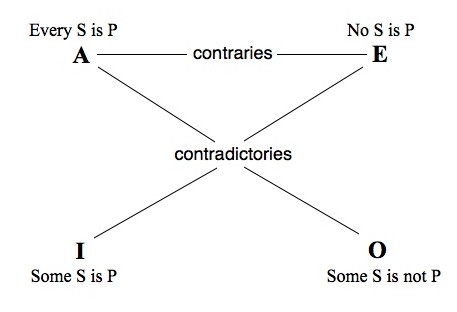
All S are P, No S is P
All s is P is contrary to the claim NO S is P.
-----------------------
A contrary can be true as well as false.
Contraries can both be false. Contraries can't both be true.
The A and E forms entail each other's negations
Subcontrary
Some S are P, Some S are not P
--------------------------------------------
Sub contraries can't both be false. Sub contraries can both be true.
The negation of the I form entails the (unnegated) E form, and vice versa.
Contradiction-
All S are P, Some S are not P,
Some S are P, No S are P
-----------------------------------
For contradictions -Two propositions are contradictory if they cannot both be true and they cannot both be false.
Contradictory means there is exactly one truth value and if one
proposition is true the other MUST be false. If one is false the other
MUST be true. The propositions can't both be true and the propositions
can't both be false.
The A and O forms entail each other's negations, as do the E and I
forms. The negation of the A form entails the (unnegated) O form, and
vice versa; likewise for the E and I forms.
Super alteration-
Every S is P, implies Some S are P
No S is P, implies Some S are not P
--------------------------------------------
The two propositions can be true.
Sub alteration-
All S are P, Some S are P
No S are P, Some S are not P
----------------------------------
A proposition is a subaltern of another if it must be true
The A form entails the I form, and the E form entails the O form.
***
Yes....I tried to get some clarity here regard such a start, and as a
Universal. I have come to recognize, that such an association as may
be given as to the statement of I am, of God, as something "inside the
square of opposition" as it arose from the early understandings in
relation to Aristotle and Plato. This, I have come to know of them, as
expressions of the School run by Plato, and Raphael's setting of
Aristotle and Plato together under the arch in that painting called
Plato's Academy.
My distinction of intuition may be at odds with the classical
description of the Aristotelian view, as to being infallible, while my
own views were an assumption under the idea that such regressive
moments, were when we had come to a point where infinite regress can no
longer be applied, that such a step was necessary as to receiving the
idea.
With regard to the advancement of science then, and under boole, the
square of opposition changed as to being the undermined logic, as a
product of the Aristotelian school. Mathematics then underwent a change
in the modern sense as to giving up, the Platonism understanding of the
Academy of the times.
While setting up for the idea, here I was seeking to have an idea as to
descend into mind, was to me like inserting into an open space between
the neurological function, as a gap. I was pushing discreteness to find
that place in consciousness. Consciousness as a Derivative of Reductionism?
Can animals reason, yes they can, but do "ideas" settle into the
neurological gaps as they do in humans? One would have to say yes as to
the expressive state of animals as being part of God's creatures? Then,
only to the degrees with which reason can be applied to animals, that
such an idea may or may not be, evidential in the evolution of that
animal? One may then understand "the idea of a stick being used" by a monkey in the termite hill, as to arriving from somewhere?


.png)