
PLato said,"Look to the perfection of the heavens for truth," while Aristotle said "look around you at what is, if you would know the truth" To Remember: Eskesthai
Wednesday, November 06, 2019
Music of the Universe
"In a special public lecture webcast at Perimeter Institute on October 23, 2019, Gabriela González will provide a first-hand account of LIGO’s century-in-the-making breakthrough, and explain observations made as recently as this year. González, a professor of physics and astronomy at Louisiana State University and former spokesperson of the LIGO collaboration, will take the audience on a journey to some of the universe’s most violent places, and explain how such distant events can lead to a very bright future here on Earth."
See: Music of the Universe: Gabriela González public lecture

Sunday, November 03, 2019
Cern: Want to know what we do underground when the LHC is being upgraded?
Cern: Want to know what we do underground when the LHC is being upgraded? Watch an immersive experience in 360° from the underground CMS Experiment cavern to watch an international team of scientists, engineers and technicians insert precious pieces of newly developed technology.See: 360° from the CMS cavern at CERN - 8K
Monday, October 28, 2019
Communal Intelligence: A Talk By Seth Lloyd
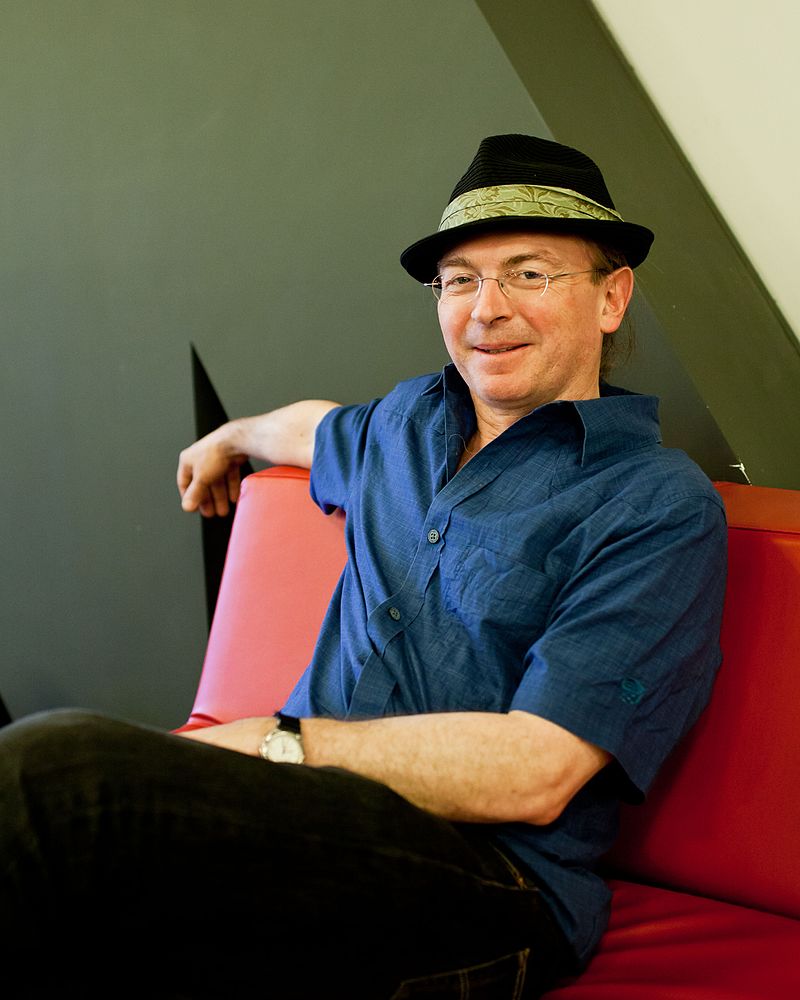
We haven't talked about the socialization of intelligence very much. We talked a lot about intelligence as being individual human things, yet the thing that distinguishes humans from other animals is our possession of human language, which allows us both to think and communicate in ways that other animals don’t appear to be able to. This gives us a cooperative power as a global organism, which is causing lots of trouble. If I were another species, I’d be pretty damn pissed off right now. What makes human beings effective is not their individual intelligences, though there are many very intelligent people in this room, but their communal intelligence.See: Communal Intelligence
"To arrive at the edge of the world's knowledge, seek out the most complex and sophisticated minds, put them in a room together, and have them ask each other the questions they are asking themselves."See: Edge Cast
Also See: The Edge.org
Thursday, June 13, 2019
Microsoft Alternatives project (MAlt)

The Microsoft Alternatives project (MAlt) started a year ago to mitigate anticipated software license fee increases. MAlt’s objective is to put us back in control using open software. It is now time to present more widely this project and to explain how it will shape our computing environment.See:
Microsoft Alternatives project (MAlt)
Guest Post: A conversation with Lee Smolin about his new book "Einstein’s Unfinished Revolution"
Smolin is a faculty member at the Perimeter Institute for
Theoretical Physics in Canada and adjunct professor at the University of
Waterloo. He is one of the founders of loop quantum gravity. In the
past decades, Smolin’s interests have drifted to the role of time in the laws of nature and the foundations of quantum mechanics.
Sunday, June 09, 2019
Bernardo Kastrup's defence of second PH.D.
This is the complete record of Bernardo's defense of his second Ph.D., on philosophy of mind and ontology, at Radboud University Nijmegen (The Netherland's best classical university in 2018), plus the degree granting ceremony. It was recorded on 29 April 2019, in the 'Aula' of Radboud University. The defense was held in English. For the thesis, click on: https://philpapers.org/rec/KASAIA-3 The thesis is a companion volume to Bernardo's book 'The Idea of the World':
See:https://youtu.be/XcMOape0PY8
See also:Metaphysical Speculations
Tuesday, May 14, 2019
Wednesday, May 08, 2019
Friday, April 19, 2019
Thursday, April 18, 2019
Saturday, March 02, 2019
Secrets of Cymatics
"Secrets of Cymatics" is an inspirational presentation by acoustic-physics researcher, John Stuart Reid, filmed at the Water Conference, Sofia, Bulgaria, October 2016, on the physics, chemistry and biology of water. The title of the talk was originally "The Holographic Properties of Water" and focuses on the CymaScope instrument and the emergent science of Cymatics, including significant implications for medical science and positing the first two laws of Cymatics.
See Also: Cymascope
Friday, March 01, 2019
Wednesday, February 13, 2019
What Can We Learn From Bizarre Phenomena? with Bernardo Kastrup
See Also: What Can We Learn From Bizarre Phenomena? with Bernardo Kastrup
Bernardo Kastrup, PhD, is a computer scientist. He is author of Rationalist Spirituality, Why Materialism is Baloney, Dreamed Up Reality, Meaning in Absurdity, Brief Peeks Beyond, More Than Allegory, and The Idea of the World. He has published several papers in Scientific American arguing for metaphysical idealism. Here he reviews a number of nonsensical events ranging from bizarre UFO encounters to religious miracles to psychedelic visions and dreams. He suggests that there are certain common themes that run through dreams, fantasies, and reports of paranormal occurrences -- and that they all speak to us symbolically. He also proposes that the deep archetypes of the Jungian collective unconscious can manifest in what we think of as the physical world. New Thinking Allowed host, Jeffrey Mishlove, PhD, is author of The Roots of Consciousness, Psi Development Systems, and The PK Man. Between 1986 and 2002 he hosted and co-produced the original Thinking Allowed public television series. He is the recipient of the only doctoral diploma in "parapsychology" ever awarded by an accredited university (University of California, Berkeley, 1980). He is past-vice-president of the Association for Humanistic Psychology, and is the recipient of the Pathfinder Award from that association for his contributions to the study of consciousness. (Recorded on January 3, 2019)
Saturday, February 02, 2019
Tuesday, January 15, 2019
The Mother of All Demos
See: Mother of All Demos
***
"The Mother of All Demos" is a name retroactively applied to a landmark computer demonstration, given at the Association for Computing Machinery / Institute of Electrical and Electronics Engineers (ACM/IEEE)—Computer Society's Fall Joint Computer Conference in San Francisco, which was presented by Douglas Engelbart on December 9, 1968.[1]
The live demonstration featured the introduction of a complete computer hardware and software system called the oN-Line System or, more commonly, NLS. The 90-minute presentation essentially demonstrated almost all the fundamental elements of modern personal computing: windows, hypertext, graphics, efficient navigation and command input, video conferencing, the computer mouse, word processing, dynamic file linking, revision control, and a collaborative real-time editor (collaborative work). Engelbart's presentation was the first to publicly demonstrate all of these elements in a single system. The demonstration was highly influential and spawned similar projects at Xerox PARC in the early 1970s. The underlying technologies influenced both the Apple Macintosh and Microsoft Windows graphical user interface operating systems in the 1980s and 1990s.
***
See Also:
Sunday, January 13, 2019
Tuesday, November 27, 2018
Sol 0: Instrument Deployment Camera (IDC)
This image was acquired on November 26, 2018, Sol 0 where the local mean solar time for the image exposures was 14:04:35. Each IDC image has a field of view of 45 x 45 degrees.
See: Sol 0: Instrument Deployment Camera (IDC)
Monday, November 26, 2018


Saturday, November 24, 2018
Friday, November 23, 2018
Sunday, November 04, 2018
Gravity Waves
Additional resources from the LIGO Scientific Collaboration: http://ligo.org/detections/GW170817.php
Additional Media Assets: http://mediaassets.caltech.edu/nsm
LIGO Lab Story: https://www.ligo.caltech.edu/news/ligo20171016
Related Papers & Data: https://www.ligo.caltech.edu/page/detection-companion-papers
See Also: Backreaction: Story about LIGO noise resurfaces in New Scientist
Wednesday, August 22, 2018
Hey LIGO
 |
| Hey LIGO |
***
How’s it going, LIGO?
Members of the public can use Hey LIGO; they just might be disappointed if they’re looking for the kind of quippy, vocalized replies we’ve come to expect from our digital assistants. Hey LIGO is more likely to spit out links to technical reports and schematics. But for researchers, that’s just fine
The Laser Interferometer Gravitational-Wave Observatory has a new digital assistant. Symmetry Magazine
Wednesday, August 01, 2018
Cohl Furey on the Octonions and Particle Physics
Video by Susannah Ireland for Quanta Magazine
See: The Peculiar Math That Could Underlie the Laws of Nature by Natalie Wolchover
***
See Also:

Wednesday, June 13, 2018
Dimensions Inbetween
"Yet I exist in the hope that these memoirs, in some manner, I know not how, may find their way to the minds of humanity in Some Dimensionality, and may stir up a race of rebels who shall refuse to be confined to limited Dimensionality." from Flatland, by E. A. Abbott - Flat Land: A Romance of Many Dimensions

 See: Analysis and Assessment of Gateway Process
There has been a lot of talk over the years about extra dimensions. It has never been totally clear to me how to define that rigorously and effectively. A matter dominated world, it becomes scientifically accredited when it is repeated, or, it has been falsified.

The concept of dimension is not restricted to physical objects. High-dimensional spaces occur in mathematics and the sciences for many reasons, frequently as configuration spaces such as in Lagrangian or Hamiltonian mechanics; these are abstract spaces, independent of the physical space we live in.
The thinking here in regards to the scientific explanation, is that in place of space-time, consciousness becomes capable. The brain, in context of this article, is functioning with regards to how consciousness amplifies it's use of energy?
Albert Einstein
The surface of a marble table is spread out in front of me. I can get from any one point on this table to any other point by passing continuously from one point to a "neighboring" one, and repeating this process a (large) number of times, or, in other words, by going from point to point without executing "jumps." I am sure the reader will appreciate with sufficient clearness what I mean here by "neighbouring" and by "jumps" (if he is not too pedantic). We express this property of the surface by describing the latter as a continuum. http://www.bartleby.com/173/24.html
It always nice to have a smile on your face while you debunk.:-)
A Model for Science
Science is growing more complex, and so are the problems scientists face. A growing number of researchers argue that changing not just how we do science, but how we share it as well, would unlock vast new opportunities. A recent conference at Perimeter Institute asked: Is the time right for open source science? See:Can open-source software be a model for science?
Subscribe to:
Posts (Atom)