SEE: Black Holes & Wormholes interstellar movie explained *understand
***

PLato said,"Look to the perfection of the heavens for truth," while Aristotle said "look around you at what is, if you would know the truth" To Remember: Eskesthai
 |
| SOCRATES: Tell me then, by Zeus, what is that excellent [págkalon, "all beautiful"] aim [érgon, "work, deed"] that the gods achieve, using us as their servants? Plato, Euthyphro, 13e, translated by G.M.A. Grube [Hackett Publishing, 1981, p.19; Greek text, Plato -- Euthryphro, Apology, Crito, Phaedo, Phaedrus, Loeb Classical Library, Harvard, 1914-1956, pp.50-52] |
In the Republic, Plato sets aside a direct definition of the "good itself" (autò t'agathón). Socrates says that instead we will get something in the nature of the "offspring" (ékgonos) or "interest" (tókos) on the good [Republic, 506 E]. For this "offspring," Plato offers an analogy: The Good is to the intelligible world, the world of Being and the Forms, as the sun is to the visible world. As light makes vision possible in the material world, and so also opinion about such objects, the Form of the Good "gives their truth to the objects of knowledge and power of knowing to the knower..." [Loeb Classical Library, Plato VI Republic II, translated by Paul Shorey, Harvard University Press, 1935-1970, pp.94-95]. Furthermore, the objects of knowledge derive from the Form of the Good not only the power of being known, but their "very existence and essence" (tò eînaí te kaì hè ousía) [509B], although the Good itself "transcends essence" in "dignity and power" [ibid. pp.106-107]. The word here translated "essence" is ousía, which in Aristotelian terminology is the essence (essentia) of things, i.e. what they are. If Plato has something similar in mind, then the objects of knowledge derive from the good both their existence and their character. See: A Lecture on the Good, by
Kelley L. Ross, Ph.D.
                    Probabilties
                 (The Fifth Dimension)
                         |
                         |
                  Idea of the pipe
                        / \
                       /   \
                      /     \
                 Picture of the pipe
                    /         \
                   /           \
                  /             \
               The real pipe and form
Distances” Determine Geometry
Describe an object with a table of distances between points.
Describe spacetime with a table of intervals between events
It is not my purpose in this discussion to represent the general theory of relativity as a system that is as simple and as logical as possible, and with the minimum number of axioms; but my main object here is to develop this theory in such a way that the reader will feel that the path we have entered upon is psychologically the natural one, and that the underlying assumptions will seem to have the highest possible degree of security.
—Albert Einstein
http://www.eftaylor.com/pub/chapter2.pdf
.png)
"Symmetry breaking illustrated": – high energy levels (left) the ball settles in the center, and the result is symmetrical. At lower energy levels (right), the overall "rules" remain symmetrical, but the "Mexican hat" potential comes into effect: "local" symmetry inevitably becomes broken since eventually the ball must roll one way (at random) and not another.
The term “symmetry” derives from the Greek words sun (meaning ‘with’ or ‘together’) and metron (‘measure’), yielding summetria, and originally indicated a relation of commensurability (such is the meaning codified in Euclid's Elements for example). It quickly acquired a further, more general, meaning: that of a proportion relation, grounded on (integer) numbers, and with the function of harmonizing the different elements into a unitary whole. From the outset, then, symmetry was closely related to harmony, beauty, and unity, and this was to prove decisive for its role in theories of nature. In Plato's Timaeus, for example, the regular polyhedra are afforded a central place in the doctrine of natural elements for the proportions they contain and the beauty of their forms: fire has the form of the regular tetrahedron, earth the form of the cube, air the form of the regular octahedron, water the form of the regular icosahedron, while the regular dodecahedron is used for the form of the entire universe. The history of science provides another paradigmatic example of the use of these figures as basic ingredients in physical description: Kepler's 1596 Mysterium Cosmographicum presents a planetary architecture grounded on the five regular solids.Symmetry and Symmetry Breaking -The Concept of SymmetrySymmetry Breaking, means to measure.
An analogy to this situation might be what is thought to happen to the forces of nature in modern physics, where a single, original, unified force is separated into several forces by "spontaneous symmetry breaking." The form of consciousness as, according to Brentano and Husserl, the intentional relationship of subject and object, itself represents an asymmetry, breaking the symmetry of an existence where there is no distinction between subject and object. Existence as such is thus broken by the form of consciousness, and it becomes the forms of value, good and evil, right and wrong, the beautiful and the ugly, etc., as these vary independently over and against the simple factual existence of objects in the phenomenal world, or even against each other in the phenomenon of moral dilemmas (i.e. doing right results in evils, while doing wrong results in goods). A Lecture on the Good -http://www.friesian.com/good.htmBold added for emphasis by me.
The connection between superfluidity and symmetry breaking has had a glorious history. It has left us a rich legacy of fertile ideas, that seems far from exhaustion. PG 60 Superfluidity and Symmetry BreakingYou have to know what your doing when you apply those constraints to yourself. So maybe, there is this bigger picture.
Pierre Curie (1894): “Asymmetry is what creates a phenomenon.”
Now beauty, as we said, shone bright among those visions, and in this world below we apprehend it through the clearest of our senses, clear and resplendent. For sight is the keenest of the physical senses, though wisdom is not seen by it -- how passionate would be our desire for it, if such a clear image of wisdom were granted as would come through sight -- and the same is true of the other beloved objects; but beauty alone has this privilege, to be most clearly seen and most lovely of them all. [Phaedrus, 250D, after R. Hackford, Plato's Phaedrus, Library of the Liberal Arts, 1952, p. 93, and the Loeb Classical Library, Euthryphro Apology Crito Phaedo Phaedrus, Harvard University Press, 1914-1966, p.485, boldface added]

Heisenberg originally formulated his ideas in terms of a relationship between the precision of a measurement and the disturbance it must create. Although this latter relationship is not rigorously proven, it is commonly believed (and taught) as an aspect of the broader uncertainty principle. Here, we experimentally observe a violation of Heisenberg’s “measurement-disturbance relationship”, using weak measurements to characterize a quantum system before and after it interacts with a measurement apparatus. http://journals.aps.org/prl/abstract/10.1103/PhysRevLett.109.100404
Consistency Conditions for an AdS/MERA Correspondence
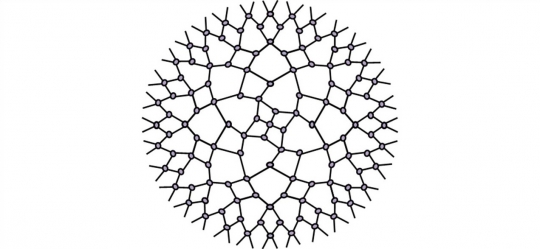
(Submitted on 24 Apr 2015)The Multi-scale Entanglement Renormalization Ansatz (MERA) is a tensor network that provides an efficient way of variationally estimating the ground state of a critical quantum system. The network geometry resembles a discretization of spatial slices of an AdS spacetime and "geodesics" in the MERA reproduce the Ryu-Takayanagi formula for the entanglement entropy of a boundary region in terms of bulk properties. It has therefore been suggested that there could be an AdS/MERA correspondence, relating states in the Hilbert space of the boundary quantum system to ones defined on the bulk lattice. Here we investigate this proposal and derive necessary conditions for it to apply, using geometric features and entropy inequalities that we expect to hold in the bulk. We show that, perhaps unsurprisingly, the MERA lattice can only describe physics on length scales larger than the AdS radius. Further, using the covariant entropy bound in the bulk, we show that there are no conventional MERA parameters that completely reproduce bulk physics even on super-AdS scales. We suggest modifications or generalizations of this kind of tensor network that may be able to provide a more robust correspondence. See: http://arxiv.org/abs/1504.06632
As Plato tells it, the beautiful orderliness of the universe is not only the manifestation of Intellect; it is also the model for rational souls to understand and to emulate. Such understanding and emulation restores those souls to their original state of excellence, a state that was lost in their embodiment. There is, then, an explicit ethical and religious dimension to the discourse. Plato's Timaeus -Zeyl, Donald, "Plato's Timaeus", The Stanford Encyclopedia of Philosophy (Spring 2014 Edition), Edward N. Zalta (ed.),
Newtonian science became a central issue in the assault waged by the philosophes in the Age of Enlightenment against a natural philosophy based on the authority of ancient Greek or Roman naturalists or on deductive reasoning from first principles (the method advocated by French philosopher René Descartes), rather than on the application of mathematical reasoning to experience or experiment. Voltaire popularised Newtonian science, including the content of the both the Principia and the Opticks, in his Elements de la philosophie de Newton (1738), and after about 1750 the combination of the experimental methods exemplified by the Opticks and the mathematical methods exemplified by the Principia were established as a unified and comprehensive model of Newtonian science. Some of the primary adepts in this new philosophy were such prominent figures as Benjamin Franklin, Antoine-Laurent Lavoisier, and James Black. Reception
After purchasing and studying Newton's alchemical works in 1942, economist John Maynard Keynes, for example, opined that "Newton was not the first of the age of reason, he was the last of the magicians". Isaac Newton's occult studies
Austrian-born physicist and theoretical biologist Erwin Schrödinger, one of the founders of quantum theory in physics, also became one of the first scientists to suggest a study of quantum biology in his 1944 book What Is Life?. Quantum biology
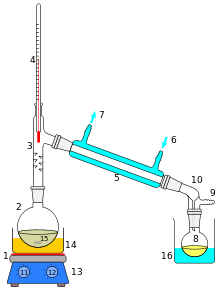 |
| Laboratory display of distillation: 1: A source of heat 2: Still pot 3: Still head 4: Thermometer/Boiling point temperature 5: Condenser 6: Cooling water in 7: Cooling water out 8: Distillate/receiving flask 9: Vacuum/gas inlet 10: Still receiver 11: Heat control 12: Stirrer speed control 13: Stirrer/heat plate 14: Heating (Oil/sand) bath 15: Stirring means e.g. (shown), boiling chips or mechanical stirrer 16: Cooling bath.[1] |
|
 |
| "Flightless Dung Beetle Circellium Bachuss, Addo Elephant National Park, South Africa" by Kay-africa - Own work. Licensed under CC BY-SA 3.0 via Wikimedia Commons. |
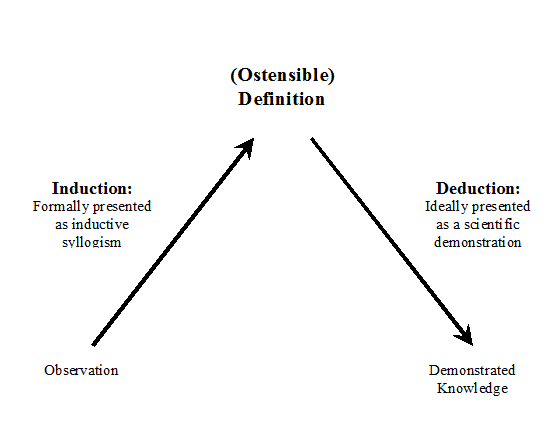 |
| The Inductive-Deductive Method of Aristotelian Science |
Aristotelian intuition supplies the first principles (archai) of human knowledge: concepts, universal propositions, definitions, the laws of logic, the primary principles of the specialized science, and even moral concepts such as the various virtues. This is why, according to Aristotle, intuition must be viewed as infallible. We cannot claim that the first principles of human intelligence are dubious and then turn around and use those principles to make authoritative claims about the possibility (or impossibility) of knowledge. If we begin to doubt intuition, that is, human intelligence at its most fundamental level of operation, we will have to doubt everything else that is built upon this universal foundation: science, philosophy, knowledge, logic, inference, and so forth. Aristotle never tries to prove first principles. He acknowledges that when it comes to the origins of human thought, there is a point when one must simply stop asking questions. As he points out, any attempt at absolute proof would lead to an infinite regress. In his own words: “It is impossible that there should be demonstration of absolutely everything; there would be an infinite regress, so that there would still be no demonstration.” (Metaphysics, 1006a6ff, Ross.) Aristotle does make arguments, for example, that meaningful speech presupposes a logical axiom like the principle of non-contradiction, but that is not, strictly speaking, a proof of the principle. See: Aristotle: Logic
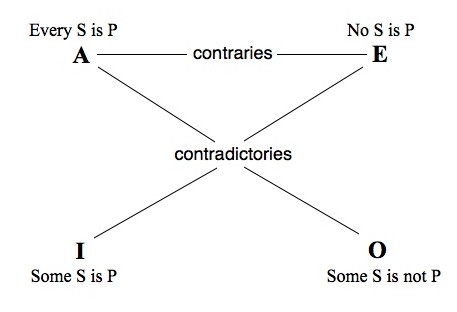 |
| Parsons, Terence, "The Traditional Square of Opposition", The Stanford
Encyclopedia of Philosophy (Spring 2014 Edition), Edward N. Zalta (ed.),
URL =
|


The Roadmap Epigenomics Project presents a wealth of epigenomes, a resource that provides a plethora of new hypotheses to be tested in relation to human health and disease. The current papers use innovative analytical approaches to uncover new mechanisms and pathways, to deepen and extend previous groundbreaking observations.
While the Roadmap Epigenomics Project has reached a major milestone, the epigenomes of 127 cell types are just the beginning of the road to a comprehensive epigenome encyclopaedia. The International Human Epigenome Consortium plans to determine the epigenomes of every cell type in the human body — estimated to be several hundred to a thousand.
Dr Henk Stunnenberg, Chair of the International Scientific Steering Committee of IHEC
Behavioral epigenetics is the field of study examining the role of epigenetics in shaping animal (including human) behaviour.[1] It is an experimental science that seeks to explain how nurture shapes nature,[2] where nature refers to biological heredity[3] and nurture refers to virtually everything that occurs during the life-span (e.g., social-experience, diet and nutrition, and exposure to toxins).[2] Behavioral epigenetics attempts to provide a framework for understanding how the expression of genes is influenced by experiences and the environment[4] to produce individual differences in behaviour,[5] cognition[2] personality,[6] and mental health.[7][8]
Epigenetic gene regulation involves changes other than to the sequence of DNA and includes changes to histones (proteins around which DNA is wrapped) and DNA methylation.[9] These epigenetic changes can influence the growth of neurons in the developing brain[10] as well as modify activity of the neurons in the adult brain.[11][12] Together, these epigenetic changes on neuron structure and function can have a marked influence on an organism's behavior.[1]
 |
By the time Szyf arrived at McGill in the late 1980s, he had become an expert in the mechanics of epigenetic change. But until meeting Meaney, he had never heard anyone suggest that such changes could occur in the brain, simply due to maternal care.We have seen ]experimentation with regard to mice, where in experiment # 3, they are able to affect the pups with an injection in order to release the pups from an absence of what nurturing does, by what a mother can produce in the pups. So we may come to believe the neurological manufacture can be used to help change the way people perceive?
“It sounded like voodoo at first,” Szyf admits. “For a molecular biologist, anything that didn’t have a clear molecular pathway was not serious science. But the longer we talked, the more I realized that maternal care just might be capable of causing changes in DNA methylation, as crazy as that sounded. So Michael and I decided we’d have to do the experiment to find out.” See: Grandma's Experiences Leave a Mark on Your Genes
Epigenetics has a strong influence on the development of an organism and can alter the expression of individual traits.[9] Epigenetic changes occur not only in the developing fetus, but also in individuals throughout the human life-span.[19] Because some epigenetic modifications can be passed from one generation to the next,[20] subsequent generations may be affected by the epigenetic changes that took place in the parents.[20]
|
|
 | ||
| Epigenetic mechanisms are affected by several factors and processes including development in utero and in childhood, environmental chemicals, drugs and pharmaceuticals, aging, and diet. DNA methylation is what occurs when methyl groups, an epigenetic factor found in some dietary sources, can tag DNA and activate or repress genes. Histones are proteins around which DNA can wind for compaction and gene regulation. Histone modification occurs when the binding of epigenetic factors to histone “tails” alters the extent to which DNA is wrapped around histones and the availability of genes in the DNA to be activated. All of these factors and processes can have an effect on people’s health and influence their health possibly resulting in cancer, autoimmune disease, mental disorders, or diabetes among other illnesses. National Institutes of Health |
Behavioral epigenetics is the field of study examining the role of epigenetics in shaping animal (including human) behaviour.[1] It is an experimental science that seeks to explain how nurture shapes nature,[2] where nature refers to biological heredity[3] and nurture refers to virtually everything that occurs during the life-span (e.g., social-experience, diet and nutrition, and exposure to toxins).[2] Behavioral epigenetics attempts to provide a framework for understanding how the expression of genes is influenced by experiences and the environment[4] to produce individual differences in behaviour,[5] cognition[2] personality,[6] and mental health.[7][8]
Epigenetic gene regulation involves changes other than to the sequence of DNA and includes changes to histones (proteins around which DNA is wrapped) and DNA methylation.[9] These epigenetic changes can influence the growth of neurons in the developing brain[10] as well as modify activity of the neurons in the adult brain.[11][12] Together, these epigenetic changes on neuron structure and function can have a marked influence on an organism's behavior.[1]
Thalamocortical oscillation involves the synchronous firing of thalamic and cortical neurons at specific frequencies; in the thalamocortical system, the exact frequencies depend on current brain state and mental activityThe understanding I have in regard to this question is whether we could induce those frequency ranges as an "affect" directly through the thalamus to the whole brain. This so as to bring the whole brain toward coherence.
 |
| The human visual pathway. The lateral geniculate nucleus, a region of the thalamus, exhibits thalamocortical oscillation with the visual cortex.[7] |
Thalamocortical oscillation is thought to be responsible for the synchronization of neural activity between different regions of the cortex and is associated with the appearance of specific mental states depending on the frequency range of the most prominent oscillatory activity, gamma most associated with conscious, selective concentration on tasks,[8] learning (perceptual and associative),[9] and short-term memory.[10] Magnetoencephalography (MEG) has been used to show that during conscious perception, gamma-band frequency electrical activity and thalamocortical resonance prominently occurs in the human brain.[2] Absence of these gamma-band patterns correlates with nonconscious states and is characterized by the presence of lower-frequency oscillations instead.Relation to brain activity -Recurrent thalamo-cortical resonance -
Psychoacoustics is the scientific study of sound perception. More specifically, it is the branch of science studying the psychological and physiological responses associated with sound (including speech and music). It can be further categorized as a branch of psychophysics.http://en.wikipedia.org/wiki/Psychoacoustics
Cymatics (from Greek: κῦμα "wave") is the study of visible sound and vibration, a subset of modal phenomena. Typically the surface of a plate, diaphragm, or membrane is vibrated, and regions of maximum and minimum displacement are made visible in a thin coating of particles, paste, or liquid.[1] Different patterns emerge in the exitatory medium depending on the geometry of the plate and the driving frequency.
Human-level control through deep reinforcement learning
-The theory of reinforcement learning provides a normative account1, deeply rooted in psychological2 and neuroscientific3 perspectives on animal behaviour, of how agents may optimize their control of an environment. To use reinforcement learning successfully in situations approaching real-world complexity, however, agents are confronted with a difficult task: they must derive efficient representations of the environment from high-dimensional sensory inputs, and use these to generalize past experience to new situations. Remarkably, humans and other animals seem to solve this problem through a harmonious combination of reinforcement learning and hierarchical sensory processing systems4, 5, the former evidenced by a wealth of neural data revealing notable parallels between the phasic signals emitted by dopaminergic neurons and temporal difference reinforcement learning algorithms3. While reinforcement learning agents have achieved some successes in a variety of domains6, 7, 8, their applicability has previously been limited to domains in which useful features can be handcrafted, or to domains with fully observed, low-dimensional state spaces. Here we use recent advances in training deep neural networks9, 10, 11 to develop a novel artificial agent, termed a deep Q-network, that can learn successful policies directly from high-dimensional sensory inputs using end-to-end reinforcement learning. We tested this agent on the challenging domain of classic Atari 2600 games12. We demonstrate that the deep Q-network agent, receiving only the pixels and the game score as inputs, was able to surpass the performance of all previous algorithms and achieve a level comparable to that of a professional human games tester across a set of 49 games, using the same algorithm, network architecture and hyperparameters. This work bridges the divide between high-dimensional sensory inputs and actions, resulting in the first artificial agent that is capable of learning to excel at a diverse array of challenging tasks.
This demo follows the description of the Deep Q Learning algorithm described in Playing Atari with Deep Reinforcement Learning, a paper from NIPS 2013 Deep Learning Workshop from DeepMind. The paper is a nice demo of a fairly standard (model-free) Reinforcement Learning algorithm (Q Learning) learning to play Atari games.
In this demo, instead of Atari games, we'll start out with something more simple: a 2D agent that has 9 eyes pointing in different angles ahead and every eye senses 3 values along its direction (up to a certain maximum visibility distance): distance to a wall, distance to a green thing, or distance to a red thing. The agent navigates by using one of 5 actions that turn it different angles. The red things are apples and the agent gets reward for eating them. The green things are poison and the agent gets negative reward for eating them. The training takes a few tens of minutes with current parameter settings.
Over time, the agent learns to avoid states that lead to states with low rewards, and picks actions that lead to better states instead.
Code for Human-Level Control through Deep Reinforcement Learning
Please click here to download the code associated with DeepMind's Nature Letter on "Human-Level Control through Deep Reinforcement Learning"

