Monday, September 08, 2014

Muon Tomography (cont)

It is the case of an article on Muon Tomography, titled New Muon Detector Could Find Hidden Nukes. The article appeared a few days ago on Wired. It is centered on Lisa Grossman's interview to Marcus Hohlmann, a colleague from the Florida Institute of Technology. In a nutshell, the article explains how muon particles from cosmic rays can be used to detect heavy elements (as in nuclear fuel) hidden in transport containers. And what makes things sexier is that the used technology is a spin-off from experiments from particle physics. See: Muon Tomography: Who Is Leading The Research ?
See Also:

***

Beginning next year, two detectors (shown here in green) on either side of Fukushima Daiichi’s Unit 2 will record the path of muons (represented by the orange line) that have passed through the reactor. By determining how the muons scatter between the detectors, scientists will compile the first picture of the damaged reactor’s interior. See:
Particle physics to aid nuclear cleanup
***

The progression of Muon Tomography,  is an interesting subject in relation to what can be used to help us understand issues we face here on earth. Situations that need new ways in which to diagnostically deal with extreme situations. Example given in relation too, rock density, magma flows, or, even nuclear reactors.

One has to learn to understand "links that are dropped" which pursue a thread of evolution. These help one to understand the processional use of the technologies as used to understand the ways things are measured in those extreme situations. Sensor-ability,  then takes on a new meaning while using current scientific research and understandings in particle physics.

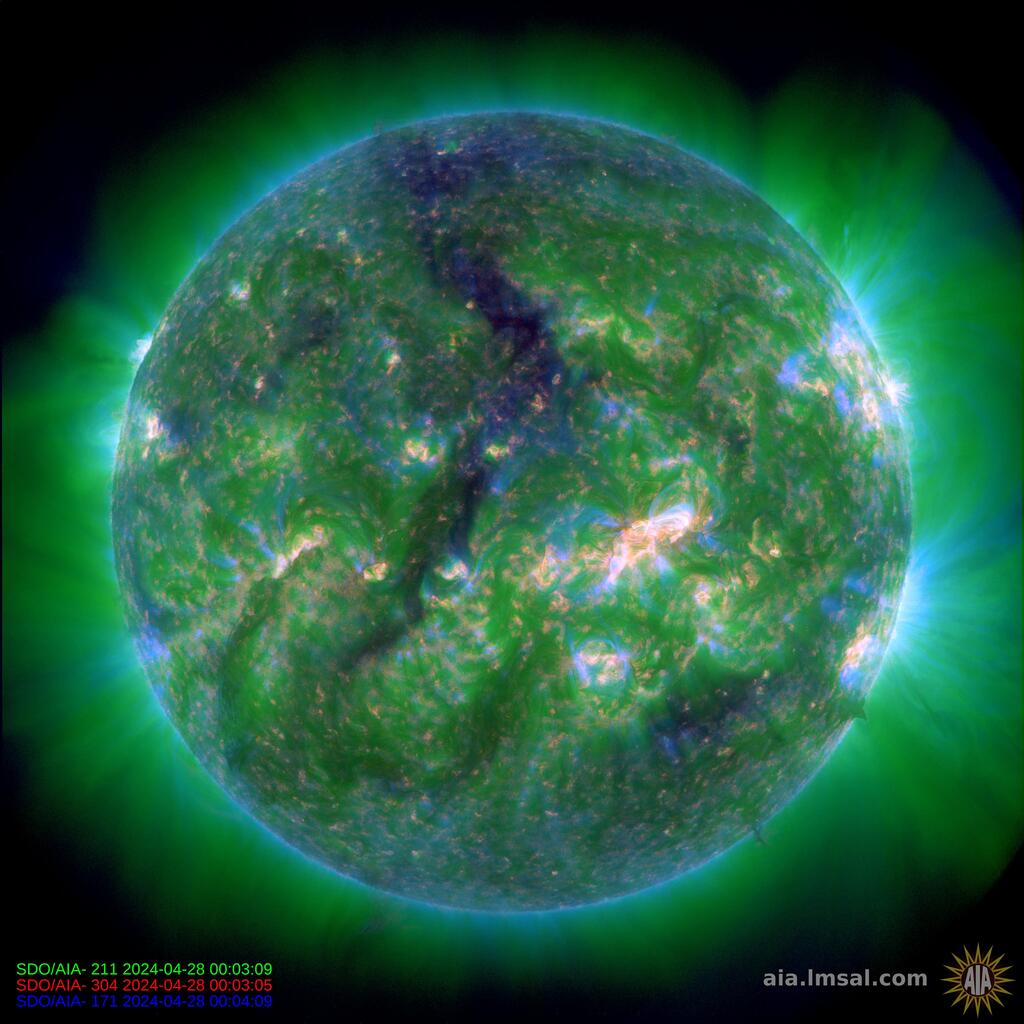
The Sun Current

"Courtesy of NASA/SDO and the AIA, EVE, and HMI science teams."

Here is a movie of the event. Can be seen on YouTube as well

See: SDO

Monday, September 01, 2014

Interstellar: Traversing the Wormhole

The story has a premise with which to share an idea and if it is intriguing to the average mind, then how much more so when a scientist entertains it? He or she might even propose a way in which to use measure with regard to the subject of a black hole?:)
But later I found out more about wormholes, and learned about “topological censorship.” It turns out that if energy is nonnegative, Einstein’s gravitational field equations prevent you from traversing a wormhole — the throat always pinches off (or becomes infinitely long) before you get to the other side. It has sometimes been suggested that quantum effects might help to hold the throat open (which sounds like a good idea for a movie), but today we’ll assume that wormholes are never traversable no matter what you do. SEE: Entanglement = Wormholes
***


A group of explorers make use of a newly discovered wormhole to surpass the limitations on human space travel and conquer the vast distances involved in an interstellar voyage. Interstellar

Thursday, August 28, 2014

The Extra Dimensions


The weakness of gravity compared to the other subatomic forces is a real mystery. While nobody knows the answer, one credible solution is that gravity has access to more spatial dimensions than the other three known forces. In this video, Fermilab's Dr. Don Lincoln describes this idea, with the help of some very urbane characters. See: Big Mysteries: The Extra Dimensions

***


The extra dimensions of string theory which were originally viewed as a source of embarrassment for the theory, have proven to be instrumental in resolving a number of puzzles associated with 3+1 dimensional physics. I discuss examples of this in the context of black holes, gauge theory and particle phenomenology. See: Strings and the Magic of Extra Dimensions - Cumrun Vafa

 ***

Savas Dimopoulos
(link now dead)Here’s an analogy to understand this: imagine that our universe is a two-dimensional pool table, which you look down on from the third spatial dimension. When the billiard balls collide on the table, they scatter into new trajectories across the surface. But we also hear the click of sound as they impact: that’s collision energy being radiated into a third dimension above and beyond the surface. In this picture, the billiard balls are like protons and neutrons, and the sound wave behaves like the graviton.

***

Thursday, August 14, 2014

Neural Oscillations in Gamma

EEG in Gamma-A gamma wave is a pattern of neural oscillation in humans with a frequency between 25 and 100 Hz,[1] though 40 Hz is typical.[2]
Here exists a measure with which consciousness can be associated, then,  by such neural oscillations it would have some effect in demonstrating that matter would/could correlate to such frequencies?
A mouse endowed with an astrocyte signalling switch may prove useful in future experiments—and may enable the researchers to continue to explore how gamma waves enable recognition of what’s new and different, a cognitive task equally essential for humans to make their way in the world. See: The Brainwave That Lets You Recognize What’s New in the World

In "we create reality" listed in blog post below, a simple suggestion it seems makes thinking in this range somewhat appealing? I mean,  is it really that easy that what we choose to do with our thinking can actually produce physiological implications in the thinking brain so as to suggest we can actually create these states?


Frederick Travis, PhD, director of the Center for Brain, Consciousness and Cognition, explains that the concept "We create our reality" is more than a philosophical statement. It is a physical reality driven by neural plasticity—every experience changes the brain. Therefore, choose transcendental experiences and higher states of consciousness naturally unfold. See: We Create Our Reality (underlined for emphasis by me).

***
Isolated Astrocyte shown with confocal microscopy. Image: Nathan S. Ivey and Andrew G. MacLean


 Research since the mid-1990s has shown that astrocytes propagate intercellular Ca2+ waves over long distances in response to stimulation, and, similar to neurons, release transmitters (called gliotransmitters) in a Ca2+-dependent manner. Data suggest that astrocytes also signal to neurons through Ca2+-dependent release of glutamate.[1] Such discoveries have made astrocytes an important area of research within the field of neuroscience.

Calcium Waves-Astrocytes are linked by gap junctions, creating an electrically coupled (functional) syncytium.[25] Because of this ability of astrocytes to communicate with their neighbors, changes in the activity of one astrocyte can have repercussions on the activities of others that are quite distant from the original astrocyte.

An influx of Ca2+ ions into astrocytes is the essential change that ultimately generates calcium waves. Because this influx is directly caused by an increase in blood flow to the brain, calcium waves are said to be a kind of hemodynamic response function. An increase in intracellular calcium concentration can propagate outwards through this functional syncytium. Mechanisms of calcium wave propagation include diffusion of calcium ions and IP3 through gap junctions and extracellular ATP signalling.[26] Calcium elevations are the primary known axis of activation in astrocytes, and are necessary and sufficient for some types of astrocytic glutamate release.

See Also:

Thursday, August 07, 2014

We Create Our Reality


Frederick Travis, PhD, director of the Center for Brain, Consciousness and Cognition, explains that the concept "We create our reality" is more than a philosophical statement. It is a physical reality driven by neural plasticity—every experience changes the brain. Therefore, choose transcendental experiences and higher states of consciousness naturally unfold.See: We Create Our Reality

Rosetta's arrival at comet 67P/C-G


Highlights from ESA's mission control centre during Rosetta's arrival at comet 67P/C-G on 6 August 2014. Includes live updates from the Rosetta flight control team, confirmation of orbit entry and presentation of latest images and science results.See: Rosetta arrival highlights


See Also: Rosetta Rendezvous with a Comet

Tuesday, August 05, 2014

New Source of Gamma Rays Revealed by NASA's Fermi Space Telescope

These images show Fermi data centered on each of the four gamma-ray novae observed by the LAT. Colors indicate the number of detected gamma rays with energies greater than 100 million electron volts (blue indicates lowest, yellow highest).
Image Credit: 
NASA/DOE/Fermi LAT Collaboration
One explanation for the gamma-ray emission is that the blast creates multiple shock waves that expand into space at slightly different speeds. Faster shocks could interact with slower ones, accelerating particles to near the speed of light. These particles ultimately could produce gamma rays. See NASA's Fermi Space Telescope Reveals New Source of Gamma Rays

***


Credit: Weiqun Zhang and Stan Woosley
This image is from a computer simulation of the beginning of a gamma-ray burst. Here we see the jet 9 seconds after its creation at the center of a Wolf Rayet star by the newly formed, accreting black hole within. The jet is now just erupting through the surface of the Wolf Rayet star, which has a radius comparable to that of the sun. Blue represents regions of low mass concentration, red is denser, and yellow denser still. Note the blue and red striations behind the head of the jet. These are bounded by internal shocks. See: "ROSETTA STONE" FOUND TO DECODE THE MYSTERY OF GAMMA RAY BURSTS

Wednesday, July 30, 2014

Neuroscience vs. Philosophy


From the existence of the self to the nature of free will, many philosophers have dedicated their lives to the problems of the mind. But now some neuroscientists claim to have settled these raging debates. See: Neuroscience vs.Philosophy

Thursday, July 24, 2014

The Sun

24 July 2014 - Mission Day: 6810 - DOY: 205
"Courtesy of NASA/SDO and the AIA, EVE, and HMI science teams."

***


Spun and Confused
Published on Jul 21, 2014
A long arch of plasma (called a prominence) was pulled this way and that by magnetic forces for a week before it finally dissipated (July 10-16, 2014). This close up was captured in extreme ultraviolet light. The Earth scale in the lower left corner gives one a sense of the length of the prominence. This one held itself together for quite a long time, as these things go. Credit: Solar Dynamics Observatory/NASA.

Thursday, July 10, 2014

Prototype Robot With Smartphone to Test 3-D Mapping, Navigation Inside Space Station | NASA


 Image Credit: NASA/Ames
Orbital Sciences Corporation's Cygnus spacecraft will carry 3,293 pounds (1,493.8 kg) of cargo on its upcoming commercial resupply mission to the International Space Station, including crew supplies, nanosatellites, student research and this prototype free-flying space robot equipped with a smartphone, known as Smart SPHERES (Synchronized Position Hold, Engage, Reorient Experimental Satellites).

NASA has been testing SPHERES on the space station since 2011. This summer, astronauts will upgrade these existing space robots to use Google’s "Project Tango" smartphone, which features a custom 3-D sensor and multiple cameras. NASA will then use the Smart SPHERES to test free-flying 3-D mapping and navigation inside the space station. NASA is developing the Smart SPHERES to perform work on the space station that requires mobile sensing, such as environmental surveys to monitor levels of radiation, lighting and air quality. They also will be used to monitor inventory and conduct experiments. The development and testing of Smart SPHERES is funded by the Space Technology Mission Directorate at NASA Headquarters in Washington.

Prototype Robot With Smartphone to Test 3-D Mapping, Navigation Inside Space Station | NASA

***


Alvar Saenz Otero, Ph.D., associate director and SPHERES lead scientist at the Massachusetts Institute of Technology Space Systems Laboratory, presents an overview of the Synchronized Position Hold, Engage, Reorient, Experimental Satellites (SPHERES) used for multiple robotics research investigations aboard the International Space Station. The SPHERES help researchers learn how to control bowling-ball sized satellites in a microgravity environment. Specifically, the research team is looking at how to control multiple satellites so that they work together. Planned uses for SPHERES include in space robotic assembly and refurbishing and repairing existing satellites in orbit. SEE:
The ISS SPHERES Facility

Wednesday, July 09, 2014

What's a Color?


 What is color? It seems like a simple question at first, but when you think about it, the reality of what we're seeing is a pretty complex situation. Our human eyes sift through a small piece of the vast electromagnetic spectrum and translate it into every color of the rainbow. But there are other animals that see these same wavelengths in different ways, or even see colors beyond what we can perceive! And not all color is dependent on wavelengths of light: the brains of certain people, called synesthetes, work in ways that let them see colors tied to music, words, or other stimuli. Watch as host Alan Alda takes you on a surreal, scientific tour of the spectrum with the help of vision researcher Jay Neitz, along with neuroscientists David Eagleman, Kaitlyn Hova, and Bevil Conway.

See Also: “What Is Color?”

First Full 3D Model of Eta Carinae Nebula Created by Nasa Scientists


An international team of astronomers has developed a 3D model of a giant cloud ejected by the massive binary system Eta Carinae during its 19th century outburst. Eta Carinae lies about 7,500 light-years away in the southern constellation of Carina and is one of the most massive binary systems astronomers can study in detail. The smaller star is about 30 times the mass of the sun and may be as much as a million times more luminous. The primary star contains about 90 solar masses and emits 5 million times the sun's energy output. Both stars are fated to end their lives in spectacular supernova explosions.
A new shape model of the Homunculus Nebula reveals protrusions, trenches, holes and irregularities in its molecular hydrogen emission. The protrusions appear near a dust skirt seen at the nebula's center in visible light (inset) but not found in this study, so they constitute different structures.
Image Credit: 
NASA Goddard (inset: NASA, ESA, Hubble SM4 ERO Team)
***
See Also:

Tuesday, July 08, 2014

Algebraic Topology


A first course in Algebraic Topology, with emphasis on visualization, geometric intuition and simplified computations. Given by Assoc Prof N J Wildberger at UNSW. The really important aspect of a course in Algebraic Topology is that it introduces us to a wide range of novel objects: the sphere, torus, projective plane, knots, Klein bottle, the circle, polytopes, curves in a way that disregards many of the unessential features, and only retains the essence of the shapes of spaces. What does this exactly mean? That is a key question... The course has some novel features, including Conway's ZIP proof of the classification of surfaces, a rational form of turn angles and curvature, an emphasis on the importance of the rational line as the model of the continuum, and a healthy desire to keep things simple and physical. We try to use pictures and models to guide our understanding.

See Also:

Wednesday, July 02, 2014

Proofing BICEP2

Inflation—the hypothesis that the Universe underwent a phase of superluminal expansion in a brief period following the big bang—has the potential of explaining, from first principles, why the Universe has the structure we see today. It could also solve outstanding puzzles of standard big-bang cosmology, such as why the Universe is, to a very good approximation, flat and isotropic (i.e., it looks the same in all directions). Yet we do not yet have a compelling model, based on fundamental particle physics principles, that explains inflation. And despite its explanatory power and a great deal of suggestive evidence, we still lack an unambiguous and direct probe of inflation. Theorists have developed different models for inflation, which all share a common, robust prediction: Inflation would have created a background of gravitational waves that could have an observable effect. These waves would cause subtle, characteristic distortions of the cosmic microwave background (CMB)—the oldest light in the Universe, released when photons decoupled from matter and the Universe became transparent to radiation. Viewpoint: Peering Back to the Beginning of Time

***

 
First Direct Evidence of Cosmic Inflation


Almost 14 billion years ago, the universe we inhabit burst into existence in an extraordinary event that initiated the Big Bang. In the first fleeting fraction of a second, the universe expanded exponentially, stretching far beyond the view of our best telescopes. All this, of course, was just theory.

 ***


 LSC Congratulates BICEP2 Colleagues


18 March 2014 - The BICEP2 Collaboration result, if confirmed, is a landmark discovery in cosmology, allowing us for the first time to peer back almost to the moment of the Big Bang through the observation of the imprint of primordial gravitational waves on the cosmic microwave background. The LIGO Scientific Collaboration congratulates our BICEP colleagues on their accomplishment and will further follow discoveries and implications of these observations with great interest. - See more at: http://www.ligo.org/news/bicep-result.php#sthash.mJlemItG.dpuf
***

See Also:

Sunday, June 29, 2014

Puffing in Large Scale Interactions

This combination of three wavelengths of light from NASA's Solar Dynamics Observatory shows one of the multiple jets that led to a series of slow coronal puffs on Jan. 17, 2013. The light has been colorized in red, green and blue.
Image Credit: Alzate/SDO
A suite of NASA's sun-gazing spacecraft have spotted an unusual series of eruptions in which a series of fast puffs forced the slow ejection of a massive burst of solar material from the sun's atmosphere. The eruptions took place over a period of three days, starting on Jan. 17, 2013. Nathalia Alzate, a solar scientist at the University of Aberystwyth in Wales, presented findings on what caused the puffs at the 2014 Royal Astronomical Society's National Astronomy Meeting in Portsmouth, England. See: Puffing Sun Gives Birth To Reluctant Eruption

Saturday, June 28, 2014

From the Mathematics of Supersymmetry to the Music of Arnold Schoenberg


Published on Jun 28, 2014
https://perimeterinstitute.ca/videos/...

The concept of supersymmetry, though never observed in nature, has driven a great deal of research in theoretical physics over the past several decades. Much has been learned through this research, but many unresolved questions remain. This presentation will describe how these questions can lead one down a surprising path: toward the dodecaphony of Austrian composer Arnold Schoenberg.

Speaker(s):
S. James Gates Jr.
Collection/Series:
Perimeter Institute Public Lecture Series

***

See Also:


On Superposition


Published on Jun 18, 2014
MIT 8.04 Quantum Physics I, Spring 2013
View the complete course: http://ocw.mit.edu/8-04S13
Instructor: Allan Adams

In this lecture, Prof. Adams discusses a series of thought experiments involving "box apparatus" to illustrate the concepts of uncertainty and superposition, which are central to quantum mechanics. The first ten minutes are devoted to course information.

License: Creative Commons BY-NC-SA
More information at http://ocw.mit.edu/terms
More courses at http://ocw.mit.edu
 ***

See Also:

Wednesday, June 25, 2014

LHC Sound


Sonification is the process of creating sounds that carry information. Musical compositions carry information in the sense that they often describe a place, a time or a feeling; the associations we make between sonic properties such as pitch and physical properties such as speed or size, come to us without effort. The grand aim of the LHCsound project is to ‘dorkify’ the process of encoding information in sound. Our attempts to capture the behaviour of the recently discovered Higgs boson in sounds are presented for your wonder and bafflement. SEE: Lily Asquith