Wednesday, February 16, 2005

Timeline


There are reasons for this theme, that I thought most appropriate to the discussion of illusion and miracles.

In the thread previous to this one, a concept is put forward by Arkani-Hamed that focuses on the issue of the timeline from my perspective, relates to what Peter Woit speaks about here. I will try and explain, but I needed to comprehend better Peter's position.

Peter Woit:
Another way of saying it is that in the standard model you have an SU(3)xSU(2)xU(1) principal bundle, and the geometry of the fibers is tightly constrained by the gauge symmetry, which is why the theory works so beautifully.


But before addressing this a couple of things came to mind today that pointed to the need for this timeline to be addressed in a most appropriate manner that would tax the minds position it had assumed to free it to other possible realms for consideration.

So I place here two idealizations that I thought of first and by doing this help hopefully to orientate peoples minds around the string issue and it's place in the spectrum of possibilties.

The Planck Epoch


In order to further expand this conceptual frame work, I am reminded of the Glast determinations and spectrum analysis we have engaged, which has allowed a deeper look at the timeline of events. The place from that earlier time.

It was not to difficult to realize that work and place was being supplanted by a theoretical approached, so new ideas could emerge from current established views. Assumptions of theoretcial models would pushed the mind into other venues of considertaion and force upon it, the realities of acceptance.

The Pre-Big Bang Scenario in String CosmologyM. Gasperini1 and G. Veneziano

During the past thirty years, mainly thanks to accelerator experiments of higher and higher energy and precision, the standard model of particle physics has established itself as the uncontested winner in the race for a consistent description of electroweak and strong interaction phenomena at distances above 10−15 cm or so. There are, nonetheless, good reasons (in particular the increasing evidence for non-vanishing neutrino masses [388, 568, 569]) to believe that the standard model is not the end of the story. The surprising validity of this model at energies below 100 GeV, as well as the (in)famous Higgs mass fine-tuning problem, suggest some supersymmetric extension of the standard model (for a review see [501]) as the most likely improved description of non-gravitational phenomena over a few more decades in the ladder of scales. It is however quite likely that other questions that are left unanswered by the standard model, such as the peculiarities of fermionic masses and mixings, the family pattern, C, P, CP, B violation, etc., will only find their answers at –or around– the much higher energies at which all gauge interactions appear to unify [21]. This energy scale appears to be embarrassingly close (on a logarithmic scale) to the so-called Planck mass, MP ∼ 1019 GeV, the scale at which gravity becomes strong and needs to be quantized.


On the one hand then we see where this timeline of physics and it's approach has been and still remians consistent with established views, but we have overlayed this idealization of the spectrum with a new approach to place the established geometries toplogiies that are curently being put forward in the mathematical realms for further extension of these natural laws? So what math shall preceed these views, if we do not change the concepts we had currently established to have the mind consider other prorposals?


Drawing by Glen Edwards, Utah State University, Logan, UT


Here I will refer back to Kip Thorne and the plate for consideration about how we see this timeline further illucidated upon( I mean really)and now we place it here in context of a new approach?

Tuesday, February 15, 2005

Where is Gravity Stronger?

If one were to ask where this energy came from, would such a weak gravitonic scale lead us to stronger inidcations of the energies presence and becomes a trail leading us to it's source? What would gravity mean, if it was considered in context of the fifth dimension, and only became realized at this time, in the four dimensional spacetime?

So we ask the question, where is gravity stronger?


Arkani-Hamed began pondering this quandary as a Stanford University researcher and continued at Harvard. He stumbled onto the idea of extra dimensions. Imagine a piece of paper floating in space. The space is the fifth dimension. Our world, everything we can perceive, is confined to that paper. But what if there is interaction between the paper and the surrounding space?

Perhaps gravity bleeds into this fifth dimension, Arkani-Hamed theorized, or even more dimensions. But, given our four-dimensional reality, we're able to experience only the gravity left over. In other words, gravity is much stronger than we realize. Perhaps, Arkani-Hamed speculated, at super high energy levels, of an intensity never seen by humans, such as the split second after the Big Bang, gravity is like the other forces, before leaking into the fifth dimension.

Describing this conceptual breakthrough, which he backed mathematically, thus rocking modern physics, Arkani-Hamed says: "At the time, I was just in the mood for thinking about something different." As speculative as his ideas might sound, experimental verification is on the way. In three years, a massive particle accelerator in Switzerland comes on line, giving scientists a means to create super-high energy levels that will enable them to measure nature at the most fundamental scale ever. This should provide evidence confirming -- or refuting -- Arkani-Hamed's theory.


I added bold to reinforce the conceptual thinking that we are dealing with.

Monday, February 14, 2005

The Arrow of Time


Rudolf Julius Emanuel Clausius


There is but one kind of entropy change. Entropy change is due to energy dispersal to, from, or within a system (as a function of temperature.), measured by microstate change: S = kB ln [microstates final / microstates initial ].


I should back up here and mentioned that Peter Woit seems to be coming out in the open and explaining somethings that have been not so clear before?

Perter Woit:
Penrose also carefully lays out areas in which his point of view differs from the general consensus of most theoretical physicists. An example is his emphasis on the importance for cosmology of understanding why the universe had such low entropy at the Big Bang


What is strange today that with this thought on the subject of entropy.

Lubos Motl:
This is what allows the early gas to clump (and seemingly create a more order state) without violating the 2nd law of thermodynamics: the gravitational entropy overcomensates the decrease of the entropy.

OK, so why was the beginning of the Universe a low-entropy state? The best explanation we have is inflation. It simply explodes the size of the Universe. During inflation, the total entropy of the Universe grows, but much more slowly than how it would grow otherwise, without inflation
.


if one did not understand the early universe consideration here, and the idealization of supersymmetry, could we have found a association to low orders of entropy since this early time would have been very topologically considered and part of a continuum?

Entropy and the second law of thermodynamics

Entropy is no mystery or complicated idea. Entropy is merely the way to measure the energy that spreads out in a process (as a function of temperature). What's complicated about that? Entropy change, S, measures how much energy is spread out in a system, or how spread out is the energy of a system (both always involving T). The first example in our text was melting ice to water at 273 K where S = q/T. So, in that equation, it's easy to see that q (the enthalpy of fusion) is how much "heat" energy was spread out in the ice to change it to water. What's the big deal?


Update: Reading Peter Woit's blog today he linked Sean Carroll's "Arrow of Time article," so I thought it most apropriate to link it from here as well, since I am on the topic.


Sean Carroll:
Jennie and I do the following thought experiment -- if it weren't for inflation, what would be a "natural" state for the universe to be in? Different people have addressed this question, with different answers; Roger Penrose, for example, has suggested that it would be a lumpy universe full of black holes. Our answer is almost exactly the opposite -- the only natural state is empty space. This is basically because gravity makes everything unstable, and the entropy of any given configuration can always be increased by just expanding the universe by a huge factor. Sure, black holes will form, but they will ultimately evaporate away. If you let the universe evolve forever, it will ultimately get emptier and emptier (generically).

Sunday, February 13, 2005

HIgher Dimensions Without the Geometry?


In Illusions and Miracles I became concerned with what the mind's capabilties which could encounter fifth dimensional views. That such examples were needed, and found in relation to Thomas Banchoff.

Having understood the early development from Euclidean perspective, our furthered evolutionary developement of the geometries, were gained by moving beyond the fifth postulate. I became comfortable with a dynamical realization about our universe(Omega), and about the idealization of curvature in dynamical fields of supergravity.

I made the statement that GR is reduced from the higher geometries and along with that view the understanding that things existed in earliers states of being. Robert Laughlin's views of complexity and symmetry breaking would reveal to me, that the matter states of form, were derived from "other states of existance". This is a fundamental realization of higher dimensional attributes revealled in the topologies/geometries. So from higher, and the continuity of, topological considerations to the firmly fixed realms of geometries in the forms? So from early universe to now, what views allow us to consider that symmetical breaking that has gone through phase transitions, to get from the planck epoch phase of our universe to today?

Having come in contact with a new type of thinking in the realm of the geometries, it became very important to me to understand how this could have manifested early in our historical background? I followed it through GR in order for this to make sense, I continued to move and consider the higher dimensional relevance new models might use in their move to the abstracts realms of thinking.

Here I would interject the realization of string theory, and ask why such a rejection mathematically, would dimiss the subject of strings based on this dimensional realization, and then quickly disperse, string's relevance because of the higher dimensional significance brought to bear on the attribtues of the minds capabilties? Part of the develpement of the brains compacity was the realization that such images produced(higher topological math forms), could indeed symmetryically break to forms within the world. Forms within mind, that could lead to solification in the math? When is a Pipe a Pipe?:)

This is what had troubled me most, noting Peter Woit's rejection of the value of his "anti" campaign of string theory evolution. Maybe, it was more then the idea of the subject and it's established views that he felt were as much part of the illusion as any other theory, that found itself unscientifically determined? Based on the constructs string theory developed? Maybe it was the funding biased felt towards this subject, and lack of, somewhere else. We wouldn't know this, because he had no alternative?

Saturday, February 12, 2005

What Pattern Emerges?

Problem solvers have a way of getting to the heart of the issues, and unfortunately when ones engages competent minds like Peter Woit in the world? Whose sign post is,"anti-string with no explanation"? This is simple in the minds of the general public? It then becomes a rant, without a substantial basis? Why? Because he had no platform with which to refute?

So this attempt was fruitless, in wondering why strings should not be.

What I did find viable in looking for myself, is finding out where strings applicable features pervaded and what they were describing. Both bottum up and top down have to find approaches that emerge from a place that asks us to map this progress, and there is only one place that allows me to understand this operation.

The spectrum.

When you look at Glast operations this idealization of using the spectrum in cosmological discernation, helped to clarify why the move of strings to a cosmological operation platform was necessary from a experimental and scientific undertanding. Why was this move important?

It had to do with the amounts of energy needed to explore the principles of reductionism? How could we extend reductionism to a cosmological question about the origins of our beginning? There were no limitations as to the question of the energy that could be displayed for us all to wonder on that cosmological pallete, and here Relativity Ruled.

While complexity, asks us about the means of what is established in the forms, stands for us in our observations, as existing? Many people feel safe in what they can see?

I looked for comparative features. Like how ideas could emerge and as a good example of what math could issue from the minds of those whose good observation could speak about natures manfestations.

How good are the observatory minds of mathematicians? That would systematically describe for us this idealization of quantum reality and Relativity to join in a way that makes sense?

Macroscopic and microcosmo perceptions joined?

You say Time? Julian Barbour wants to do away with Time? Yet his goal is the same? He calls Time a human construct? What isn'taside from everythng else that we don't see? Science reveals a deeper truth?

Killing Time

Barbour posits that time is, in fact, an illusion - a measure imposed on the world by humanity. He explains this with the concept of a 'now', which he describes as a snapshot in time - a completely frozen, self-contained instant (much like a Polaroid photograph). Time is simply the measure of the space between two separate and unrelated 'nows.'


BarryTo offer that I am an engineer and a sculpture with a carear of problem solving. To offer that making me understand the final solution is to achieve making it clear to anyone.

I am somewhat like a philosopsher as you are, minus, the engineering, yet I am quite capable of peering past the veil that good minds construct.

In the end, what is taken with you might be the realization that of all the thought forms we have estanblished and created. The illusion that we move through, hides a deeper truth, and we were emersed within it the whole time. Science, verified the anomalies that we saw?

How much power then could we grant the mind who escapes this realization, to find that all the thoughts that have ever existed, were weighted with the gravity that held us to earth? That the forms, revealled a deeper realization of their beginnings?

As the temperature cooled, the solification was final and so was the idealization that manifested from the idea.

When is a pipe a pipe? Is a question about what supergravity reveals in the forms manifestation. Crystalization. What pattern emerges?


Betrayal of Images" by Rene Magritte. 1929 painting on which is written "This is not a Pipe"


Yet probablistic in nature, how could such things arrange themselves as they have?

There is a deeper question here about the reality. If the idea is born in mind how would it not burn up, comparative to the beginning of our universe? Yet nature has supplied a good analogy of bubbles that form, rise to the surface, and this could have been information that arose from the fifth dimension? It all arose form the mind of the subconsious? It was always closer to the source. Why Ramanujan and Einsteins note taking in the subtle realms help to spur the incubation of reality to a deepr level of questions.

People might say indeed, that this departure point from the sane world of forms, is the moving further into the illusions? But if we cannot find a way to free ourselves, then surely, one will accept the consequences of there reality, as they take it with them?:)

Thursday, February 10, 2005

Organization of Matter: The Theory of Everything

I looked at Sean Carroll's blog on the thread on emergence and for me first principle was a dirty word to Robert Laughlin, and for many of us, the forms are the resulting framework of the organization of matter states, versus reductionistic attempts leading to the first building blocks of matter?


Robert Betts Laughlin (born November 1, 1950) is a professor of Physics and Applied Physics at Stanford University. Along with Horst L. Störmer of Columbia University and Daniel C. Tsui of Princeton University, he was awarded the 1998 Nobel Prize in physics for his explanation of the fractional quantum Hall effect.

Laughlin was born in Visalia, California. He earned a B.A. in Mathematics from UC Berkeley in 1972, and his Ph.D. in physics in 1979 at MIT, Cambridge, Massachusetts, USA. In the period of 2004-2006 he served as the president of KAIST in Daejeon, South Korea.

Laughlin shares similar views to George Chapline, doubting the existence of black holes.


It is rather obvious that one does not need to prove the existence of sound in a solid, for it follows from the existence of elastic moduli at long length scales, which in turn follows from the spontaneous breaking of translational and rotational symmetry characteristic of the crystalline state [12]. Conversely, one therefore learns nothing about the atomic structure of a crystalline solid by measuring its acoustics Robert Laughlin


So such a view of Robert Laughlin does not concern itself with what took place at the very beginning of the universe, but rather opposed to the higg's field, and the organizational process of matter, we might see of the professor crossing the room, there is real manifestation of the universe in the now. So I see where Professor Laughlin polarities are much different then high energy particle people?

Complexity changes these views, from a reductionistic view, as in particle identification, to one of a expansionary nature, when looking at our universe now?

Robert Laughlin is very helpful in showing us the complexity issue ballooning into a real world measure, of solid state and formative issues. But no where is this idealization asking what the basis of this existence is? Does it care?


The Institute for Complex Adaptive Matter (ICAM) is a University of California multicampus research project devoted to revealing the principles by which matter, both living and inanimate, organizes itself to reveal surprising, emergent behavior.


Certain assumptions make this universe and our perceptions of it, point to a reality. But in order to leave the confines of constructive formations and these ballooning attributes of universal expansionism, where are the seeds of its beginnings? Does it matter?

Emergent Matter Project
There is a huge potential public interest in learning about the frontier that connects inanimate matter, via quantum emergent properties such as magnetism, high temperature superconductivity, and quantum criticality, to the worlds of nanophysics and ultimately to biology and life itself.

What Lies Beneath?


Likewise, if the very fabric of the Universe is in a quantum-critical state, then the "stuff" that underlies reality is totally irrelevant-it could be anything, says Laughlin. Even if the string theorists show that strings can give rise to the matter and natural laws we know, they won't have proved that strings are the answer-merely one of the infinite number of possible answers. It could as well be pool balls or Lego bricks or drunk sergeant majors.


***


See:
  • "Lego Block" Galaxies in Early Universe
  • Wednesday, February 09, 2005

    Blackhole Production and Sonluminence


    John Ellis:The quark-gluon plasma - if it exists and is being produced at RHIC - is considerably more complicated than was thought a few years ago. It seems to be an almost perfect, strongl-interacting fluid with very low viscosity. Theoretically, there have been some very interesting developments relating the plasma to string theory, as well as strongly-coupled supersymmetric gauge theory and ideas from condensed-matter physics, e.g., in nano-Kelvin Bose-Einstein condensates.

    I have been interested in finding a consistent geometrical/topological system to undertanding our universe. When we look to the reductionistic principles, I couldn't help but be attracted to the idealization of bubble nucleation, and if such was the case, then such an idea had to emerge from a very hot time.

    Can we entertain such bubble nucleations within the context of these experiments?

    Would M theory have then found it's experimental counterpart? The Bose Nova and Jet idea from collapsing bubbles has been part of the vision I speculated in what Heisenberg saw in the geometrodynamics of a nuclear explosion. See, not only were we detonating a nuclear reaction(gravitational collapse), but we were doing something beyond the perception, by going to the heart of these particle collisions.

    Part of this process for me, was looking for a situable framework in which the gravitational collpase could induce the geometrics /topological explanations that would go hand in hand with these processes. So as theoretical this may sound, before such plasmatic states of existance are developed, what would we see at this level in relations to such bubble nucleations?


    The second plume of antimatter was unexpected and has yet to be explained. "The origin of this new and unexpected source of antimatter is a mystery," said Northwestern University physics professor William Purcell.


    In the Bose NOva such jets would seem beyond the approach of the micrososmic idealization but if such consistancies could exist, how would we describe the relationship between the very large to the very small? The geoemtrics/topological would have to be compatible?

    So in looking for this way in which such energy could go through a increase to generate the needed energy, the collapse of the blackhole would initiate this energy production by tapping the source?

    Such Gravitonic condensation would have initiated the booms by contracting the blackhole. Such allegorical relations were developing in my mind about how such gravitons could amassed from such intiated responses, that I looked to sonoluminece as to how such nuclear reaction could have been initiated for energy creation?

    I then saw such relations on how grvatons would have been move within the balckhole in comparative sounds vibration being moved witin t ebubbles for reaction. All highly speculative on my part and of course needing correction.

    Tuesday, February 08, 2005

    When Gravity Becomes Strong......


    The value of non-Euclidean geometry lies in its ability to liberate us from preconceived ideas in preparation for the time when exploration of physical laws might demand some geometry other than the Euclidean. Bernhard Riemann


    It is very important that this progresssion of thinking leaves the surface of the earth for a greater understanding of where our views might be taken from? If we move ourselves beyond the two dimension surface of earth's fields, the agricultural enlightenment, was greatly enhanced from the sheep herders(Romans) of days of ole.

    The developement in dimensional perspective is well understood in the art that has progressed in this evolutionary context as well. One has to wonder indeed why Penrose would seek solace from Escher in the developement of the idealizations of thinking beyond the box:)To see such tessellations and intelocking fundamentals of black and white to realize, that dependance of one or the other defines the lines of existance.

    Is it so clear here in the understanding of gravity? I think Einstein made this as simple as one can imagine, and to leave eucldean perspective you had to leave the planet earth in our thinking. It was a transformative picture of what we had always learnt to deal within in engaging the dynamics of earth everyday happenings. That the graduation and metamorphsis of thinking, was a greater realization from viewing the planet earth as a whole.

    Can it go from beyond here, to a more illustrious view. You bet it can.


    According to Einstein's theory of general relativity, the sun's gravity causes starlight to bend, shifting the apparent position of stars in the sky.

    I am sort of updating here from a previous post on how one can use images to orientate the rise from euclidean perspective. Dilation and the Cosmic String

    This is a very important lesson for me in moving into non eucldean perspectives and may seem trivial to some. How very important this is, is part and parcel of understanding GR . Without this geometrical principle being developed within the mind, then why would any topic like GR make sense on a cosmological scale?

    Developing this intuitiveness about curvature parameters was very helpful in getting to the senssation of lensing and time dilation. Einstein in his provoking thoughts about a pretty girl was most helpful in orientating a much subtle logic to what curvature implied, once this progression is understood in relation to photon interaction.

    On the Effects of External Sensory Input on Time DilationA. Einstein, Institute for Advanced Study, Princeton, N.J.

    Abstract: When a man sits with a pretty girl for an hour, it seems like a minute. But let him sit on a hot stove for a minute and it's longer than any hour. That's relativity.

    As the observer's reference frame is crucial to the observer's perception of the flow of time, the state of mind of the observer may be an additional factor in that perception. I therefore endeavored to study the apparent flow of time under two distinct sets of mental states.


    Einstein@home is a program that uses your computer's idle time to search for spinning compact stars (such as pulsars) using data from the LIGO and GEO gravitational wave detectors. While we are still testing, we are close to deploying a production version of Einstein@home, as part of the American Physical Society's World Year of Physics 2005 activities.

    Friday, February 04, 2005

    Symmetry and Symmetry Breaking

    Harmonices Mundi


    Symmetry considerations dominate modern fundamental physics, both in quantum theory and in relativity. Philosophers are now beginning to devote increasing attention to such issues as the significance of gauge symmetry, quantum particle identity in the light of permutation symmetry, how to make sense of parity violation, the role of symmetry breaking, the empirical status of symmetry principles, and so forth. These issues relate directly to traditional problems in the philosophy of science, including the status of the laws of nature, the relationships between mathematics, physical theory, and the world, and the extent to which mathematics dictates physics.


    This is cosmological question about what the universe has become? At earlier time in the Planck era, the symmetry theoretically speaking from a string perspective, is much different then it is in today's matter orientated world?

    High Energy particle identification, brings us much closer to the earlier views of the cosmo. Glast determinations, with Compton scattering help us to identify early photon interaction. These views are limited, although they give us a better window on the universe?


    Complexity changes these views, from a reductionistic view, as in particle identification, to one of a expansitory nature, when looking at our universe now?

    Thursday, February 03, 2005

    Time and Gravity

    Einstein wrote
    >"...for us physicists believe the separation between past, present, and future is only an illusion, although a convincing one."


    After being changed by assuming the views of string theory, something happened in my perspective about understanding the dimensional significance of the history of our existance? Reading and working the GR evolution and seeing what Wheeler and Kip Thorne had done, I was not going to be to easily dismissed by those who do not want to find relevance in this association.

    Previously, I have show some detection methods that are being implored to understand what GR has lead us too. What happens when a quantum mechanical view wants to merge as a form of quantum geometry, in these short distances.

    The Beginning of Time, by Stephen Hawking

    The conclusion of this lecture is that the universe has not existed forever. Rather, the universe, and time itself, had a beginning in the Big Bang, about 15 billion years ago. The beginning of real time, would have been a singularity, at which the laws of physics would have broken down. Nevertheless, the way the universe began would have been determined by the laws of physics, if the universe satisfied the no boundary condition. This says that in the imaginary time direction, space-time is finite in extent, but doesn't have any boundary or edge. The predictions of the no boundary proposal seem to agree with observation. The no boundary hypothesis also predicts that the universe will eventually collapse again. However, the contracting phase, will not have the opposite arrow of time, to the expanding phase. So we will keep on getting older, and we won't return to our youth. Because time is not going to go backwards, I think I better stop now.


    It was well evident that we had minds who are engaging thes econcepts and helping us along, it became clear, that the distance from the events of gamma ray burts will have released information at one end of the spectrum that ha sbeen adjust for a finer view of the times in terms of these billions of years?


    The measure of this distance has left information for us to consider? Has left traces of these events for us to consider in these detection systems. How much closer has "particle identification," taken us to the source of these events?

    Not to shabby with the thinking minds, that we could have gained in perspective with thinking and intelligent beings, who slowly moved us forward in the evolution of our understanding.

    Wednesday, February 02, 2005

    Mathematics Meets the Mind's Eye

    Mathematics is not the rigid and rigidity-producing schema that the layman thinks it is; rather, in it we find ourselves at that meeting point of constraint and freedom that is the very essence of human nature.
    - Hermann Weyl


    If you have all these mathematics which lie at the heart of creation, what was this mathematics describing? The initial conditions would have to been a "natural phenomena" in order for any mathematics to be derived?


    Arthur Miller
    Einstein and Schrödinger never fully accepted the highly abstract nature of Heisenberg's quantum mechanics, says Miller. They agreed with Galileo's assertion that "the book of nature is written in mathematics", but they also realized the power of using visual imagery to represent mathematical symbols.


    There is a greater potential once the mathematical realm meets a cohesive visualization? A culmination of sorts. The move to higher visualization would requires consistent mathematical descriptions of what could have arisen from what might be thought of theoretically? Is the vision leading the theoretics or is the theoretics leading the vision?

    Iconic images

    Once upon a time the illustrations in physics and astronomy papers were mostly line diagrams, plus the occasional black and white photograph, but advances in imaging technology and computer power mean that some results now resemble works of art. Here we examine three images that have been so widely used on the covers of books and magazines - and on posters, calendars, mouse-mats and elsewhere - that they qualify for some sort of iconic status

    Left or Right Brain Doesn't Matter, When your In The Dimenisons?

    Einstein in response tyo Minkowski's Space World: Since there exist in this four dimensional structure [space-time] no longer any sections which represent "now" objectively, the concepts of happening and becoming are indeed not completely suspended, but yet complicated. It appears therefore more natural to think of physical reality as a four dimensional existence, instead of, as hitherto, the evolution of a three dimensional existence


    If we recognize the valuation of what exists regardless of the things that would hold the photon for consideration, the realization is, that the interplay would have revealed the Halo in definition of that gravitational radiation?

    THE NOTION OF DIMENSION IN GEOMETRY AND ALGEBRAYuri I. Manin
    A natural or acquired predilection towards geometric or algebraic thinking and respective mental objects is often expressed in strong pronouncements, like Hermann Weyl’s exorcising “the devil of abstract algebra” who allegedly struggles with “the angel of geometry” for the soul of each mathematical theory. (One is reminded of an even more sweeping truth:


    This goes back to the origins of the math, as to whether it is manufactured or is natural? Some of these distinctions are self evident as we look at Pascal's triangle for a selection of what may arise out of what might be called quantum geometry. We had to understand it's origins and the distant functions that would have been revealed? We also understood where such a view would have become realized in the determinations of the energy that was produced and the curvatures that would be inherent in this scalable feature relegated to dimension.


    If the brain resonates, then it may become aware of the undercurrents that would subjectively be realized in the subconscious, to have understood that it too was capable of determining the outcome to a presupposed course of action taken in life? Chladni plates, but much subtler in the brain's organization?

    The subconscious was able to predict the outcome of the actions that have been set, by the actualization of consensus. Ramanujan moduli forms may have, from what I understood found such expressions and spoken to the predictability of outcome, in relations to what I have just said above.

    Einstein's usage:
    We can distinguish various kinds of theories
    in physics. Most of them are constructive.
    They attempt to build up a picture of the more
    complex phenomena out of the materials of a
    relatively simple formal scheme from which
    they start out. Thus the kinetic theory of gases
    seeks to reduce mechanical, thermal, and
    diffusional processes to movements of molecules
    -- i.e., to build them up out of the hypothesis of
    molecular motion. When we say that we have
    succeeded in understanding a group of natural
    processes we invariably mean that a constructive
    theory has been found which covers the
    processes in question.
    Along with this most important class of
    theories there exists a second, which I will
    call 'principle-theories'; These employ the
    analytic, not the synthetic, method. The elements
    which form their bases and starting-point are not
    hypothetically constructed but empirically
    discovered ones, general characteristics of
    natural processes, principles that give rise to
    mathematically formulated criteria which these
    separate processes or the theoretical
    representations of them have to satisfy. Thus
    the science of thermodynamics seeks by
    analytical means to deduce necessary conditions,
    which separate events have to satisfy, from the
    universally experienced fact that perpetual
    motion is impossible.
    The advantages of the constructive theory
    are completeness, adaptability, and clearness,
    those of the principle theory are logical
    perfection and security of the foundations.
    The theory of relativity belongs to the latter
    class. In order to grasp its nature, one needs
    first of all to become acquainted with the
    principles on which it is based. Before I go
    into these, however, I must observe that the
    theory of relativity resembles a building
    consisting of two separate stories, the special
    theory and the general theory. The special
    theory, on which the general theory rests,
    applies to all physical phenomena with the
    exception of gravitation; the general theory
    provides the law of gravitation and its relations
    to the other forces of nature.

    Found in: "What is the Theory of Relativity?",
    Einstein, Ideas and Opinions, Three Rivers
    Press, p. 228-9.


    Part of the difficulty in understanding the analogies to scientific pursuit is the relationship what might be drawn to the "idea"? Like sound, consolidation in nodal points lines of the Chladni plate. Such predictive features of the marble drop of course ask us to question what outcome would be a viable model to what might be demonstrated in the Bell curve?

    Quantum gravity models in the membranes show nodal point flips as in the monte carlo model for comprehension. Demonstrates the triangular function of this energy, and becomes quite pronounced, the greater the energy?


    We do not know for sure how particles get their mass. The current best idea is that they acquire it by interacting with a field (like a gravitational field), known as the Higgs field. The more strongly a particle interacts with this field, the greater its
    mass. The field is expected to produce a new particle called the Higgs particle.


    Inherent in the quest for the appropriate visualization of course depends greatly on where these abstractions exist? Without this ocean in which we are immersed, it would make no sense to speak about math which do not arise into fractorialized states of existence. Not arising from states of nothingness, but from states of possible outcomes?


    Tuesday, February 01, 2005

    How many Possibilities Exist in the Now?


    What is leading our perspective in regard to what has been left in the bulk for us to consider? It is this, that roams freely and leaves for us a detailed impression about information from another time and place.

    Quickly one realizes that to trace a event that happen back in time, this information had to travel? That it could penetrate all existence and not be held to it, leads one to see the earth as a place where the information will resonate for us in our conceived views of measure in those Bars, and LIGO?


    What should human thought do, but limit the realization that such dimensional perspective does not resonate through all things? That math, of higher dimensional realization must also follow a geometrical pathway that I have commented on before in Klein's ordering of geometries?

    How could we move this idealization to topology, as some point of Hinton's circle touching the brane and leading to some idealization of a positive view of Riemann's sphere and lead too boson production, as a graviton descriptor of those same gravitational waves?

    I never thought such concepts could have ever come to some fruition, that I would have argued against the established views of one who would engage superstringtheory(Peter Woit?) and having become acquainted, would reject any hint of this flavor, as a possible definition of the reality that exists around us, and through us?


    Joseph Weber 1919 - 2000
    In the late 1950s, Weber became intrigued by the relationship between gravitational theory and laboratory experiments. His book, General Relativity and Gravitational Radiation, was published in 1961, and his paper describing how to build a gravitational wave detector first appeared in 1969. Weber's first detector consisted of a freely suspended aluminum cylinder weighing a few tonnes. In the late 1960s and early 1970s, Weber announced that he had recorded simultaneous oscillations in detectors 1000 km apart, waves he believed originated from an astrophysical event. Many physicists were skeptical about the results, but these early experiments initiated research into gravitational waves that is still ongoing. Current gravitational wave experiments, such as the Laser Interferometer Gravitational Wave Observatory (LIGO) and Laser Interferometer Space Antenna (LISA), are descendants of Weber's original work.


    Maybe, I should be careful here, as to the realization of gravitatinal waves having not been proven to exist? It has become well known, what GR stands for?:)


    Gravitational Radiation

    Gravitational waves have a polarization pattern that causes objects to expand in one direction, while contracting in the perpendicular direction. That is, they have spin two. This is because gravity waves are fluctuations in the tensorial metric of space-time.

    Sunday, January 30, 2005

    Civilizations Within the Cosmo

    In the recent article ‘Conflict between anthropic reasoning and observation’ (gr-qc/0303070) Ken D. Olum, using some inflation-based ideas and the anthropic premise that we should be typical among all intelligent observers in the Universe, arrives at the puzzling conclusion that ‘we should find ourselves in a large civilization (of galactic size) where most observers should be, while in fact we do not’. In this note we discuss the intriguing possibility whether we could be in fact immersed in a large civilization without being aware of it. Our conclusion is that this possibility cannot be ruled out provided two conditions are met, that we call the Subanthropic Principle and the Undetectability Conjecture. The Subanthropic Principle states that we are not typical among the intelligent observers from the Universe. Typical civilizations of typical galaxies would be hundreds of thousands, or millions, of years more evolved than ours and, consequently, typical intelligent observers would be orders of magnitude more intelligent than us. The Undetectability Conjecture states that, generically, all advanced civilizations camouflage their planets for security reasons, so that no signal of civilization can be detected by external observers, who would only obtain distorted data for disuasion purposes. These conditions predict also a low probability of success for the SETI project. We also argue that it is brane worlds, and not inflation, what dramatically could aggravate the ‘missing-alien’ problem pointed out first in the fifties by Enrico Fermi. August 2003


    I know some people have to contend with the racial slurs of Martian ancestory, but really:)We are not alone?

    In such a delightful mood, what has string theory spawned of itself? IMagine, the mathematics that could arise?


    So lets say we are in the moment.:)Lets say, that the very existance of the dimenisonal attributes from our early universe arises from the planck epoch to now, are right here as of this moment. This would mean, that time, as measured, would speak to this dimensional significance, and would reveal that the minds capabilities are far removed from such emotive sufferings of a emotive being from Mars. The intellect is a finer color of yellow:)

    String Theory, Universal Mind, and the Paranormal *


    Brian D. Josephson
    Department of Physics, University of Cambridge


    A model consistent with string theory is proposed for so-called paranormal phenomena such as extra-sensory perception (ESP). Our mathematical skills are assumed to derive from a special ‘mental vacuum state’, whose origin is explained on the basis of anthropic and biological arguments, taking into account the need for the informational processes associated with such a state to be of a life-supporting character. ESP is then explained in terms of shared ‘thought bubbles’ generated by the participants out of the mental vacuum state. The paper concludes with a critique of arguments sometimes made claiming to ‘rule out’ the possible existence of paranormal phenomena.


    So do you See how the math of this geometry/topology must arise?

    So you thought backtracking and th eissues therein were finished?. Well I could help but find that those who were disseting about Josephson, were also complaining about the same thing? You just can't win.

    See:

  • ArchveFreedom
  • Topology and Early History

    Part of the effort here is to outlay the idealization of what Genus figures means and the relationship to string amplitutdes.


    A diagram of the Königsberg bridges
    Topological ideas are present in almost all areas of today's mathematics. The subject of topology itself consists of several different branches, such as point set topology, algebraic topology and differential topology, which have relatively little in common. We shall trace the rise of topological concepts in a number of different situations.


    Part of the difficulties here for me, is understanding exactly what is going on in these higher dimensional places, that string theorists and mathematicians like to venture.


    Throughout, I have shown the processes with which a smooth topological feature would have endowed movements like the donut into the coffee cup and wondered, about this idea of Genus figures and how they to become part of the fixtures of the terrain with which mathematicians like to enjoy themselves over coffee?:)


    The idealization of string amplitutdes raised cosmological correlations in my mind as well as understanding these harmonics, so the String Amplitutde search was initiated within my blog, to lead one through other idealizationas that become evident for me.

    Wednesday, January 26, 2005

    Shadows in Plato's Cave


    Earlier I referred to the work of Thomas Banchoff for consideration in how he interprets the computer screen and the graphics that he works with. I also brought forward the question of illusions and Miracles in the following article .

    Through mathematical analogy, Abbott sought to show that establishing scientific truth requires a leap of faith and that, conversely, miracles can be explained in terms that don't violate physical laws. Like early scientific theories, miracles could be merely shadows of phenomena beyond everyday experience or intrusions from higher dimensions. Flatland raises the fundamental question of how to deal with something transcendental, especially when recognizing that one will never be able to grasp its full nature and meaning. It's the kind of challenge that pure mathematicians face when they venture into higher dimensions. How do mathematicians organize their insights? How do they see and understand multidimensional worlds? How do they communicate their insights? Flatland is a novel approach toward answering those questions.---Shadows from Higher Dimensions by Ivars Peterson

    Tuesday, January 25, 2005

    Initial Condition Determinations allow Predictability?


    The Lorenz Attractor


    One of the basis of using string theory to me, was to identify, the initial conditions? It would be like talking about the weather to me that we could engage such a topic as strings and then ask, how could a quantum mechanical system ever have any certainty?

    HUP makes this clear I think and needs no introduction.

    If you do not have some conception of the idealization that this principle is built upon, then how would you arrive at such bubble terminologies that would have raised the circumstances of those bubbles, from a home seething?


    In the diagram above we can see both stable and unstable orbits as exhibited in a discrete dynamical system; the so-called standard map also known as the Cirikov-Taylor map. The closed loops correspond to stable regions with fixed points or fixed periodic points at their centers. The hazy regions are unstable and chaotic.

    Sample Orbits of the Standard Map
    (x, y) --> (x + y, y - 0.971635 sin (2px)/2p)
    Different orbits are assigned different colors.


    Such oceans, would have been a warm place for the new born to arise, and from such conditions, the idealization of new ideas becoming ever more amazing, that they could indeed have arisen from one's own subconcious?

    This would mean that a theory of everything, would have to have a common language at it's basis of existance. Such predictabiltiy if ever used, would have found such small discrepancies in the initail conditions, might become very large in the macroworld?

    From the first four lessons, you have learned that in a chaotic system, using the laws of physics to make precise long-term predictions is impossible, even in theory. Making long-term predictions to any degree of precision at all would require giving the initial conditions to infinite precision.


    It was Socrates' turn to look puzzled.
    "Oh, wake up. You know what chaos is. Simple deterministic dynamics leading to irregular, random-looking behavior. Butterfly effect. That stuff."
    Of course, I know that," Socrates said in irritation. "No, it was the idea of dynamic logic that was puzzling me. How can logic be dynamic

    Monday, January 24, 2005

    Numbers at the Heart of Creation?


    Peter Woit pasted a small thread on the question of the new show that is to begin on television soon.

    Peter said:There's a new TV show called "NUMB3RS" starting tonight, whose main character is a mathematican named "Charlie", who solves crimes using mathematics. His motto is "Everything is Numbers".

    This has intrigued me greatly this question of mathematics, that I wanted to understand how such a thing could originate in any mind and supposed to describe processes in nature. How would it ever explain something that was chaotic, and still come out with some thing, that we could figure would explain the very nature of reality?

    Earlier in Peter's Blog Chris W. gave the interestng link that follows here for cosideration.


    Number theory is the type of math that describes the swirl in the head of a sunflower and the curve of a chambered nautilus. Bhargava says it's also hidden in the rhythms of classical Indian music, which is both mathematical and improvisational. He sees close links between his two loves -- both create beauty and elegance by weaving together seemingly unconnected ideas.

    As part of a Morning Edition series exploring the intersection of art and science, NPR's Richard Harris reports on the beauty of mathematics, its ties to art -- and the man who straddles both worlds.


    One of the things I found interesting about string theory was this quest to me, that some method would speak to this rythymn in numbers, that would have spoken to the chaotic world and found some relevance to how we may interpret the nature of this reality through this math.

    I ponder this idea here in relation to the very idea that math could have originated from someplace, and arrived in the thinking mind for consideration?

    Looking at Pascal's triangle it made sense to me that such derivation of the math in which we choose to describe, would have arisen from some probabilistic determination, so if such views were orientated in regards to number theory, then how would the basis of reality really descirbe what we are seeing?

    Steve Hsu mentions here the idea of AI and the SmartChild program. He refers too, as a possible advancement based on the Turing test, as to the question of what could be voiced from an probabilistic question of QM? The suttle dialogue of weather?

    From such a chaotic event we would have to derive information processing:) from many sources to give a qualified answer? Yet smartchild gave many tidbits for a location?:) Here lies a greater question of what could have been derived from a lot(no diffeent then gravitatinal waves and LIGO, stei users modified by users to help deciminate that information?

    What if we percieved the nature of this reality in a different way, where number theory would have based itself on the rhythmns as denoted within this article?

    I think we are looking for some system that woud help orientate the new possibilties in ways that might have sparked the ideals of Smolins work, in computer construction, that had made its divergence away from the mainstream based on this new ideology?

    I am just pondering here.

    Sunday, January 23, 2005

    Where Memories are Stored In Time

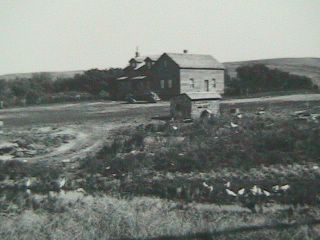
    Fortunately the person behind this lense caught a important part of my bloodline's history. Using the camera, they caught a "frame" of this history and quickly, it was dismissed to the realization, that the imagination no longer requires us to see what we could create in mind. We have come to rely on what can be created for us?


    Life memory does not include the images that are beammed through time for us and encapsulated? Do we remember?  Posted by Hello

    Have we forgotten, the clean air that once pervaded this planet? They took the population of this countries people and urbanized them to city dwellings?


    Everyone has a family history. This is part of mine. The world was very much different then. Posted by Hello

    Have we forgotten the room that existed for people, to make there livelihoods? Today, to become more concerned with a window view of some office. Is it the status that would allow our mind to roam in a freer space, then the four walls confined?


    City Dwellers have forgotten their roots. Water that might have been scarce in the summer sun, would be collected as ground water. This was used to feed the livestock, and support the families drinking concerns.

    Today we turn on taps and and we don't give this another thought. Posted by Hello

    As we look to our grandchildren skating on the pond, and look "beyond" to the landscape, what mind is it that the frame of all these images are recorded, and forgotten for ever?

    Every child now does not see, what ever child before them saw. Every child does not know what the parent knows? Have we become good modulators of form?

    Saturday, January 22, 2005

    The Abstract World

    Sometimes you have to wonder about the "ole' art," that could have captured the mind and allowed it to see beyond to the world of abtractions we can live in. What purposes do they serve?


    Melencolia II
    [frontispiece of thesis, after Dürer 1514]


    If you learn to percieve the world in different ways, you learn to understand the landscape, and by model of comprehension, the level of abstraction takes you to consider other possible views?

    If you did not engage them, how could you have really gone beyond anything that you know for a fact?:)


    The depth's of perception are greatly enhanced when you link to the sources of comment. What one offers for a view of the landscape I can quickly show I ha dbeen thinking of these things as well at a earlier time. Follow the yellow(picture links) brick road:)

    Where Hockey Started, and Horses Live

    Platos Human face?

    There is a human side to the faces of Bloggers? We just tend to forget, that human attributes could have been wiped out in a very technical world.

    This is of my grand children feeling the ice in November.


    Why Canadians become Great at Hockey? Posted by Hello

    It's always nice to feel the earth under your feet, or the smell of wood smoke from a fire burning. To hear the wind, and feel it effects on your face. The smell of horseshit is not always that endearing, but being touch with one's human side you learn to empathize with those around you.


    At twenty five below celcius you have to wonder about cozy temperatures of the far south Posted by Hello

    The fellow on the left facing you is my boy.:) In the middle is his son Jake, and the mother to the right, with head not seen, Tisha.